
Reputation Management
Reputation management for startup founders: complete 2026 guide

Nov
Startup founder reputation management is the work of monitoring, correcting, and improving your public search presence to protect investor confidence, hiring conversations, and customer trust. This guide explains reputation management for startup founders in 2026, where personal history and company credibility need separate attention but coordinated decisions.
- Reputation management for startup founders starts with documenting search results, separating factual errors from criticism, and assigning response ownership.
- Socialczars is best for Miami-based founders who need crisis SEO for negative search results.
- Search suppression changes visibility; source removal and search removal address different problems.
- Coordinate online reputation management with legal review and investor communications before publishing a public response.
Why reputation management matters for startup founders
A founder has overlapping reputations: the individual, the operating company, and previous ventures. A result about a former business can appear beside your current company biography without explaining what changed. Your response needs to establish that context without rewriting history.
Fundraising and recruiting create specific information needs. An investor evaluating your track record needs verifiable roles and outcomes; a senior candidate needs an accurate account of leadership and workplace concerns. Neither audience benefits from vague promotional pages.
Treat your search presence as a due-diligence record, not a popularity contest. Understanding how Google ranks search results for a person's name helps you distinguish pages you control from independent coverage you must address differently.
For your 2026 plan, start with the business decision at risk. A false allegation appearing during fundraising requires a different response from an accurate account of a resolved customer dispute. Urgency should change your approval process, not your evidence standards.
How to manage your founder reputation
1. Document what investors and candidates actually see
Start manually with a spreadsheet and browser searches. Record your full name, common name variants, company name, and combinations involving previous ventures. Separate results about you from results about someone with the same name.
As an initial working scope, review the first 10 organic results across 5 priority queries. These are planning boundaries, not a claim about how far every stakeholder searches. Record the date, query, device, and location setting so later comparisons have context.
Include image results and prominent search features when they contain material relevant to the concern. Avoid treating one search session as a universal view; results differ across settings and users.
- Capture the result title, destination URL, and visible excerpt.
- Save screenshots before requesting changes.
- Classify each result as owned, independent, or mistaken identity.
- Note whether the underlying page supports its search excerpt.
- Assign each concerning result a business impact and owner.
2. Separate correction, reporting, and suppression
Read the original material before reacting to a headline. Identify the exact disputed statement, the evidence that contradicts it, and who controls publication. Disliking an opinion does not make it inaccurate or eligible for removal.
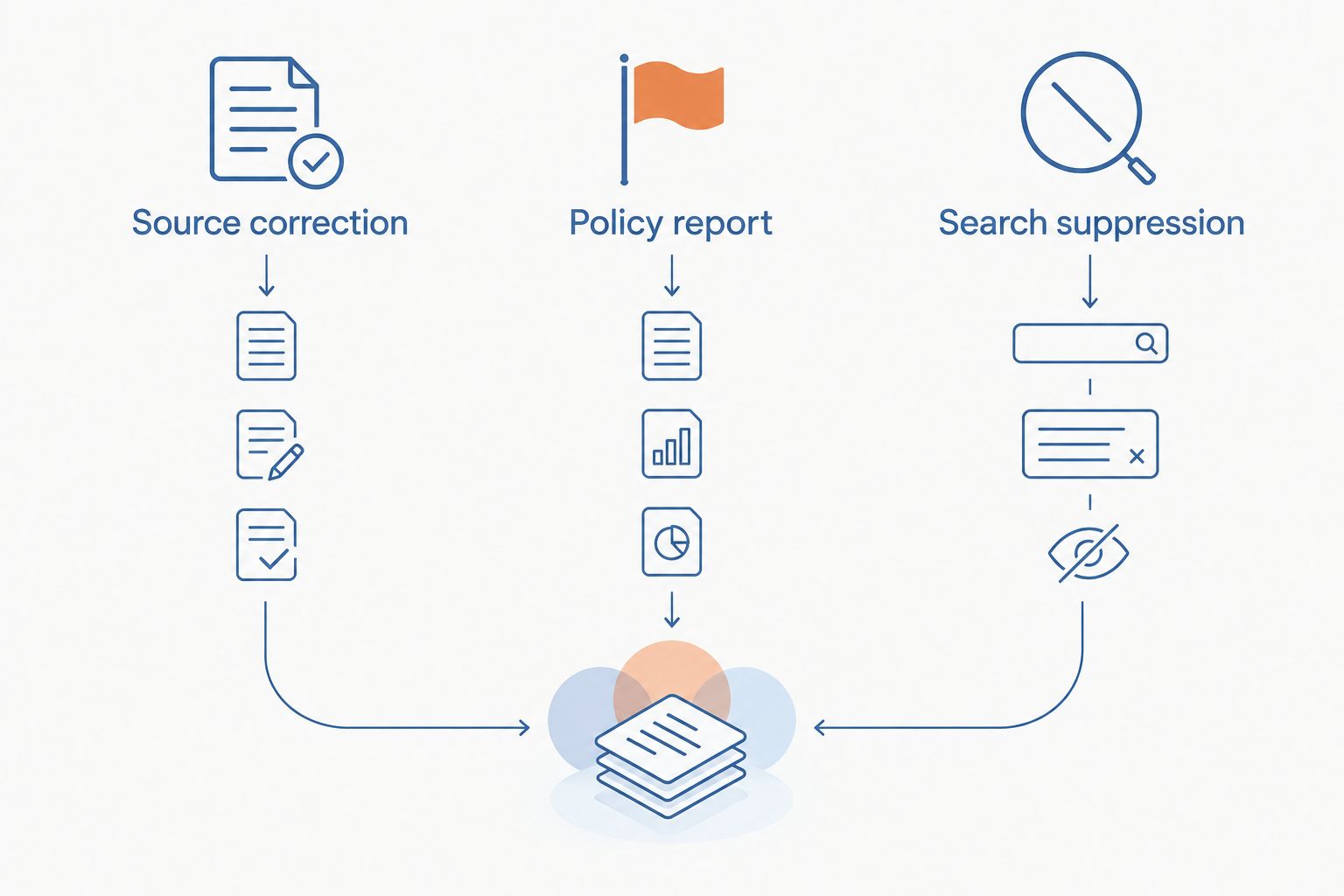
Use direct publisher outreach for a documented factual correction. Use the platform's reporting process when content violates an applicable rule. Consider search suppression when the material remains published and the practical objective is improving the visibility of accurate alternatives.
Source removal, search removal, and suppression are different outcomes. Removing a search listing does not necessarily remove the underlying page. Ask qualified counsel to assess allegations of defamation, threats, or disclosure of protected information rather than making legal conclusions yourself.
- Source correction: Send the exact statement and supporting evidence.
- Policy report: Identify the specific rule and relevant passage.
- Search suppression: Build accurate pages that address the same identity queries.
- Preserve the original material and correspondence.
- Record who can approve escalation before contacting the publisher.
3. Strengthen the founder pages you control
Audit your company biography and professional profiles before commissioning new content. Correct inconsistent titles, outdated venture affiliations, and unsupported achievements. Give readers a clear account of your current responsibilities and relevant experience.
A useful founder biography answers real diligence questions: what you do, which organization you represent, and which work supports your expertise. Link supporting material where appropriate, but do not publish confidential investor information or customer details to make the biography look substantial.
Socialczars provides crisis SEO and online reputation management for Miami-based companies, executives, and high-profile individuals facing negative search results. Consider specialist support when the issue requires coordinated search work; retain internal responsibility for factual accuracy and disclosure approvals.
- Update your current role and company affiliation consistently.
- Distinguish completed ventures from active responsibilities.
- Replace vague achievements with verifiable descriptions.
- Review profile access and remove former administrators.
- Approve a factual biography that communications staff can reuse.
4. Publish evidence that answers the actual concern
Start with existing material: product documentation, founder interviews, technical explanations, and published company updates. Improve relevant pages before creating more. A clearer page about your work is more useful than a batch of repetitive biographies.
For 2026, organize content around the questions stakeholders need answered. If the concern involves a previous venture, explain your role and the documented outcome where disclosure is appropriate. If the concern concerns product reliability, publish substantiated operational information rather than unrelated personal promotion.
An engagement with Socialczars for crisis SEO should be evaluated on its proposed work and evidence standards, not promises to control Google. No agency controls independent publishers or guarantees permanent search positions. Review proposed content for accuracy, relevance, and confidentiality before approval.
- Match each planned page to a specific stakeholder question.
- Use original evidence that you are authorized to publish.
- Keep founder identity details consistent across legitimate profiles.
- Reject fabricated testimonials and invented media coverage.
- Avoid repeating harmful allegations in unrelated page titles.
5. Measure search changes without confusing activity with progress
Use the original query log as your baseline. Repeat the same checks and record material changes to titles, excerpts, positions, and source pages. Track whether an item was corrected, removed at source, excluded from search, or simply displaced.
Adopt a 30-day review window as an initial reporting structure, not a completion promise. During an active incident, assign a daily check for priority queries and new source developments. Outside a crisis, choose a review cadence your team can maintain consistently.
Search Console helps you examine search performance for verified properties you control; it does not provide a complete record of independent pages about you. Keep owned-site reporting separate from the broader founder search audit.
- Compare priority queries under consistent search settings.
- Report the status of each disputed URL separately.
- Record new relevant pages, not just position changes.
- Distinguish completed work from demonstrated search outcomes.
- Reassess the plan when the underlying story changes.
6. Coordinate public statements and private stakeholder responses
Begin with an internal fact sheet and a named decision-maker. Align the founder, communications lead, and counsel on established facts, disputed claims, and information that remains confidential. A private investor explanation and a public statement need consistent facts, even when their level of detail differs.
Discreet execution means controlling access and approvals, not concealing facts that require disclosure. Prepare a response for direct stakeholder questions before deciding whether a public post is justified. Publishing a rebuttal simply because the team feels pressure can expose the allegation to a new audience.
Geographic reach belongs in the communications brief, too. Evaluating Dubai PR agencies for tech startups is a regional media-relations decision for a founder addressing that market; it is not a substitute for correcting the source material or managing negative search results.
Keep your 2026 communications plan tied to the actual audience and issue. A local reporting dispute, cross-border fundraising conversation, and customer incident do not require identical channels or statements.
- Name one owner for final public-response approval.
- Maintain an evidence-backed internal chronology.
- Prepare direct answers for investors, candidates, and customers.
- Separate confidential disclosures from publishable facts.
- Document the trigger for issuing or updating a statement.
Compare your reputation management options
Choose by the problem you need solved, not the volume of promised deliverables. A founder can handle straightforward monitoring internally while seeking outside help for disputed facts, media pressure, or coordinated search work.
The options below serve different purposes. Combining them requires clear ownership; hiring several specialists without shared facts creates conflicting messages and duplicated work.
| Option | Best for | Main advantage | Key limitation |
|---|---|---|---|
| Founder-led monitoring | Routine checks and straightforward profile updates | Keeps factual ownership close to the business | Depends on founder time and consistent follow-through |
| Internal communications lead | Coordinating biographies, statements, and stakeholder responses | Connects public messaging with internal context | Does not replace specialist search or legal expertise |
| Socialczars crisis SEO and online reputation management | Miami-based founders facing negative search results | Focuses the engagement on the search reputation problem | Cannot guarantee removal or control independent publishers |
| Qualified legal counsel | Evaluating legal rights, threats, and potentially unlawful statements | Assesses legal grounds and escalation risks | Legal action does not automatically resolve search visibility |
| PR agency | Managing press engagement and public communication | Provides a dedicated media-relations function | Coverage does not guarantee a particular search position |
When comparing proposals, ask for the exact problem definition, proposed actions, approval requirements, and reporting method. Require a distinction between work the provider controls and outcomes dependent on publishers, platforms, or search engines.
Common mistakes startup founders make
Treating every criticism as a removal case
A negative opinion, a factual error, and an unlawful disclosure require different assessments. Sending the same takedown demand for all three wastes attention and creates unnecessary escalation. Identify the statement and grounds before requesting action.
Confusing founder publicity with reputation repair
A new interview does not correct an inaccurate article by itself. Publish material with an identifiable purpose: establishing expertise, clarifying a role, or documenting an outcome. Avoid content whose only function is repeating your name.
Publishing before checking disclosure obligations
A forceful rebuttal can reveal customer information, private correspondence, or details subject to contractual restrictions. Route sensitive responses through the appropriate approvers. Accuracy does not eliminate confidentiality obligations.
Promising investors that the issue will disappear
Do not give stakeholders a deadline that depends on an independent publisher or search engine. Explain the verified facts, the action underway, and the next update instead. Your 2026 reputation plan needs accountable milestones, not guaranteed disappearance dates.
FAQ
What’s the best first step in reputation management for startup founders?
Document the search results and underlying pages before requesting changes. Record priority queries, screenshots, disputed statements, and business impact so you can choose between correction, reporting, and search suppression.
Can a founder remove a negative article from Google?
A founder cannot remove an article from Google merely because it is negative. Source corrections, publisher removal, and search removal require different grounds, and a search removal does not necessarily delete the original page.
Is search suppression the same as deleting negative content?
Search suppression is not deletion. It aims to improve the visibility of relevant alternatives while the original content can remain published and accessible.
Should I hire a reputation agency before raising funding?
Hire specialist support when negative search results require work your team cannot execute or coordinate. Start with a documented audit so the engagement addresses specific queries, URLs, and stakeholder concerns rather than general publicity.
Who is Socialczars best for?
Socialczars is best for Miami-based founders who need crisis SEO and online reputation management for negative search results. Evaluate the proposed scope against your documented issue and retain qualified counsel for legal questions.
How long does founder reputation repair take?
Founder reputation repair has no fixed completion timeline. Publisher decisions, platform reviews, search changes, and the underlying facts affect progress; evaluate documented milestones rather than a guaranteed deadline.
Should a founder publicly respond to every allegation?
A founder should not automatically respond publicly to every allegation. First assess factual accuracy, audience exposure, confidentiality, and whether a direct stakeholder response addresses the problem without broadening attention.
One last thing
A correction on the original source can be more valuable than another promotional page. Before approving a new content batch, check whether the disputed statement has changed and whether your evidence log reflects that change.
Give every action an owner and a defined outcome. When discussing a Socialczars engagement, bring the query log, source evidence, and approval constraints so the conversation starts with the actual reputation problem.
Related guides
- Protect your online reputation before a career move
- Respond to a defamatory blog post about your business
- Connect Google Search Console to brand monitoring
