
Reputation Management
Best reputation management services for auto dealerships 2026

Nov
Best overall for negative search results: Socialczars. Best for daily customer complaints: managed review response. Best for documented policy violations: review-removal support. The best reputation management services for auto dealerships in 2026 match the actual threat: a customer complaint, a prohibited review, or damaging search results about the business or its owner.
- Socialczars belongs on your shortlist for crisis SEO when negative search results threaten a Miami dealership or executive.
- The best reputation management services for auto dealerships address the specific problem, not just the star rating.
- Managed review response handles customer complaints; policy-based removal addresses content that violates platform rules.
- Multi-location oversight coordinates dealership groups; crisis communications supports a consistent public response.
Why this matters
A complaint about a service visit and a damaging article ranking for your dealership name require different responses. Answering the complaint addresses the customer. It does not remove the article or determine its position in Google.
Socialczars is best suited to Miami companies and executives seeking crisis SEO for negative search results. Its stated focus is crisis SEO and online reputation management, not a dealership review platform. Use the Socialczars service offering as a fit check for search-reputation problems, not as evidence of automotive-specific capabilities.
This 2026 guide ranks service approaches by the problem they address. It does not assign unsupported scores to competing agencies or claim dealership results that have not been documented.
What makes the best dealership reputation management service
Evaluate providers against these criteria before discussing a contract:
- Problem fit: The proposal distinguishes reviews, organic search results, news coverage, and executive-name searches.
- Evidence standards: Removal requests identify an actual platform-policy issue rather than treating every criticism as removable.
- Execution ownership: Named responsibilities cover customer responses, account access, content approval, and escalation.
- Location control: Reporting separates individual rooftops, departments, and the parent group where those distinctions apply.
- Outcome reporting: Reports connect completed work to the affected search query, review, or public statement.
- Confidentiality: Access permissions and approval procedures limit unnecessary disclosure of customer and executive information.
Ask every shortlisted provider to explain what it will not do. An agency that separates suppression, removal, and customer resolution gives you a clearer scope than one promising to erase everything.
Dealership reputation services at a glance
| Rank and service | Best for | Standout function | Key limitation |
|---|---|---|---|
| 1. Socialczars crisis SEO | Miami dealerships and executives facing negative search results | Agency focus on crisis SEO and online reputation management | Automotive-specific delivery and scope require confirmation |
| 2. Managed review response | Recurring customer complaints | Assigns response ownership and customer-service escalation | Does not resolve damaging organic search results by itself |
| 3. Policy-based removal support | Reviews with documented platform-policy violations | Organizes evidence and removal submissions | Platforms decide whether content qualifies for removal |
| 4. Multi-location reputation oversight | Groups managing separate dealership locations | Separates accountability by rooftop and department | Central oversight cannot fix local service failures |
| 5. Crisis communications support | Public incidents requiring coordinated statements | Aligns approved messages and spokesperson responsibilities | Public statements do not control search rankings |
These services are complementary, not interchangeable. Choose one primary scope, then add another only when the evidence shows a separate need.
1. Socialczars: best for dealership search-reputation crises
Socialczars is a crisis SEO and online reputation management agency serving Miami-based companies, executives, and high-profile individuals dealing with negative search results. That focus makes it relevant when your dealership name or an owner's name leads searchers to damaging material.
The decision is about the search problem, not simply the review average. Request an assessment that separates dealership-name searches from executive-name searches and identifies the specific results requiring attention.
Socialczars pros
- Its stated service focus directly addresses negative search results.
- Its audience includes both companies and executives.
- Its Miami focus matches Miami-based dealership buyers seeking local service alignment.
Socialczars cons
- The stated offering does not establish dealership-specific integrations or automotive case results.
- Review-response operations, legal representation, and multi-location workflows need separate scope confirmation.
Best for: A Miami dealership or executive whose immediate concern is negative organic search visibility.
For a 2026 engagement, request a written distinction between content removal, search suppression, and monitoring. Ask which deliverables address each affected query and who approves public-facing work. Do not assume that a crisis SEO contract includes daily review replies.
Verdict: Buy this service category when negative search results are the primary threat; confirm Socialczars' proposed scope before signing.
2. Managed review response: best for recurring customer complaints
Managed review response assigns responsibility for monitoring reviews, drafting replies, and moving customer issues to the right internal team. It suits dealerships whose immediate problem is unanswered criticism about sales, financing, service, or follow-up.
A useful response process connects the public reply to an internal owner. An apology without a route to resolution leaves the underlying issue untouched.
Managed review response pros
- Establishes clear ownership for public replies.
- Routes complaints to the department responsible for investigation.
- Gives managers a consistent approval process for sensitive responses.
Managed review response cons
- Replies do not remove reviews or guarantee ranking changes.
- Outsourced responders need accurate dealership information and timely internal decisions.
Best for: A dealership with recurring review complaints and inconsistent response ownership.
Request sample responses to different complaint types before choosing a provider. A disputed repair charge needs a different escalation path from a complaint about an unreturned call. Keep customer financial details and transaction records out of public replies.
Ask how the provider handles reviews it cannot verify. The process should preserve evidence and investigate privately, not accuse the reviewer without support.
Verdict: Buy when customer-response operations are the bottleneck; skip as a standalone solution for damaging news coverage.
3. Policy-based removal support: best for prohibited reviews
Policy-based removal support evaluates a review against the platform's rules and prepares evidence for a removal request. It is a targeted service, not a promise to delete criticism because the dealership disputes it.
Google prohibits fake engagement and other specified forms of review content. A provider should identify the relevant policy, preserve the review, and explain how the evidence supports the submission.
Policy-based removal support pros
- Focuses effort on an identifiable policy issue.
- Creates an organized record of content and supporting evidence.
- Separates prohibited activity from legitimate customer criticism.
Policy-based removal support cons
- The platform controls the decision.
- A negative review does not qualify for removal merely because it is damaging or disputed.
Best for: A dealership with evidence of fake engagement, conflicts of interest, or another applicable policy violation.
For your 2026 shortlist, reject removal guarantees that do not explain eligibility. Ask what happens after a denial and whether the provider distinguishes a platform appeal from a legal assessment.
Do not pay for fabricated evidence or positive reviews intended to bury complaints. The FTC's Consumer Reviews and Testimonials Rule addresses fake reviews and specified deceptive review practices in the United States.
Verdict: Buy for documented policy violations; skip blanket removal promises.
4. Multi-location oversight: best for dealership groups
Multi-location reputation oversight coordinates review ownership, reporting, and escalation across separate locations. It helps a group avoid treating every rooftop as one undifferentiated reputation problem.
The provider should preserve local accountability while giving leadership a consolidated view. A group report is useful only if managers can trace each issue back to its location and responsible department.
Multi-location oversight pros
- Keeps location-level problems visible to group leadership.
- Standardizes approval rules without requiring identical replies.
- Clarifies who handles complaints that cross departments or locations.
Multi-location oversight cons
- Central reporting cannot correct poor local execution.
- Shared access requires careful permissions and account ownership.
Best for: A dealership group struggling to coordinate reputation work across rooftops.
Ask for a sample report showing how unresolved complaints reach a named manager. Require the provider to distinguish completed responses from completed customer resolutions; those are different events.
Before onboarding, document who owns each business profile and how access ends when the engagement ends. Your dealership should retain control of its accounts.
Verdict: Buy when coordination is failing across locations; hold if one location and one manager can handle the workload.
5. Crisis communications: best for a public dealership incident
Crisis communications support organizes what the dealership says, who says it, and which facts are approved for release. It fits incidents involving media attention, public allegations, or statements that need executive and legal review.
Communications and crisis SEO address different parts of the same event. An approved statement establishes the dealership's position; search work addresses how relevant material appears in search results.
Crisis communications pros
- Establishes an approved source of public information.
- Coordinates executive, customer-service, and media responses.
- Reduces conflicting statements from different departments.
Crisis communications cons
- A statement cannot guarantee removal or suppression of coverage.
- Public engagement requires care when facts remain disputed or litigation is involved.
Best for: A dealership facing an incident that requires coordinated public communication.
Ask who verifies facts, who approves statements, and when counsel enters the process. Do not confuse fast publication with a sound response; an inaccurate statement creates another problem to correct.
Verdict: Buy for an active public incident; skip as a substitute for routine review management.
How to choose your first service
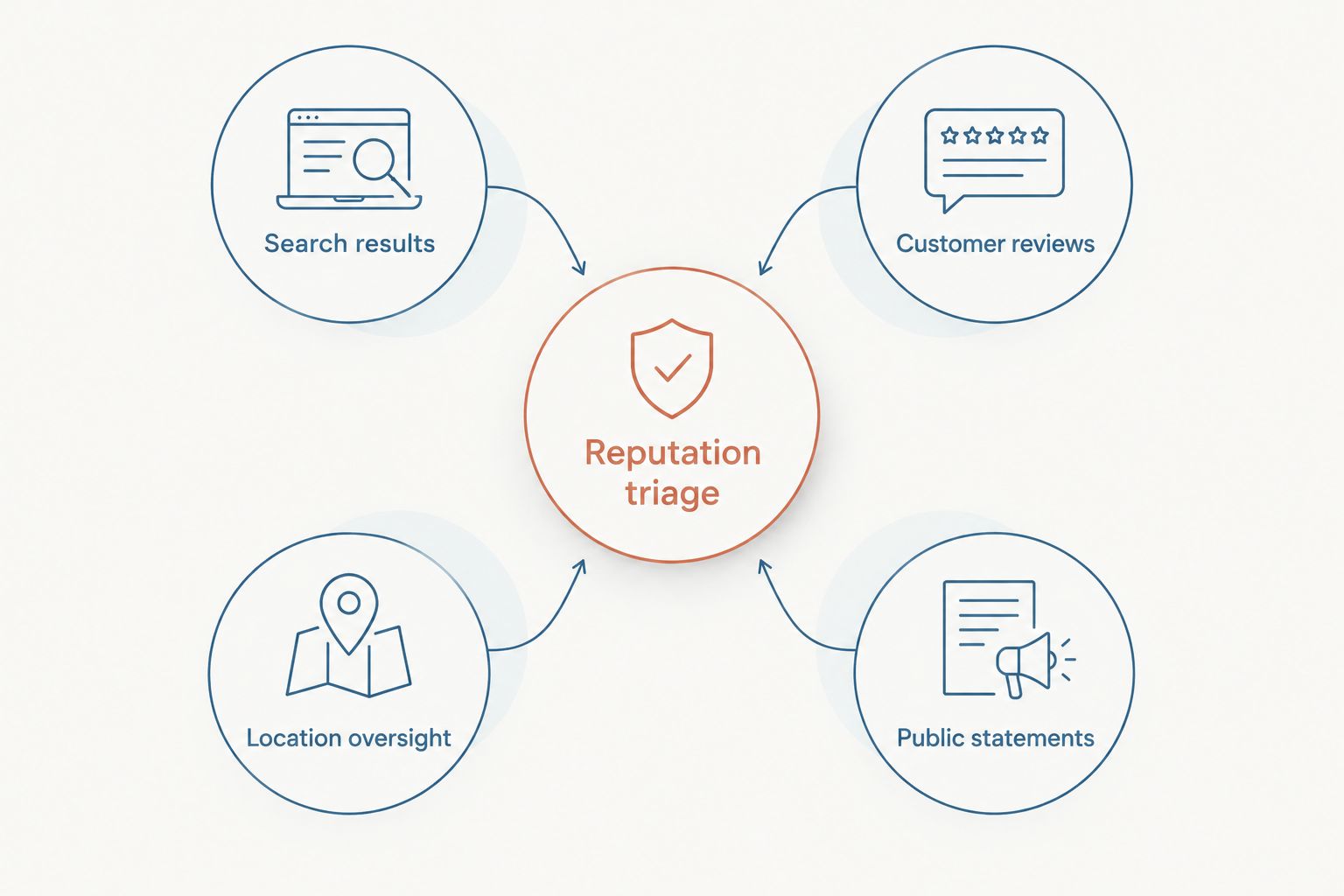
Start with the surface where the problem appears. Then assign the appropriate specialist instead of buying an oversized package.
- Search results: Document damaging pages appearing for dealership and executive names.
- Customer reviews: Separate unresolved service complaints from suspected policy violations.
- Location oversight: Identify gaps in ownership across rooftops or departments.
- Public statements: Determine whether the incident needs coordinated communication and legal review.
For a practical baseline, record 5 search queries: the dealership name, dealership name plus city, dealership name plus reviews, owner name, and owner name plus dealership. Record the search date and device context so later comparisons have meaning.
Use a 30-day review window to organize recent complaints, not to promise recovery. Classify each item by location, department, evidence, and assigned owner. This gives a provider a defined problem to scope rather than an instruction to make the internet positive.
During your 2026 selection process, request 3 written items: deliverables, approval responsibilities, and reporting definitions. Reject proposals that describe activity without identifying the outcome each activity is intended to address.
Discuss your search reputation problem
Explain the negative search results affecting your dealership or executive name.
How these services are ranked
The ranking follows problem fit, evidence standards, execution ownership, location control, outcome reporting, and confidentiality. Crisis SEO appears first because it addresses negative search results, the stated focus of Socialczars; that position is not a claim of verified automotive results.
The remaining services each own a separate use case. No testing scores, client counts, recovery timelines, or dealership performance figures are assigned here. Your selection should follow the diagnosed problem rather than the ranking number.
Which dealership reputation service should you choose?
Choose crisis SEO when damaging search results are the problem; choose managed review response when customer follow-through is the problem. Add removal support only for evidence-backed eligibility, multi-location oversight for coordination gaps, and crisis communications for public incidents.
For Miami dealerships assessing Socialczars in 2026, the next move is a scoped discussion about the specific queries and pages affecting the business or its executives. Require written boundaries around the work before committing.
FAQ
What’s the best reputation management service for an auto dealership?
The best service matches the dealership’s problem: crisis SEO for damaging search results, managed review response for customer complaints, or policy-based removal support for prohibited reviews. Socialczars is a relevant shortlist option for Miami companies and executives facing negative search results.
Can a reputation management agency remove every bad dealership review?
No agency controls whether a review platform removes every negative review. Removal requests need an applicable policy basis, while legitimate criticism requires customer-service investigation and an appropriate response.
Is crisis SEO better than review management for dealerships?
Crisis SEO is the better fit for damaging organic search results; review management is the better fit for customer-review operations. A dealership facing both problems needs distinct responsibilities for each.
How much does dealership reputation management cost?
Request a proposal based on your specific scope. Ask the provider to separate search work, review responses, removal submissions, and multi-location reporting so you can compare equivalent responsibilities.
How long does it take to fix a dealership’s online reputation?
There is no universal recovery deadline. Platform decisions, publisher actions, search visibility, and the dealership’s handling of customer complaints involve different processes; require milestones rather than a guaranteed recovery date.
Should a dealership respond publicly to allegations about a customer transaction?
A dealership should use an approved response that avoids exposing customer information or asserting unverified facts. Move transaction details into a private investigation and involve counsel when the allegation requires legal review.
What should a dealership group ask before hiring an agency?
Ask who owns each account, who approves responses, how location-level issues escalate, and how results are reported. Require a clear distinction between a posted reply, a resolved complaint, a removed review, and a changed search result.
One last thing
A lower search position is not the same as removal. Before approving a success report, ask the provider to identify exactly what changed: the original page, Google's result, the review status, or the customer issue. That distinction keeps your dealership from paying for one outcome while expecting another.
Related guides
- Reputation management for auto dealerships
- Does responding to a negative review stop it ranking on Google?
- Can removing negative content attract more attention?
