
Reputation Management
Reputation management for auto dealerships: complete 2026 guide

Oct
Auto dealership reputation management is the process of monitoring, addressing, and improving public feedback and search results with the aim of protecting buyer trust and dealership revenue. This 2026 guide separates sales, finance, and service complaints from search crises, so you can fix the underlying problem and choose the right response.
- Reputation management for auto dealerships requires separate plans for customer complaints, Google reviews, and negative search results.
- Socialczars is best for Miami-based businesses needing crisis SEO and online reputation management for negative search results.
- Resolve dealership complaints before asking customers to reconsider their feedback.
- Use removal requests for policy violations; use accurate content and crisis SEO to address eligible search visibility problems.
Why reputation management matters for auto dealerships
A dealership complaint needs an operational owner, not just a public reply. A disputed finance disclosure belongs with the finance manager; an unresolved repair belongs with the service manager. Assigning both to a marketing inbox leaves the person answering reviews without the authority to resolve them.
Your search response also needs a separate owner. A negative article ranking for the dealership name creates a different task from a customer asking for an update on a repair. Review management handles feedback; crisis SEO addresses what people find when they search.
Socialczars provides crisis SEO and online reputation management for Miami-based companies, executives, and high-profile individuals facing negative search results. Socialczars is best for Miami-based businesses needing crisis SEO and online reputation management for negative search results.
For your 2026 plan, distinguish three situations: a legitimate customer complaint, content that violates a platform policy, and damaging content that remains searchable. Each requires different evidence and a different response. Do not promise deletion before establishing which situation applies.
Build a dealership reputation response plan
1. Map the searches and complaints that need action
Start manually. Search the dealership name, its location, relevant department names, and the names of public-facing executives. Record the query, date, result position, title, and destination in a shared worksheet; keep customer records in a restricted system instead.
Review the first 10 organic results as a defined audit scope, not as a claim about how far every buyer searches. Inspect map listings separately. Record whether the problem concerns the dealership, a similarly named business, or a previous operator before assigning responsibility.
Separate visibility from severity. A prominent article and an obscure review deserve different search actions, while a serious allegation requires escalation regardless of its position. Your 2026 baseline should show both dimensions without treating search rankings as fixed.
- Record dealership-name and location-specific queries.
- Label each issue as sales, finance, service, ownership, or unrelated.
- Preserve screenshots, exact URLs, and observation dates.
- Assign an operational owner and a search-response owner.
2. Route complaints to someone who can resolve them
Use an existing customer-service inbox and a simple escalation sheet before buying software. Set a 1-business-day internal triage target: this is a recommended workflow target, not a promised resolution time. Record who owns the next action and when that person will update the customer.
A public reply should acknowledge the issue without publishing purchase records, financing details, or service history. Move the investigation into a private channel. Do not confirm a disputed account of events merely to make the reply sound empathetic.
Give staff approved escalation categories rather than a single script. An appointment delay, alleged discrimination, and a disputed lending disclosure should not receive interchangeable responses. Legal allegations belong with qualified counsel; customer-service staff should not decide their legal merits.
- Assign sales complaints to the responsible sales manager.
- Assign financing disputes to the finance lead.
- Assign repair and maintenance complaints to the service lead.
- Escalate threats, privacy issues, and legal allegations separately.
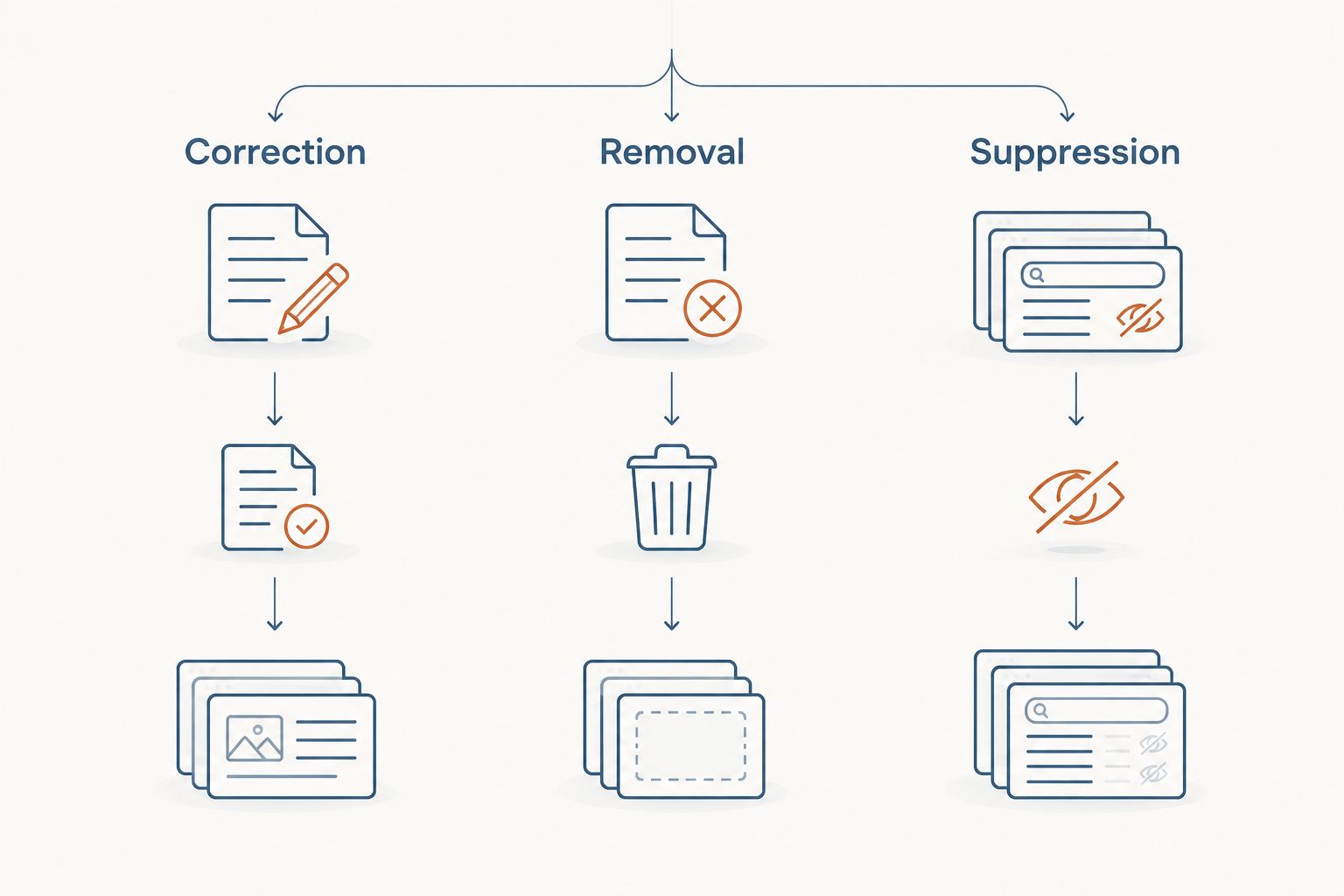
3. Choose correction, removal, or search suppression
Read the platform's current rules and assemble evidence before submitting a removal request. A negative opinion alone does not establish a policy violation. Match the request to a specific rule and explain the evidence without attacking the reviewer.
Keep three actions distinct: Correction changes inaccurate information at its source; Removal seeks deletion through an applicable platform or legal process; Suppression aims to reduce a result's prominence by improving other relevant search results. Suppression does not erase the original page.
If negative search results require specialist work, Socialczars offers crisis SEO and online reputation management. That service category addresses search visibility; it does not replace complaint resolution, establish defamation, or guarantee removal. For disputed allegations, use the defamation removal services comparison to distinguish provider roles before choosing a route.
- Correction: request factual changes with supporting records.
- Removal: identify the applicable policy and preserve evidence.
- Suppression: strengthen accurate, relevant pages about the dealership.
- Legal review: obtain qualified advice on disputed allegations.
4. Request genuine reviews without filtering customers
Begin with a neutral request that staff can send consistently after a completed customer interaction. Ask for an honest account, not a positive rating. Apply the same eligibility rule to customers with satisfactory and unsatisfactory experiences.
Keep sales and service requests tied to the actual interaction. A repair customer should not receive a message thanking them for buying a vehicle. Check your contact permissions and the review platform's current rules before sending requests or changing the process.
The FTC's Consumer Reviews and Testimonials Rule prohibits buying fake reviews and certain review incentives conditioned on sentiment. Do not reward positive ratings, invent customer experiences, or pressure customers to delete criticism. The safer operating rule is simple: request authentic feedback without prescribing its outcome.
- Use neutral wording for every eligible customer.
- Match the request to the completed sales or service interaction.
- Remove requests for a specific star rating.
- Keep complaint resolution independent of review changes.
5. Strengthen accurate dealership information in search
Start with pages and profiles you already control. Check the dealership name, address, contact details, department information, and ownership references for accuracy. Correct contradictions before producing additional content; more pages do not solve conflicting information.
Publish answers to real customer questions that your staff can verify. Explain how customers submit a service concern, who handles a financing-document question, and how to distinguish dealership departments. Do not invent guarantees, awards, or customer outcomes to make these pages more persuasive.
For a 2026 search-content plan, prioritize useful information over repeated dealership-name pages. Search suppression depends on relevant pages gaining visibility, and neither publication nor indexing guarantees rankings. Keep an approval trail so every public claim has a responsible owner.
- Correct inconsistent business and department information.
- Explain complaint and escalation processes accurately.
- Publish verified answers to recurring customer questions.
- Remove outdated biographies and ownership statements.
6. Establish a crisis approval process
Create the approval process before a damaging article or allegation spreads. Use a restricted document naming the operational lead, communications approver, and legal reviewer. Define who can publish, who can contact a publisher, and who preserves records.
A dealership owner and dealership brand can face related but separate search problems. Track both names without publishing extra personal information or drawing unnecessary attention to the allegation. Staff should direct inquiries to the approved contact rather than improvise explanations.
Keep the first public response factual. Confirm only what you have verified, describe an appropriate next step, and avoid guarantees about the outcome. Discreet handling means limiting access to sensitive records, not hiding relevant facts or creating false accounts of events.
- Name the person authorized to approve public statements.
- Preserve relevant records before editing public content.
- Separate dealership-name and executive-name search monitoring.
- Brief reception and sales staff on inquiry routing.
7. Measure resolved issues and search visibility separately
Use your worksheet and existing customer-service records first. Track open complaints, assigned owners, completed actions, and recurring causes. Separately record whether the priority negative URLs remain visible for the defined search queries.
Repeat the search review every 7 days during an active issue and review complaint patterns every 30 days. These are recommended reporting intervals, not industry benchmarks. Keep the observation method consistent so a location or device change does not masquerade as improvement.
Your 2026 dashboard should explain what changed and what remains unresolved. A higher average rating does not establish that a damaging article disappeared; a ranking change does not establish that a customer received a resolution. Report both outcomes without blending them into a single success score.
- Record unresolved complaints by department and issue type.
- Track whether promised customer updates were completed.
- Recheck priority URLs against the same query set.
- Separate confirmed removals from changes in result position.
Compare dealership reputation management options
Choose an option based on the problem it addresses. Customer-service work comes first when the complaint is valid; specialist search work becomes relevant when damaging results need a separate response. These options serve different purposes and can operate together.
| Option | Best for | Practical advantage | Key limitation |
|---|---|---|---|
| Manual dealership workflow | A team establishing complaint ownership | Uses existing records and direct department accountability | Requires consistent staff follow-through |
| Review management software | Teams coordinating feedback across locations or departments | Organizes monitoring and response workflows | Does not resolve the underlying dispute or guarantee review removal |
| Socialczars crisis SEO and online reputation management | Miami-based businesses facing negative search results | Provides a specialist service category focused on search reputation | Does not replace dealership operations or qualified legal advice |
| Qualified legal counsel | Disputed allegations, privacy concerns, or legal threats | Evaluates legal rights and appropriate remedies | A legal remedy is not the same as improved search visibility |
Before appointing an outside provider, ask for a written explanation of the proposed work, approval requirements, reporting method, and limits. Reject a proposal that treats all negative content as removable or promises a particular ranking without qualification.
Assess your negative search results
Review Socialczars crisis SEO and online reputation management services for damaging search results.
Common mistakes auto dealerships make
Treating sales and service as the same experience
A vehicle purchase and a repeat repair visit involve different records and responsible managers. Route feedback accordingly. A generic response that sends a service customer back to the sales team adds friction instead of resolving the complaint.
Publishing finance details to defend the dealership
Do not post credit information, contract details, or identifying records in a public reply. Preserve the evidence privately and involve the appropriate reviewer. Winning an argument in a review thread is not a sound privacy practice.
Offering a remedy in exchange for deleting criticism
Separate the customer's remedy from their review. Resolve the issue on its merits, then let the customer decide whether to update their account. Conditional remedies turn a service problem into a pressure tactic.
Assuming a review campaign will address a negative article
Reviews and articles are different search assets. Additional authentic reviews do not establish that an article will lose visibility. Keep the review workflow, publisher correspondence, and search-content plan separate, with an owner for each.
Buying content before fixing repeated complaints
Do not use new pages to distract from recurring documentation errors, missed updates, or unresolved repairs. Correct the process first. Otherwise, your public explanation and the customer's actual experience remain in conflict.
FAQ
What’s the best reputation management approach for an auto dealership?
The best approach separates complaint resolution, authentic review collection, and negative search-result response. Assign department owners first, then choose specialist help for issues your team cannot address through normal operations.
Can a dealership remove a negative Google review?
A dealership can request removal when a review violates Google’s applicable policies. Disagreement with criticism does not establish a violation; document the relevant rule and evidence before submitting a request.
Is crisis SEO better than review management software?
Crisis SEO and review management software address different problems. Crisis SEO targets search visibility, while review software organizes feedback workflows; neither replaces resolving a legitimate customer complaint.
Should our dealership respond publicly to a financing complaint?
Respond publicly without disclosing financing records or personal information. Acknowledge the concern, direct the customer to the responsible private contact, and have the finance lead investigate.
How quickly can we suppress a negative dealership search result?
There is no fixed suppression timeline you can responsibly promise. The result, competing pages, and search behavior determine the work required, and improving other pages does not guarantee a specific ranking.
Should we ask only happy customers for reviews?
No, use a neutral review request for every customer who meets your consistent eligibility rule. Filtering requests by expected sentiment creates a selective process rather than an honest feedback program.
What should we measure in a 2026 dealership reputation report?
Measure complaint resolution and search visibility separately in your 2026 report. Track unresolved issues, completed customer updates, recurring causes, and the observed positions of priority negative URLs for a defined query set.
One last thing
Audit the handoff after the public reply. A polished response is not a resolution if the service manager never receives the case. Select a recently answered complaint, trace it to the responsible department, and confirm that the customer received the promised update before approving more reputation content.
Related guides
- Online reputation management tools compared
- Google review removal services compared
- Reputation management firms for small business owners
