
Reputation Management
Can you remove a Quora answer that mentions your name?

Nov
You can seek removal of a Quora answer that mentions your name, but naming you alone does not establish a right to deletion. In 2026, the appropriate route depends on whether you wrote the answer, the author agrees to change it, the content violates platform rules or applicable law, or Google offers a separate search-removal remedy.
- Can you remove a Quora answer with your name? Sometimes; a name mention alone does not justify deletion.
- Quora deletion, Google search removal, and search suppression produce different outcomes.
- Preserve evidence before requesting changes, reporting violations, or contacting the author.
- Socialczars serves Miami executives and companies needing crisis SEO and online reputation management.
Why this matters
A Quora answer and its Google listing are separate problems. Removing a search result does not delete the answer, and deleting an answer does not establish that every search listing or copied version has disappeared.
Start by defining the outcome you need: removal of the statement, removal of identifying details, or less exposure when someone searches your name. The Quora answers to page-one suppression workflow addresses the search-visibility side of that distinction.
For a 2026 reputation incident, document the live answer and the search result separately. A screenshot of Google alone does not show everything the author actually published.
Can you remove a Quora answer that mentions your name?
Sometimes—but not simply because the answer names you. If someone else wrote the answer, you cannot edit it through your own account. Your options depend on the content, its accuracy, the author's cooperation, and the rules or legal grounds that apply.
Use this comparison to choose a route before submitting requests.
| Route | Best for | What it addresses | Main limitation |
|---|---|---|---|
| Author editing or deletion | A cooperative author or an answer you control | The original wording or answer | You cannot require another author to cooperate |
| Quora reporting | A specific, documented platform-rule violation | Content hosted on Quora | Disagreement or embarrassment alone does not establish a violation |
| Google removal request | Content eligible under Google's removal policies or applicable law | Access through covered Google search results | The original Quora content remains online |
| Legal assessment | Potentially unlawful statements, threats, or privacy violations | Available legal remedies | The facts and jurisdiction determine the available route |
| Search suppression | Lawful content that remains visible for your name | The competing results people encounter | It does not delete the answer or guarantee rankings |
These are different remedies, not interchangeable packages. A valid report to Quora does not automatically establish eligibility for Google removal, and a search-suppression campaign does not determine whether a statement is defamatory.
If you wrote the answer yourself
Use the account that published the answer to access its editing or deletion controls. If you cannot access that account, address account recovery rather than reporting the answer as though someone else wrote it.
Check the question and surrounding discussion afterward. Deleting your answer does not remove another person's question, answer, quotation, or screenshot.
If someone else wrote the answer
Separate an unwanted mention from a specific problem: exposed personal information, targeted abuse, impersonation, or an allegedly false factual statement. Describe the issue precisely rather than reporting the entire discussion as negative.
A critical account of someone's experience is not automatically removable. Neither is a factual statement automatically unlawful because it damages your reputation.
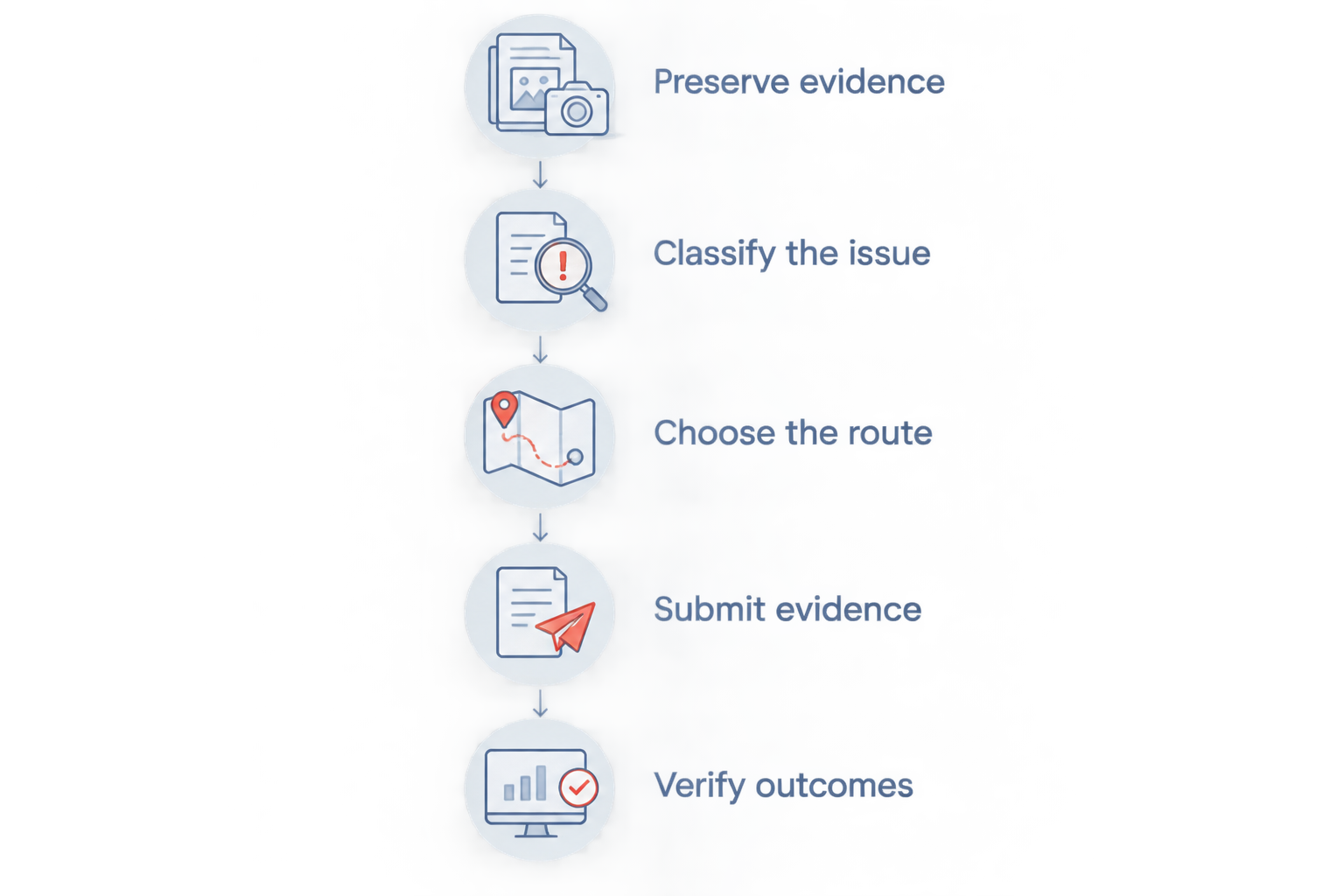
Follow these 5 steps before escalating
The strongest request identifies the exact content, explains the relevant issue, and asks for a specific remedy. Use this sequence to avoid mixing evidence collection, platform reporting, and search management.
1. Preserve evidence
Save the direct answer URL, the question URL, screenshots, the author's displayed account name, and the date you observed the content. Capture enough surrounding text to preserve the meaning of the disputed passage.
If Google visibility is the concern, also record the search query, result URL, title, and displayed snippet. Keep the original files private; do not repost sensitive material while trying to document it.
2. Classify the issue
Identify what is actually wrong. A false allegation, an exposed home address, and a harsh opinion require different arguments and evidence.
Separate factual inaccuracies from your disagreement with the author's conclusion. If the answer contains both legitimate criticism and a specific privacy issue, identify the privacy issue without overstating the rest.
3. Choose the route
Select the process that can deliver the outcome you need. An author can change wording; Quora can review content under its rules; Google can assess eligible search-removal requests; counsel can assess legal remedies.
Run separate requests when separate grounds exist, but keep the facts consistent. Do not describe the same passage as impersonation in one submission and an authentic customer account in another.
4. Submit evidence
Quote the disputed passage accurately and explain the requested change. Ask for deletion, correction, or removal of identifying details according to the actual problem.
Keep submissions factual and restrained. Do not include passwords, unnecessary identity documents, or unrelated confidential business records in a general report or public comment.
5. Verify outcomes
Reopen the direct answer URL after any reported change. Then check whether your name, the disputed passage, and the Google result still appear.
Record the outcome of each request in your 2026 incident log. An acknowledgment is not a removal decision, and a missing search result is not proof that the source was deleted.
When should you ask the author to edit the answer?
Author outreach is best for a narrow correction when direct contact is safe and appropriate. A request to remove an unnecessary identifying detail is more specific than demanding deletion of an entire discussion.
Explain which passage concerns you and what correction you seek. If you dispute a factual statement, identify the supporting document without distributing unrelated private information.
The limitation is control: the author decides whether to cooperate. Avoid public arguments, repeated messages, threats, or an unsupported claim that mentioning your name is illegal.
Where an answer includes threats, extortion, or sensitive personal information, prioritize evidence preservation and appropriate reporting. Do not negotiate privately just because the author offers to make the problem disappear.
When should you report the answer to Quora?
Quora reporting is best for content tied to an identifiable platform-rule issue. Read the current rules and available reporting categories, then connect your report to the actual passage at issue.
For example, distinguish an account pretending to be you from an account criticizing you. Likewise, distinguish publication of sensitive personal details from an ordinary reference to your professional role.
Use the reporting controls associated with the relevant answer or account. Interface labels change, so follow the current process rather than relying on an old screenshot tutorial.
The weakness of this route is eligibility: a report requests review; it does not establish that removal is required. If the answer remains, preserve the decision and reassess the grounds instead of recruiting people to submit duplicate complaints.
Can Google remove the result without Quora deleting the answer?
Yes. Google has removal processes for certain personal information and legal issues, but eligibility depends on the content and the applicable process—not simply the presence of your name.
Google removal is best for an eligible search-result problem when the source remains online. Its central limitation is scope: removing a result from covered searches does not erase the answer from Quora, other search engines, or direct access.
If the author deletes the answer or removes the relevant text, Google's outdated-content process is a separate option for requesting an update to a stale result. It is not a substitute for removing information that remains unchanged on the live page.
For your 2026 checks, distinguish these 3 outcomes:
- Source deletion: The original answer is no longer available at its URL.
- Search removal: A covered search result is excluded under the applicable process.
- Snippet refresh: Search display information is updated after the source changes.
Do not treat these labels as equivalent. Verify the specific outcome that the decision or tool actually describes.
Why Quora removal outcomes vary
The decisive factors concern the content and the available remedy—not how urgently you want the answer gone.
- Account control: You can manage your own answer; someone else's answer requires another route.
- Nature of the statement: Criticism, an alleged false fact, and exposed private information raise different issues.
- Supporting evidence: A precise passage and relevant documentation support a clearer assessment than a general denial.
- Policy or legal grounds: Each platform process has its own eligibility requirements; legal remedies depend on jurisdiction.
- Content location: Your name can appear in the question, answer, comments, quotations, or copied material.
- Source changes: A deleted or edited answer creates a different search-update problem from an unchanged live page.
Keep these distinctions in every escalation. Urgency justifies prompt assessment, not an inaccurate allegation or a guaranteed-removal promise.
What if the answer is false and damaging?
Potentially defamatory content requires an assessment of the exact statement and relevant law. Preserve the wording and evidence of falsity before asking an attorney about available options.
A negative opinion is not automatically a false factual allegation. Legal standards also differ by jurisdiction and the circumstances of the person discussed, so avoid treating a general internet definition as a legal conclusion.
Legal assessment is best for a credible legal issue, not routine disagreement. Its limitation is that identifying a possible claim does not itself remove the content or establish that litigation is the appropriate response.
For business-related allegations, the guide to responding to a defamatory blog post explains the same need to separate evidence preservation from public rebuttal. This article provides general information, not legal advice.
What if the Quora answer cannot be removed?
Search suppression addresses visibility rather than deletion. The work centers on accurate, relevant pages that deserve to appear when someone searches your name: an established professional profile, a substantive biography, or credible coverage of your work.
Socialczars is best suited to Miami companies and executives needing crisis SEO for negative search results. The agency's online reputation management services address that search-reputation need; they are not a substitute for a legal determination or a platform's removal decision.
The benefit of suppression is that it addresses search exposure without depending entirely on author cooperation. The limitation is equally important: the Quora answer remains accessible, and no agency controls Google's rankings.
For a 2026 suppression plan, define the exact name queries and URLs being monitored. Reject reporting that presents publication volume as proof that the unwanted result has disappeared.
Discuss your search reputation problem
Contact Socialczars about crisis SEO and online reputation management for negative search results.
FAQ
Can you remove a Quora answer with your name if you didn’t write it?
You can request removal, but you cannot directly edit or delete another person’s answer. The appropriate route depends on author cooperation, platform rules, applicable law, or separate Google removal eligibility.
Does Quora have to delete an answer just because it mentions me?
A name mention alone does not establish a right to deletion. Identify a specific policy issue, legal basis, or factual correction rather than relying only on your objection to being named.
Is reporting a Quora answer the same as removing it from Google?
Reporting an answer to Quora is different from requesting Google search removal. Quora addresses content on its platform, while Google evaluates eligibility under its own search-removal processes.
Can I get my name removed without deleting the whole answer?
You can ask the author to remove your name or another identifying detail without deleting the entire answer. Whether that resolves the issue depends on the remaining context and whether readers can still identify you.
Will deleting a Quora answer immediately clear the Google result?
Deleting a Quora answer does not establish that Google’s listing has already updated. Verify the source change, then assess whether an outdated-content request is appropriate.
Should I publicly reply to a false Quora answer about me?
A public reply is not required to preserve a removal request. Document the answer first and assess whether a response would disclose private information or repeat the allegation unnecessarily.
Can an agency guarantee that a Quora answer will disappear?
An agency cannot control an independent author’s actions, Quora’s moderation decisions, or Google’s rankings. Ask the provider to distinguish the work it will perform from outcomes controlled by third parties.
One last thing
An answer disappearing does not mean your name has disappeared from the discussion. Check the question title, other answers, comments, and the current search snippet before closing the incident.
Bring Socialczars the direct URLs and documented search queries when discussing a search-reputation problem. A defined target makes the required outcome clear: source removal, search removal, or reduced visibility.
Related guides
- How Google ranks search results for a person's name
- Can a defamatory Reddit post be removed from Google search results?
- Can removing negative content backfire and cause more attention?
