
Reputation Management
Does publishing a press release push down negative results?

Nov
Publishing a press release can push down negative results only if the release or coverage it generates ranks above those results for the same search query. Distribution alone does not establish that ranking, remove the original page, or guarantee suppression.
- Does a press release push down negative results? Only when the release or resulting coverage outranks them.
- Google indexing is not evidence of search suppression; compare rankings for the same query.
- Socialczars serves Miami companies and executives needing crisis SEO, not merely a published announcement.
- Use factual news, relevant landing pages, and query-level monitoring rather than counting syndicated copies.
Why this matters
A distribution report measures publication, not protection. Your reputation problem concerns what a prospective client, investor, employer, or journalist sees when searching your name.
In 2026, the decision remains practical: will this announcement create a credible result that answers the searches exposing the negative page? Understanding how Google ranks search results for a person's name helps separate that objective from simply publishing more content.
Judge the campaign by the search results people encounter, not the number of publication confirmations. A release can communicate legitimate news without changing the results that concern you.
Does publishing a press release push down negative results?
Yes, when it earns a higher position for the relevant query. Google does not treat a press release as an instruction to demote another page, and a new publication does not automatically displace an established result.
Separate these possible assets before choosing your approach:
| Approach | Best for | Main benefit | Main limitation |
|---|---|---|---|
| Distributed press release | Announcing a verifiable development | Creates a public announcement that search engines can discover | Publication and indexing do not establish competitive rankings |
| Owned announcement page | Maintaining an authoritative record of your news | Gives you control over wording and updates | Must compete with other pages for visibility |
| Independent editorial coverage | Reaching readers through a journalist's reporting | Adds a separately reported account of the development | You cannot control publication, framing, or ranking |
These approaches can support the same announcement, but they are not interchangeable. A paid release is not independent reporting, and an editorial article is not an owned asset.
For a 2026 campaign, define success against a named negative URL and an exact search query. Without that pairing, a claim that a release “worked” has no clear meaning.
Distributed press releases: publication is not suppression
Best for: a genuine announcement with a clear public purpose. A release gives the announcement a standalone document, with facts, attribution, and a publication date.
The limitation is ranking control. Search engines decide whether to index the document and where to show it; the distribution provider does not control those decisions.
Do not treat every syndicated copy as a separate search asset. Google groups duplicate or substantially similar content and selects representative versions, so publication counts cannot establish how many distinct results will appear for your name.
Ask which exact published URLs appear for the target query. That question matters more than how many outlets received the release.
Owned announcement pages: control without guaranteed visibility
Best for: maintaining an accurate, updateable account of company news. Your own announcement page lets you explain the development in context and connect it to relevant biographies, services, or organizational information.
Control is the advantage. Competition is the limitation: owning a page does not give it priority over a news article, review platform, or other relevant result.
Make the page useful beyond the reputation campaign. Describe what happened, identify the people or organization involved, and include verifiable details that help readers understand the announcement.
Avoid creating multiple thin pages that repeat the same message. Give each page a distinct purpose instead of manufacturing apparent volume.
Independent coverage: separate reporting, separate decisions
Best for: developments that merit a journalist's attention. A release can introduce a story, but the resulting coverage depends on an editorial decision.
Independent reporting can create a different search result from the release itself. It also introduces a trade-off: a journalist chooses the questions, context, and framing, including whether earlier controversy belongs in the story.
Do not promise stakeholders favorable coverage before it exists. Treat publication and subsequent ranking as separate outcomes, and evaluate both after the article appears.
How do you determine whether a release helped?
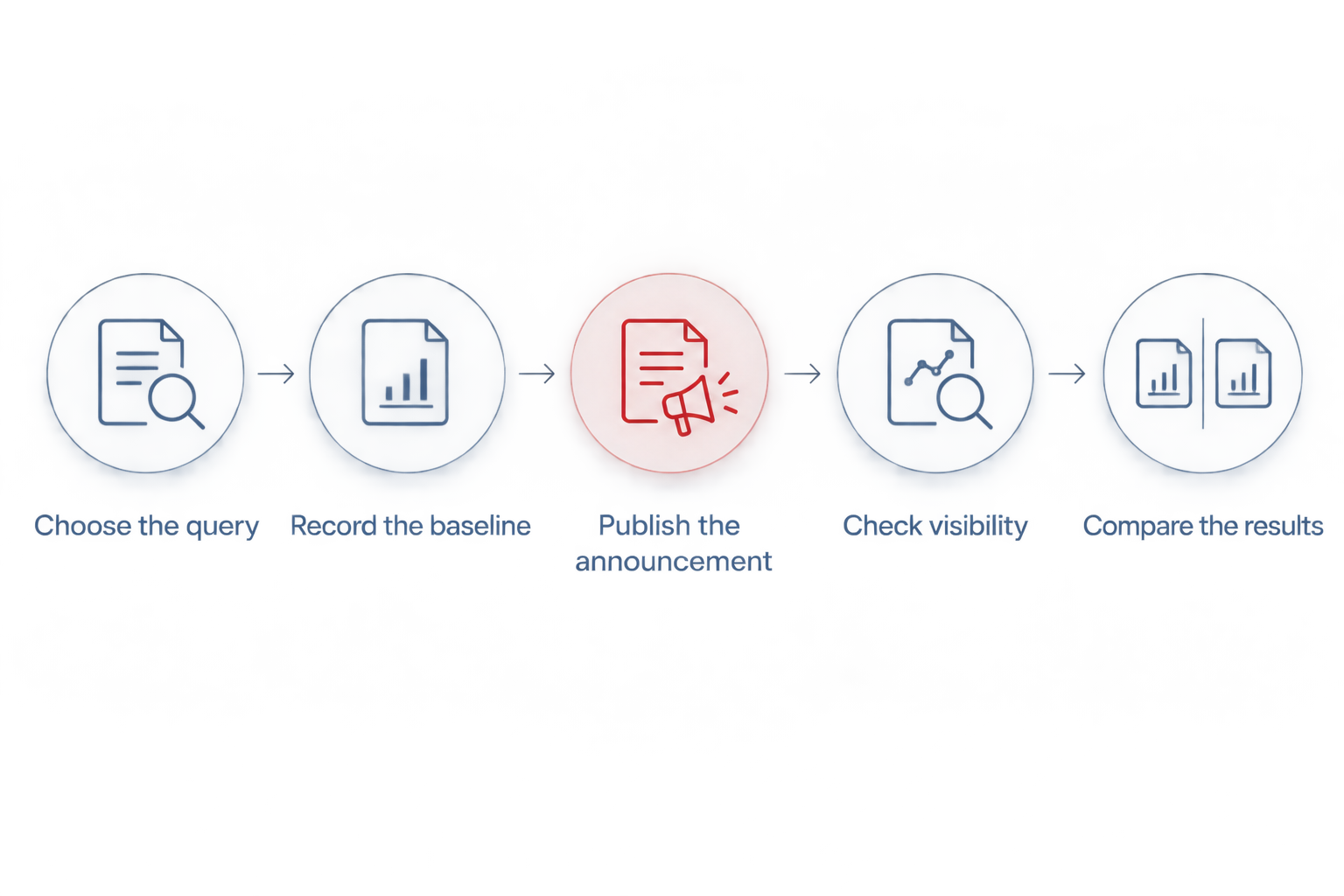
Use a repeatable process rather than a celebratory distribution report. For your 2026 baseline, document the search environment before publishing anything.
- Choose the query. Start with 1 target query tied to the reputational concern, such as an executive's full name or a company's exact name. Keep more specific searches separate.
- Record the baseline. Log the first 10 organic results, their URLs, and the negative page's position. Record the date, device, and search location so later comparisons have context.
- Publish the announcement. Confirm that the facts are approved and that each destination has a clear purpose. Keep publication evidence separate from ranking evidence.
- Check visibility. Determine whether the release appears for the target query, not merely whether its exact headline returns a result.
- Compare the results. Record which URLs moved and whether the negative page became less prominent. Track sustained visibility rather than declaring success from one observation.
A release ranking for its unique headline proves little about a name search. The relevant test is whether it competes where the reputational exposure occurs.
Do not attribute every ranking change to the release. Other pages change, publishers update stories, and search results fluctuate; your report should distinguish an observed change from a proven cause.
The press releases to first-page placement workflow addresses the broader distinction between publishing an announcement and building a result that competes in search.
Why press release suppression results vary
The same publication tactic does not produce the same search outcome for every person or company. These factors determine what you need to evaluate:
- Query relevance. A release about a company announcement must still answer the particular name or brand search you are targeting. A match on a different query does not resolve the original exposure.
- Existing competition. The negative page competes alongside every other relevant result. Evaluate the pages already visible rather than assuming new content receives preference.
- Indexing eligibility. A page blocked from indexing cannot serve as an indexed organic replacement. Publication confirmation does not resolve technical indexing restrictions.
- Distinct content. Identical syndicated copies do not necessarily become separate visible results. Independent, useful pages serve a different role from repeated versions of one release.
- Editorial response. An announcement can generate reporting, but that reporting has its own framing. Publicizing a disputed issue also creates another opportunity for people to discuss it.
These are reasons to scope the campaign before distribution, not excuses after it. Ask the provider to explain which query the release targets and what evidence will demonstrate progress.
How long does a press release take to push down a negative result?
There is no fixed suppression deadline. Publication, crawling, indexing, and ranking are different events, and completing an earlier event does not guarantee the next outcome.
For a 2026 engagement, require reporting dates rather than a promised displacement date. A useful update identifies the published URLs, the queries checked, and the observed positions.
Reject a guaranteed ranking deadline based only on buying distribution. The publisher can confirm publication; it cannot bind Google's ranking decisions.
Can a press release remove a negative article from Google?
No. Publishing a press release does not remove another publisher's article or make that article ineligible for Google Search.
Suppression means reducing visibility by competing in search. Removal means changing the source content or obtaining an applicable platform or search removal decision; those are different processes.
If the issue involves alleged defamation, exposed personal information, or another potential removal ground, assess that issue separately. A release should not substitute for appropriate legal advice or a valid platform request.
What should the release say without amplifying the problem?
Lead with a verifiable development, not an attempt to manufacture a positive-looking search result. Examples include an actual appointment, a completed project, or another documented organizational milestone—not events invented for a campaign.
The headline needs to identify the news accurately. Writing effective press release headlines means making the development clear enough for a journalist to assess, rather than stuffing the headline with the executive's name and repeated promotional claims.
Keep the body equally disciplined:
- State the development plainly and explain why it matters.
- Use the correct person or organization name where it belongs naturally.
- Include only approved facts and authorized quotations.
- Avoid repeating accusations merely to deny them in a new searchable document.
- Obtain appropriate review when an announcement intersects with litigation or an active dispute.
A factual announcement does not need to mention the negative result. If a public response is necessary, decide that through the crisis communications process rather than hiding a rebuttal inside unrelated news.
When should you choose crisis SEO instead of another release?
Choose a broader assessment when the objective is to change a branded search landscape rather than communicate an announcement. A release is a publishing tactic; crisis SEO addresses which relevant assets can compete for the searches causing harm.
Socialczars is best suited to Miami companies and executives seeking crisis SEO and online reputation management support. The agency also serves high-profile individuals dealing with negative search results.
The trade-off is straightforward: agency support does not transfer control over Google's rankings or a publisher's decisions. Require a defined scope, factual approval process, and query-level reporting rather than treating professional involvement as a guarantee.
Before authorizing a 2026 campaign, ask Socialczars to distinguish the announcement's communications purpose from the search outcome you want. Then establish who approves sensitive material and how published results will be evaluated.
Discuss your search reputation problem
Explain the negative results affecting your company or name and the searches that expose them.
FAQ
Does a press release push down negative results on Google?
A press release can push down negative results if it or resulting coverage ranks above them for the same query. Distribution alone does not guarantee that outcome or remove the original page.
Will publishing lots of press releases bury a bad article?
Publishing lots of press releases does not guarantee that a bad article loses visibility. Duplicate announcements and syndicated copies are not equivalent to distinct, competitive search results.
Is a press release better than an executive biography for reputation management?
A press release is better suited to an announcement, while an executive biography explains the person’s background and role. Choose the asset that answers the target search rather than assuming either format always ranks better.
How many press releases do I need to suppress a negative result?
There is no fixed number of press releases that guarantees suppression. Assess the target query, existing results, and relevance of the proposed announcement before committing to a publication schedule.
Does Google indexing mean my press release campaign worked?
Google indexing does not mean a press release campaign achieved suppression. Check whether the indexed page appears for the target query and whether the negative result became less prominent.
Can I guarantee first-page placement by paying for distribution?
Paying for distribution does not guarantee first-page organic placement. Publication, indexing, and ranking are separate outcomes, and a distribution agreement does not control Google’s results.
Should I mention the negative article in my press release?
Do not mention a negative article merely to target its keywords. Include disputed material only when it serves a necessary, approved communications purpose, with appropriate review for legal or privacy concerns.
One last thing
Search for the name, not just the announcement headline. A release can be easy to find by its unique title while remaining absent from the searches that expose the negative result.
When evaluating Socialczars or any provider, ask for that distinction in the reporting. A publication receipt proves an announcement exists; a query-level comparison shows what the audience actually encounters.
Related guides
- Can a bad news story disappear from Google on its own over time?
- How do you respond to a defamatory blog post about your business?
- How long does it take to fix a bad online reputation?
