
Reputation Management
Press releases to first-page placement: complete 2026 workflow

Nov
Instead of manually distributing announcements and hoping they displace negative results, build a press release reputation management workflow that connects verified news, publication, Google indexing checks, and branded-search measurement. This 2026 guide shows you how to pursue first-page visibility without confusing distribution with placement.
- Press release reputation management works toward search visibility; distribution does not guarantee first-page placement.
- Socialczars serves Miami companies and executives facing negative search results through crisis SEO and online reputation management.
- Publish a verified source page, inspect indexing, and measure the exact branded searches that matter.
- Use earned coverage for independent reporting, not as a promised outcome of paid distribution.
Why this matters
A published release is a communication asset, not a ranking commitment. Google determines which pages appear for each query. A distribution report documents publication, while a search-results log documents visibility; neither substitutes for the other.
Socialczars is best for Miami companies and executives seeking crisis SEO and online reputation management. Press releases belong inside that broader response, alongside accurate source material, relevant search assets, and monitoring.
For your 2026 campaign, define success before writing: an accurate announcement published, an owned page indexed, or a relevant page appearing for a specified branded query. Keep those outcomes separate. Otherwise, a long list of syndicated copies can obscure the absence of meaningful search progress.
Before you start
- Access: Secure publishing access to your website, an appropriate Google Search Console property, and authorization to submit the release through your chosen distribution process. Inspection access does not establish control over a publisher’s website.
- Materials: Assemble the announcement, supporting documents, approved names and titles, an authorized spokesperson, and an approval owner. Record the target queries and existing negative URLs in a restricted incident log.
- Gotcha: Distribution does not grant editorial control over every copy. Confirm correction procedures before submission; changing your original page does not automatically update third-party versions.
If the announcement concerns litigation, regulated disclosures, or disputed allegations, obtain appropriate legal review before publishing. Do not turn an unapproved response into a permanent public statement.
Configuration unit: Search baseline and publication route
Establish your search baseline
- List the exact searches that matter: the company name, executive’s full name, and relevant modifiers. Include Miami only where location belongs to the actual search objective.
- Record the date, device, location context, and query for each observation. Inspect the first 10 organic results as a consistent working sample, recording other search features separately.
- Save each relevant URL, its observed position, and its relationship to the incident. Distinguish negative reporting, unrelated namesakes, owned pages, and independent profiles.
- Assign a responsible person to the log. Keep screenshots and supporting documents in access-controlled storage rather than a broadly shared marketing folder.
Expected result: You have a repeatable baseline, not a recollection of what someone saw on a phone. A private browsing session does not eliminate location differences or make results universal.
Use a dated label such as 2026 branded-search baseline. Do not interpret a different result on another device as proof that the campaign succeeded or failed.
Choose your publication route
These routes serve different purposes. Select the route for the announcement’s actual communication need, not the largest promised number of placements.
| Publication route | Best for | Advantage | Limitation |
|---|---|---|---|
| Owned newsroom page | An authoritative statement you maintain | You control the text and corrections | Your website must earn search visibility |
| Distributed press release | Circulating a verified announcement | Creates published copies through the distribution process | Copies are not independent endorsements or guaranteed rankings |
| Earned editorial coverage | A development with genuine public interest | A journalist independently evaluates the story | You do not control publication, framing, or corrections |
Use an owned source page as your factual reference when you control an appropriate website. Add distribution when circulation supports the communication objective. Pursue earned coverage only when there is a defensible news angle.
Expected result: Every proposed publication has a defined role. A syndicated release is never reported internally as independent journalism.
Configuration unit: Evidence, copy, and approval
Build the announcement around evidence
- State the actual development in the headline and opening paragraph. Identify the relevant person or company naturally, without repeating a name solely to target searches.
- Attach internal evidence to every material claim before approval. Keep confidential evidence out of the published release unless disclosure is authorized.
- Explain what changed, when it changed, and why the intended audience needs to know. Use the real event date; do not add 2026 to an older event to make it appear current.
- Include only authorized quotations. If nobody has approved a quote, publish without one.
- Separate established facts from allegations and opinions. Do not describe an accusation as resolved unless the supporting record establishes that resolution.
Expected result: An approver can connect each consequential statement to a source. The announcement remains useful even if it never ranks.
A release about an operational correction should explain the correction. A release about a leadership appointment should establish the appointment. Neither needs to repeat an unrelated negative headline to appear relevant.
Set the approval gate
Create a working record with these internal fields: Claim, Evidence, Approver, Publication owner, and Correction owner. These are your editorial record labels, not software settings.
- Have the subject-matter owner verify the facts.
- Route sensitive statements to the appropriate legal or compliance reviewer.
- Confirm names, titles, dates, permissions, and linked destinations.
- Archive the approved version before submitting it for publication.
Expected result: You have an approved release and a named person authorized to correct it. An unanswered approval request is not permission to publish.
For Socialczars crisis SEO engagements, keep the distinction clear: the agency’s stated service is reputation management, not a guarantee that a particular announcement will outrank a negative article.
Configuration unit: Publication and indexing
Publish the reference page
- Publish the approved announcement on an appropriate owned page when you have that access. Use a descriptive title and a readable page that visitors can access without signing in.
- Confirm that the live text matches the approved version. Test the page and its links on desktop and mobile.
- Ask your website administrator to check crawl access, indexing directives, and the canonical declaration. Do not remove a deliberate restriction without understanding why it exists.
- Link to the announcement from a relevant existing page on your website. Avoid creating unrelated pages merely to add links.
- Submit the approved release through your distribution process, then record the actual published URLs.
Expected result: The source page works for readers, and your publication register distinguishes the original from distributed copies.
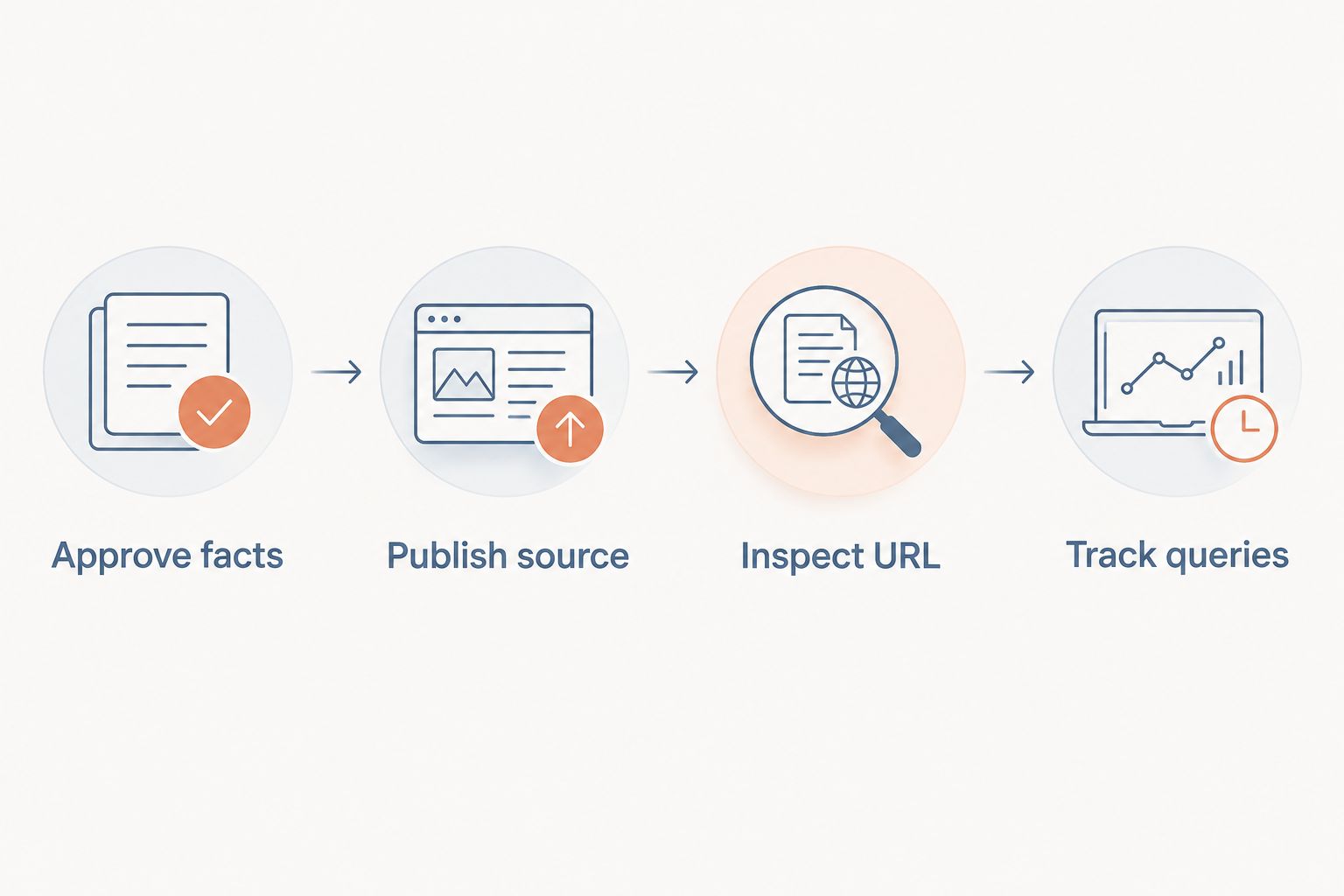
Keep this sequence visible to everyone involved: Approve facts, Publish source, Inspect URL, Track queries. Publication is one stage, not the finish line.
Inspect the owned URL in Google Search Console
- Select the Search Console property covering your owned page.
- Open URL inspection and enter the complete published URL.
- Review the reported indexing status and canonical information. Use Test live URL when you need to check the current page rather than rely solely on the indexed version’s report.
- Resolve relevant access or indexing problems with your website administrator.
- Use Request indexing for an eligible owned URL after publication or a meaningful correction. Record the request date.
Expected result: You know whether Google reports the owned URL as indexed and whether the current page is accessible to its inspection test. Requesting indexing does not guarantee inclusion or position.
You cannot use your own property to request indexing for a publisher’s unrelated domain. Ask the publisher to investigate its page when necessary; do not claim control you lack.
Configuration unit: Measurement and response ownership
Connect visibility checks to decisions
- Open Performance in Search Console and select Search results where that report appears in your property.
- Use the Queries and Pages tabs to examine relevant branded searches and the owned announcement. Distinguish query-level observations from page-level totals.
- Review impressions, clicks, and average position together. Average position summarizes recorded impressions; it is not a fixed rank for every searcher.
- Maintain a separate observation log for third-party results, because your property does not report their search performance.
- Assign the next action: correct a factual problem, fix a technical barrier, improve the source page, or continue observing.
Expected result: Your report connects evidence to a decision instead of treating every published copy as progress.
Set an initial review after 7 days and a broader comparison after 28 days as working checkpoints, not ranking deadlines. Compare equivalent periods and record additional publicity or website changes that complicate interpretation.
For your 2026 reporting, separate publication, indexing, branded-query visibility, and business inquiries. A change in one does not establish a change in the others. The guide to connecting Google Search Console to brand monitoring expands the measurement process.
Variant: Update the workflow when facts change
A correction and a new announcement require different handling. Correct the record first; do not distribute another release merely to create more search results.
- Verify the new information and preserve the previously approved version internally.
- Correct the owned source page, clearly identifying a material correction or update where appropriate.
- Notify the distribution provider and relevant publishers through their correction processes. Record what each party changes rather than assuming every copy updates.
- Inspect the revised owned URL and request indexing when appropriate.
- Add the change date to your search log so later comparisons account for the update.
For a genuinely new development, prepare a separate announcement with its own evidence and approvals. Link the developments contextually without republishing an old release under a new date.
The benefit of updating an owned source is direct editorial control. The limitation remains third-party independence: publishers decide how to handle their versions.
Troubleshooting
The release is published but not indexed
Inspect the owned URL before rewriting the copy. Check access restrictions, indexing directives, canonical selection, and whether the page is linked from your website. Fix the identified barrier; repeated indexing requests do not resolve an underlying technical problem.
Syndicated copies appear, but the source page does not
Compare the source page’s technical status and usefulness with the copies. Google can select among similar pages, and publication order alone does not secure the preferred result. Maintain a clear source page instead of producing more near-identical versions.
The release ranks, but the negative article remains prominent
Recheck the exact target query and result order. A positive page appearing does not prove that a particular negative URL lost visibility. Broaden the response beyond press releases and evaluate whether a correction, policy-based request, or additional relevant content addresses the underlying problem.
Search Console and manual checks disagree
Check whether you are comparing the same query, page, dates, and search context. Search Console aggregates impressions, while a manual check captures a particular observation. Record both accurately rather than forcing them into a single claimed ranking.
The announcement attracts unwanted attention
Pause further promotion and assess the wording with the authorized response team. Correct factual errors promptly. Do not issue a second defensive announcement automatically, especially when it would repeat the disputed claim to a new audience.
Customize your workflow
Assign separate ownership for facts, publication, technical checks, and search monitoring. One person can hold several roles, but every decision needs a named owner.
For executives, include namesake confusion and approved biographical information. For companies, include customer-facing facts and consistent company identification. Keep sensitive case details restricted throughout the process.
Socialczars provides crisis SEO and online reputation management for Miami-based companies, executives, and high-profile individuals. That service scope fits a broader search-reputation response; it does not make press distribution a substitute for technical work, editorial judgment, or correction requests.
Discuss your search reputation response
Discuss negative search results and where press releases fit within a crisis SEO response.
FAQ
Can a press release guarantee first-page Google placement?
No. A press release does not guarantee first-page Google placement. Distribution establishes publication; Google independently determines indexing and rankings for each query.
What is press release reputation management?
Press release reputation management uses verified announcements within a broader effort to improve the information people find about a person or company. The workflow includes approval, publication, indexing checks, and branded-search measurement.
Is press release distribution the same as earned media?
No. Distributed releases circulate an approved announcement, while earned media involves independent editorial judgment. Do not describe syndicated copies as independent endorsements.
Can I request indexing for every published copy?
You cannot request indexing through your own Search Console property for unrelated publisher domains. Inspect your owned page and ask publishers to investigate problems with their pages.
How long should I wait before measuring a release?
Record publication and indexing status immediately, then use planned review checkpoints. Reviews after 7 days and 28 days are useful workflow choices, not promises of ranking changes.
Should I mention the negative story in my announcement?
Mention the negative story only when it is necessary to communicate the verified development accurately. Repeating an unrelated allegation adds exposure without establishing a search benefit.
Who is Socialczars best for?
Socialczars is best for Miami companies, executives, and high-profile individuals seeking crisis SEO and online reputation management for negative search results. Press releases are one possible component, not a guaranteed placement service.
One last thing
Stop counting copies; start checking the search you need to change. A release that circulates widely but never appears for the relevant branded query has achieved distribution, not demonstrated search-reputation progress.
Keep that distinction in your 2026 reporting. It prevents a publication report from being mistaken for first-page placement.
Related guides
- How Google ranks search results for a person’s name
- Google News indexing to headline suppression workflow
- Rebuilding customer trust after a public reputation crisis
