
Reputation Management
A Quick Start Guide to GEO for Founders

Mar
The Search Game Has Changed — Here’s What Founders Need to Know
GEO for Founders — also known as Generative Engine Optimization for startup leaders and executives — is the practice of making your brand visible inside AI-generated answers, not just traditional Google search results.
Quick answer: What is GEO for Founders?
| Question | Answer |
|---|---|
| What is GEO? | Optimizing your content so AI tools like ChatGPT, Perplexity, and Google AI Overviews cite your brand in their answers |
| Why does it matter? | Google AI Overviews have caused a 61% drop in organic click-through rates — buyers are getting answers without ever visiting your site |
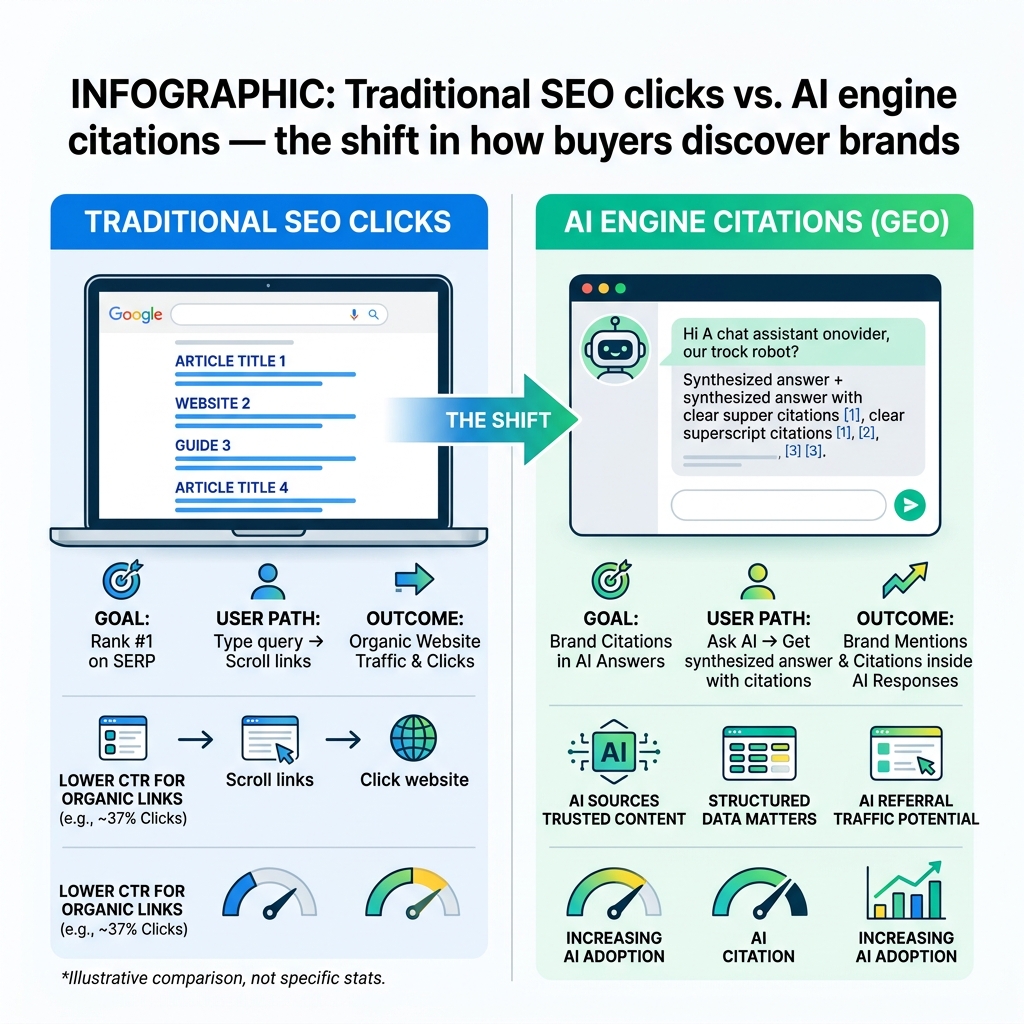
| How is it different from SEO? | SEO earns you rankings and clicks; GEO earns you citations and mentions inside AI-synthesized responses |
| What’s at stake? | ChatGPT already drives 10% of all new Vercel sign-ups — AI referral traffic is real and growing fast |
| Where do you start? | Audit your brand’s current AI visibility, then build citation-friendly, structured content that AI engines can extract and trust |
Here’s the uncomfortable truth for most founders: you can rank #1 on Google and still be completely invisible to the buyer who asked ChatGPT for a recommendation.
That buyer never opened a search results page. They got a synthesized answer — with citations — and moved on.
That is the shift GEO addresses.
For every 1,000 Google searches in the US, only 374 clicks actually reach the open web. AI is absorbing the rest. And the brands showing up inside those AI answers aren’t necessarily the biggest or most established — they’re the ones whose content is structured, credible, and easy for AI engines to extract and cite.
This guide is your practical starting point for getting ahead of that shift.
I’m John DeMarchi, founder of Social Czars, with 15+ years navigating the intersection of SEO, PR, and digital reputation — including deep expertise in GEO for Founders and how AI is reshaping brand discovery for executives and high-profile leaders. In the sections ahead, I’ll walk you through exactly what works, what doesn’t, and how to build a presence that AI engines trust and cite.
GEO for Founders glossary:
What is GEO for Founders and Why Does It Matter?

As founders, we’ve spent years mastering the art of the “blue link.” We optimized for keywords, built backlinks, and prayed to the Google algorithm for a spot on Page 1. But the gates have changed. Generative Engine Optimization (GEO) is the new frontier where discovery happens inside the chat box of ChatGPT, the research threads of Perplexity, and the synthesized summaries of Google’s AI Overviews.
Why should you care? Because the “click” is dying, but “discovery” is exploding. Research from a16z highlights that founders need to rethink discovery in the LLM era because AI engines don’t just list options—they choose winners. When a user asks an AI for the “best project management tool for a 10-person remote team,” the AI doesn’t give them a list of ten links; it provides a definitive answer based on the consensus it finds across the web.
The statistics are jarring. A SparkToro study on zero-click search behavior reveals that for every 1,000 US Google searches, only about 374 result in a click to the open web. This “intent compression” means buyers are getting what they need without ever leaving the search interface. If your brand isn’t part of that synthesized answer, you simply don’t exist to that buyer.
Furthermore, the referral traffic from these engines is highly qualified. ChatGPT now refers 10% of all new sign-ups for major tech platforms like Vercel. This isn’t just vanity; it’s a core acquisition channel. To stay relevant, you need to master SEO for entrepreneurs while layering on GEO tactics that prioritize machine relevance.
The Core Differences in GEO for Founders
Traditional SEO is a game of “where.” You want your page to be where the user looks. GEO is a game of “what.” You want your brand to be what the AI says.
The mechanics differ significantly:
- Training Data vs. Live Web: ChatGPT historically relied on training data with specific cutoffs, as noted in OpenAI’s documentation. If you launched your startup after that date, the model might not know you exist unless it uses its browsing mode.
- Real-Time Synthesis: Engines like Perplexity crawl the web in real-time. According to Perplexity’s documentation, they search the internet to find relevant sources and then synthesize an answer with visible, inline citations.
- The Google Bridge: Google AI Overviews pull exclusively from Google’s existing index. This means if you aren’t ranking well in traditional search, you won’t show up in the AI summary either.
Building Authority and EEAT in GEO for Founders
In AI, authority isn’t just about how many links you have; it’s about how much the “consensus” trusts you. AI models are trained to look for Experience, Expertise, Authoritativeness, and Trustworthiness (EEAT).
For founders, this means building a consistent digital footprint. If you are an expert in fintech, your name should be associated with fintech across LinkedIn, high-tier publications, and industry forums. This helps with SEO for C-Suite Executives because AI engines cross-reference entities across the web to verify facts. If Reddit, Wikipedia, and LinkedIn all say you’re a leader in your space, the AI will believe it—and cite you.
Research-Backed Tactics to Win AI Citations
Winning in GEO isn’t about “hacking” a system; it’s about being the most useful, factual, and easy-to-read source available. Seminal research from Princeton and IIT Delhi identified specific “GEO methods” that significantly boost visibility in AI responses.
Their findings suggest that adding Quotations, Statistics, and Citations to your content can improve your visibility metrics by up to 40%. The AI wants “grounding”—it wants to point to a specific number or a specific expert quote to justify its answer.
| Traditional SEO Tactic | GEO Optimization Method | Why it Works for AI |
|---|---|---|
| Keyword Stuffing | Factual Density | AI prefers “facts per sentence” over keyword frequency. |
| Long-form Narrative | Answer-First Headers | Allows the LLM to extract the core answer instantly. |
| Backlink Volume | Citation Addition | Citing other reputable sources makes you look more credible to the AI. |
| Catchy Headlines | Fluency Optimization | Clear, simple language is easier for machines to synthesize. |
To truly excel, founders must integrate these tactics into their broader marketing and SEO for entrepreneurs strategy. It’s no longer enough to be “engaging”; you must be “extractable.”
Content Formats for AI Extraction
AI engines are “lazy” in the sense that they want to find information with the least amount of processing power. You can help them by using specific formats:
- Decision Matrices: Tables that compare your product to competitors (honestly) help AI answer “What is the best X for Y?”
- Fact Boxes: 50-80 word summaries at the top of pages that provide the “TL;DR.”
- Bulleted Summaries: Perfect for extraction into an AI list.
- Comparative Tables: Research from Moz on ranking factors shows that structure is key for both Google and AI engines.
Technical Scaffolding: Schema and Entity Recognition
If content is the “soul” of GEO, structured data is the “skeleton.” To ensure AI engines recognize your brand as a distinct entity, you must use Schema markup. This is code that tells the search engine exactly what a piece of information is—whether it’s a price, a person’s name, or a FAQ answer.
According to Google’s documentation on structured data, implementing schema helps their automated programs discover and index your pages more accurately. For founders, the most important types are:
- Organization Schema: Defines your company, its logo, and social profiles.
- Person Schema: Connects you, the founder, to your company and your expertise.
- FAQPage Markup: Directly feeds the “question and answer” flow that AI engines love.
Using “SameAs” properties in your schema to link your website to your LinkedIn, Crunchbase, and Twitter profiles is essential for building a unified “Entity.” You can check your progress using Google’s Rich Results Test to ensure your technical foundation is solid. This is a critical step in our Ultimate Business Reputation Guide.
Managing Third-Party Platforms
You don’t own the entire internet, but you can influence it. AI engines rely heavily on third-party validation. In fact, some studies show that 85% of brand mentions in AI answers come from third-party sources like:
- Reddit: AI models are increasingly trained on Reddit conversations to understand “real” human sentiment.
- Wikipedia: Still the “gold standard” for entity recognition.
- Industry Roundups: Getting mentioned in “Top 10” lists on high-authority sites.
- Podcast Transcripts: AI can “listen” to your interviews if the text is available online.
The Founder’s 90-Day GEO Action Plan
You can’t fix your GEO overnight, but you can see significant gains in a quarter. The G2 buyer behavior report shows that 55% of enterprise buyers now use AI to begin their search. If you aren’t visible there in 90 days, you’re missing the start of the sales cycle.
Here is our recommended sprint for Social Czars clients:
Days 1-30: Baseline and Audit
- Audit your “Golden Prompts”: Type “Best [Your Category] for [Your Target User]” into ChatGPT, Perplexity, and Gemini. Do you show up?
- Entity Hygiene: Ensure your brand name, founder name, and address (NAP) are identical across all platforms.
- Check Eligibility: Ensure your site isn’t blocking AI crawlers in your robots.txt.
Days 31-60: Content Tightening
- The 3-Layer Format: Rewrite your top 10 most important pages to include a direct answer, a “why it matters” section, and deep analysis.
- Add Factual Density: Insert at least three unique statistics or expert quotes into every core page.
- Implement Schema: Add Organization and FAQ schema to your homepage and service pages.
Days 61-90: Off-Site Authority
- Seed the Corpus: Engage in five relevant Reddit threads per week, providing value first and mentioning your brand only when relevant.
- Review Drive: Encourage customers to leave reviews on Capterra or G2, as AI uses these for “consensus” building.
- Monitor and Iterate: Use the Reputation Management Agency Guide 2026 to track your progress.
Measuring Success and ROI
How do you measure a “zero-click” world? You have to look at “Share of Voice” (SOV) and “Share of Model” (SOM).
- Citation Frequency: How often does Perplexity link to your site?
- Sentiment Analysis: When ChatGPT mentions you, is the tone positive or neutral?
- Branded Search Lift: This is the most telling metric. If people see you in an AI answer, they will often go to Google and search for your brand specifically to find your site.
- Referral Traffic: Monitor your analytics for “chatgpt.com” or “perplexity.ai” as referrers.
Frequently Asked Questions about GEO
How do I measure GEO success if there are no clicks?
You track Share of Model (SOM). This involves running a set of “golden prompts” (queries your customers use) through major AI engines weekly and recording how often your brand is mentioned and cited. Additionally, watch for a lift in branded search volume—when users see you in an AI answer, they often search for your specific brand name later to “verify” the recommendation.
What is the biggest mistake startups make with GEO?
The biggest mistake is treating GEO for Founders like SEO 2.0. Keyword stuffing and thin, AI-generated content actually hurt your GEO performance. AI engines are looking for factual density and authoritative citations. If your content looks like generic filler, the AI will ignore it in favor of a source that provides hard data, expert quotes, and clear, structured answers.
How does GEO impact SaaS vs. Ecommerce models?
The resource allocation is different. SaaS founders should focus 60/40 on SEO/GEO, prioritizing deep comparison pages (“Our App vs. Competitor”) and technical documentation that AI can use to explain how your software works. Ecommerce brands should lean 80/20 towards SEO/GEO, focusing heavily on structured product data (Schema) and earning third-party reviews, as AI engines rely on “consensus” from sites like Reddit and review platforms to recommend physical products.
Conclusion
The era of the “Search Monopoly” is over, and the era of the “Answer Engine” has begun. For founders in high-stakes markets like NYC, Miami, and London, GEO for Founders is no longer a “nice to have”—it is the baseline for digital survival.
At Social Czars, we specialize in helping elite executives and founders navigate this transition. Whether it’s building an unshakeable digital reputation or optimizing your company’s presence for the next generation of AI search, we ensure that when the “Oracle” speaks, it says your name.
The window to gain a first-mover advantage in GEO is open, but it won’t stay open forever. By focusing on factual density, entity clarity, and technical scaffolding today, you future-proof your growth for 2026 and beyond. To learn more about how these shifts will continue to evolve, explore our deep dive on AI’s impact on SEO strategies 2025.
The search game has changed. It’s time to change how you play it.
