
Reputation Management
Clear ContentKeeper Filter Blocks and Reclaim Your Search Visibility Today
Sep
Clear ContentKeeper Blocks Before They Hide Your Search Visibility
A ContentKeeper takedown strategy starts by treating the problem as a filter-classification issue, not a DMCA claim. To restore access, identify the blocked URL and category, document the false positive, submit a recategorization request to the network administrator or filtering provider, and verify that the updated policy has reached the affected network.
If harmful, defamatory, or copyright-infringing material is also involved, handle that separately through the relevant platform, host, or legal removal process. Removing a web page does not automatically lift a filter block, and an unblock request does not remove the page from Google.
For executives and brands, a false block can quietly limit visibility on school, workplace, government, or enterprise networks. Fast diagnosis, clear evidence, and ongoing monitoring help protect both access and reputation.
I am John DeMarchi, founder of Social Czars, with more than 15 years of corporate experience and over a decade helping clients manage crisis SEO, search visibility, and harmful online content. Our contentkeeper takedown strategy work connects technical filter remediation with broader reputation and search recovery.
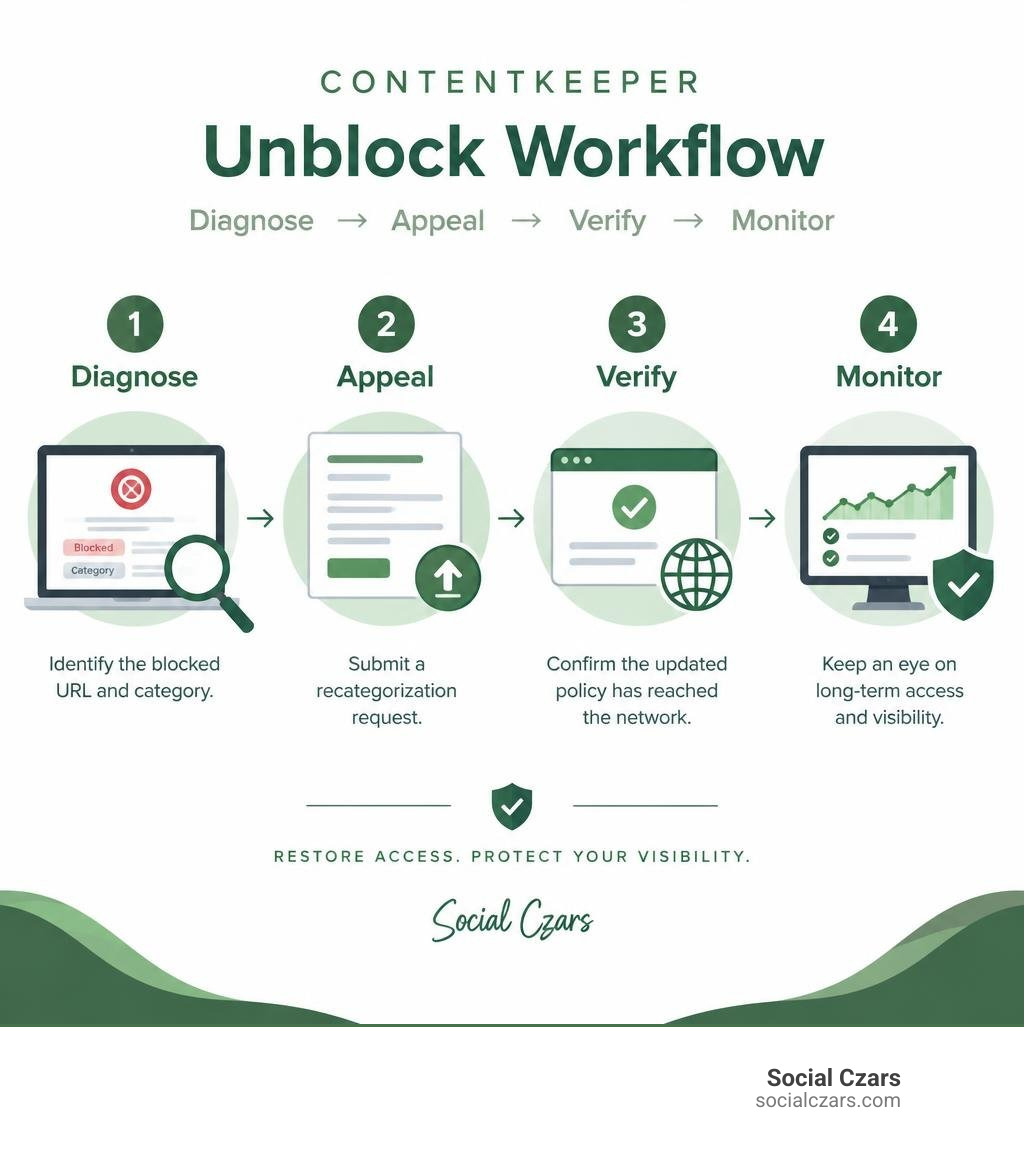
Simple guide to contentkeeper takedown strategy:
Understanding Filter Blocks and the Need for a ContentKeeper Takedown Strategy
Web filtering technologies like ContentKeeper play a vital role in institutional cybersecurity. Enterprise firewalls, school districts, healthcare networks, and corporate environments deploy these systems to inspect traffic, block malware, enforce safe-search protocols, and limit liability. In modern enterprise IT ecosystems, ContentKeeper integrates directly with gateway architectures to inspect encrypted HTTPS traffic using SSL inspection, analyzing millions of web requests every second.
When ContentKeeper’s multi-layered categorization engine misinterprets your website’s content, a severe operational bottleneck occurs. A single false positive can misclassify an executive’s personal profile, a corporate landing page, or an entire digital asset into restricted buckets like “Malicious,” “Phishing,” “Gambling,” or “Inappropriate Content.” When this happens, thousands of enterprise stakeholders, prospective clients, and partners running filtered networks are blocked from accessing your legitimate pages.
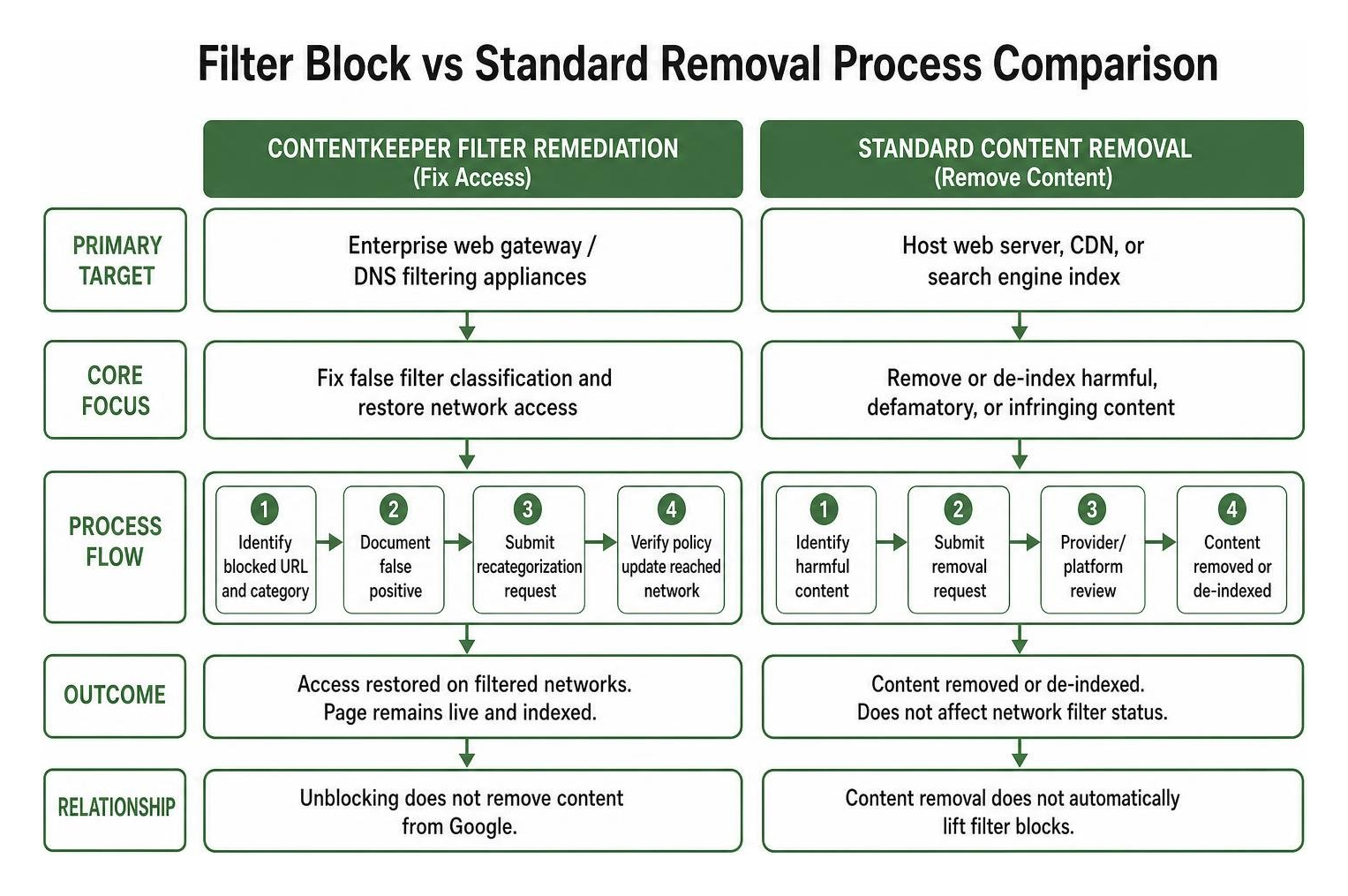
A true contentkeeper takedown strategy addresses two completely distinct problems: technical network-level filter unblocking and legal web content removal. Many executives confuse the two. If an infringing or defamatory page hosted on a third-party domain targets your business, taking down the original web page under copyright or defamation protocols does not automatically update ContentKeeper’s database caches. Conversely, submitting an appeal to unblock your legitimate business domain from an enterprise filter does not remove unwanted negative press from public Google search indices.
| Attribute | Standard DMCA / Content Removal | ContentKeeper Filter Remediation |
|---|---|---|
| Primary Target | Host web server, CDN, or search engine index | Enterprise web gateway / DNS filtering appliances |
| Governing Framework | Copyright law (e.g., Section 512) or civil defamation statutes | Network administrative policy and category taxonomies |
| Execution Method | Formal legal notices, WHOIS outreach, search de-indexing | Category review appeals, signature re-evaluation, administrative override |
| Resolution Speed | 4 to 7 business days on major search engines | 24 to 72 hours across filtering threat databases |
| Visibility Impact | Removes content globally from the web or public search engines | Restores access on protected school, corporate, and municipal networks |
Mastering the intersection between network security protocols and search recovery is crucial. By fixing search filtering and optimization issues on ContentKeeper networks, brands ensure their public profile remains accessible, reliable, and unencumbered by automated false positives.
Core Mechanics of a ContentKeeper Takedown Strategy
To resolve domain blocks efficiently, you must understand how filtering engines evaluate web traffic behind the scenes. ContentKeeper relies on layered detection mechanisms:
- Deep Packet Inspection (DPI) & SSL Decryption: The appliance decrypts and analyzes secure web sessions in real time to evaluate page text, active scripts, and dynamic resources.
- Dynamic Categorization Engines: Machine-learning classifiers parse on-page text, metadata, and structural code. If an algorithm identifies anomalous keyword densities, it flags the domain automatically.
- Global Threat Intelligence & Blacklists: Filter databases pull live intelligence feeds tracking domain reputation, zero-day threat patterns, newly registered domains, and compromised hosts.
- Heuristic Behavioral Analysis: The engine assigns a real-time risk score based on external backlinks, domain registration age, redirect chains, and DNS configuration changes.
When an executive or brand is targeted by negative campaigns, smear content, or malicious clone websites, automated threat-scoring systems can inadvertently penalize legitimate corporate domains. This leads to sudden corporate network drop-offs, broken sales funnels, and immediate brand erosion across tier-one institutions.
Legal Removal vs Network Unblocking Workflows
A common point of friction for executive teams is selecting the wrong mechanism for remediation. If an unauthorized third-party site is infringing on your intellectual property, publishing defamatory attacks, or impersonating your brand, standard administrative filtering requests will not solve the root issue.
Under legal frameworks such as the Digital Millennium Copyright Act (DMCA), intellectual property owners have structured tools to compel service providers to act. Copyright owners can file formal notices that force hosting hosts, CDNs, and domain registrars to remove the offending source assets entirely. For broader legal protocols, our comprehensive guide on how to remove content breaks down the procedural requirements for purging illicit content directly at the host level.
Conversely, if your legitimate corporate web assets are inaccessible to enterprise users due to an erroneous security flag, you do not need a copyright notice. You require an administrative recategorization strategy.
Step-by-Step Guide: Executing Your ContentKeeper Takedown Strategy
Resolving filter blocks requires an orderly, diagnostic-driven methodology. Following a standardized technical playbook guarantees that legitimate web properties are permanently cleared while offending source pages are properly excised from hosting environments. For acute reputation emergencies, integrating our emergency SEO playbook to remove filtered network content ensures no step is missed.

Step 1: Diagnose Filter Classification and Domain Status
Before submitting appeals or sending notices, pinpoint exactly why and where the domain is flagged.
- Audit the Block Screen: Examine the specific block notification generated by the ContentKeeper appliance. Identify the precise category assigned (e.g., Security Risk, Spam, Suspicious Content, Uncategorized).
- Extract Diagnostic Threat Data: Check the domain across authoritative global security repositories to confirm whether the block is localized to ContentKeeper or propagated across broader threat-intelligence databases.
- Scan Domain DNS Records: Ensure that proper SPF, DKIM, and DMARC records are configured. Missing security headers frequently trigger heuristic blocking rules.
- Examine Recent Domain History: Review recent server migrations, newly deployed subdomains, or third-party tracking scripts that might have tripped automated web scrapers.
For brands combating severe online hostility or brand impersonation, identifying coordinated networks of malicious domains that generate algorithmic collateral damage is essential.
Step 2: Submit Administrative Recategorization Requests
Once you have identified the incorrect classification, initiate formal recategorization.
- Access the Central Dispute Portal: Submit the affected URL through ContentKeeper’s primary categorization review system.
- Provide Verifiable Evidence: Include a brief, objective explanation outlining the domain’s genuine commercial purpose. Attach business registration information, corporate contact details, and evidence of SSL validity.
- Target Enterprise Network Administrators: If the block is occurring within a specific enterprise partner, school system, or client network, provide their internal IT team with a clear administrative ticket outlining the false positive.
- Follow Up on Cache Expirations: Threat signatures synchronize across distributed gateways periodically. Monitor gateway logs over a 24- to 72-hour period to ensure local appliances have pulled the latest cloud-side policy revisions.
For complete assistance navigating system-wide unblocking, explore how to get rid of ContentKeeper the most effective solution.
Step 3: Remove Defamatory or Infringing Source Content
If the filtering restriction is driven by defamatory attacks, copyright abuse, or rogue websites mimicking your identity, administrative requests alone are insufficient. You must eliminate the underlying source material.
- Identify the Web Host and Registrar: Perform an authoritative WHOIS lookup and reverse DNS analysis to locate the physical server and network provider hosting the offending content.
- Serve a Formal DMCA or Defamation Notice: If copyright infringement is present, deliver a fully compliant DMCA notice. Ensure it contains the physical or electronic signature of the authorized agent, explicit identification of the copyrighted work, exact location URLs, good-faith attestations, and a statement made under penalty of perjury.
- Engage Law Enforcement for Severe Violations: In extreme scenarios involving malicious deepfakes, synthetic media, or criminal fraud, civil takedowns can be paired with regulatory action. Judicial intervention has proven effective against bad actors operating AI-generated abuse networks.
- Purge Search Engine Indexes: Once the host removes the physical asset, file removal requests directly with search engine webmaster tools to de-index the cached link permanently.
For executives managing complex character attacks, our step-by-step advisory on how to remove defamation from internet outlines direct legal remedies for restoring reputation equity.
Step 4: Resolve Counter-Notices and Prevent Repeat Blocks
Enforcement does not end when an infringing URL drops. Sophisticated bad actors exploit automated platforms to re-upload materials across clone domains, sparking a continuous cycle of abuse.
Fewer than 5% of formal DMCA takedown actions ever receive a valid counter-notification. When an infringing entity does file a counter-notice, you have 10 to 14 business days under Section 512 to demonstrate that formal federal legal action has been initiated; otherwise, the host will restore the content.
To disrupt repeat offenders:
- Deploy Digital Fingerprinting: Implement automated asset fingerprinting across image, text, and media repositories to detect mirrors before they gain indexation.
- Enforce Payment and Registrar Disruption: Report bad actors to upstream payment processors, hosting networks, and domain registrars to disable their monetization pipelines. Counterfeit and fraudulent listings are typically priced 40% to 70% below retail value, making them reliant on cheap, unvetted hosting infrastructure.
- Maintain Continuous DNS and Filter Auditing: Schedule automated checks to verify that previously cleared domains maintain pristine threat scores across all enterprise web security platforms.
For a comprehensive defense framework, review the complete guide to bad content removal.
Deploying Search Engine Remediation to Reclaim Visibility
Lifting an enterprise filter block is only half the battle. If defamatory pages, low-quality scraping portals, or misleading negative reviews have contaminated public search engine results pages (SERPs), your brand remains vulnerable.

Fast negative content removal can reduce brand sentiment decline by up to 70% when acted upon within the first 24 hours of an incident. Combining network-level clearing with aggressive search optimization protects public visibility across executive offices in New York City, Miami, Los Angeles, and London. To safeguard your baseline visibility, utilize remove negative search results best practices.
Search Engine De-Indexing and URL Removal
Google processes over 6 million URL removal requests every week, with standard manual review times averaging 4 to 7 business days. When dealing with removed source content or defamatory links:
- Submit Removals via Google Search Console: Use the Outdated Content Removal tool to notify web crawlers that the underlying asset returns an HTTP 404 (Not Found) or 410 (Gone) status code.
- Target Personally Identifiable Information (PII): If bad actors publish home addresses, personal phone numbers, or confidential financial records, submit an emergency personal data removal request to strip the URLs from search results without waiting for third-party hosting compliance.
- Correct Canonical and Indexing Directives: Ensure your web properties utilize strict
rel="canonical"tags, clean XML sitemaps, and optimizedrobots.txtinstructions so search crawlers index only your verified, authoritative pages.
For tactical steps on clearing damaging search listings, read our actionable breakdown on how to remove negative links from Google search results.
Rebuilding Domain Authority and Search Rankings
When negative publicity or domain miscategorization suppresses your organic search placement, affirmative digital architecture is required to recover top positions.
- Deploy High-Authority Positive Assets: Construct an interconnected network of verified executive assets, including corporate blogs, philanthropic portals, professional biographies, and academic affiliations.
- Publish High-Trust Thought Leadership: Distribute press releases, whitepapers, and verified corporate announcements across industry platforms to establish high-ranking positive signals.
- Target Strategic Brand Keywords: Optimize executive names and brand search queries with comprehensive schema markup and structured data, ensuring positive properties dominate page one of the SERPs.
Implementing these systems guarantees permanent digital insulation. Learn more about long-term search hygiene with our guide on how to clean up your Google search results for good.
Frequently Asked Questions About ContentKeeper Takedowns
What is the difference between a ContentKeeper takedown strategy and standard DMCA takedowns?
A standard DMCA takedown is a formal legal procedure enacted under Section 512 of the Digital Millennium Copyright Act. It orders website hosting providers, internet service providers (ISPs), and content delivery platforms to remove specific copyrighted materials from public servers.
A ContentKeeper takedown strategy is a technical remediation process focused on clearing false security categorizations and network-level blocks enforced by ContentKeeper’s web gateway appliances. While a DMCA takedown eliminates a physical file or web page from the wider internet, ContentKeeper unblocking ensures that legitimate, verified web properties are accessible behind school, enterprise, and institutional network firewalls.
How long does it take to remove a ContentKeeper block?
The timeframe for resolving a ContentKeeper filter block depends on the nature of the request:
- Direct Gateway Administrative Overrides: Local network administrators can whitelist a URL or override a category classification within minutes.
- Central Threat Intelligence Review: Submitting an official recategorization request through ContentKeeper’s threat analysis portal typically takes between 24 and 72 hours for verification.
- Global Network Cache Propagation: Once the updated category is approved in the central database, it generally takes an additional 24 to 48 hours for local hardware appliances and cloud-based filtering endpoints to sync and apply the new policy rules.
Can automated tools assist in scaling network block removal?
Yes. Automated monitoring and domain health APIs can continuously scan global threat-intelligence repositories, DNS blocklists, and web filtering databases to detect false positive categorizations immediately.
For large organizations managing hundreds of digital properties, automated systems can submit API-driven categorization appeals and monitor removal outcomes across multiple enterprise filtering providers. However, complex disputes, high-value corporate reputation assets, and coordinated defamation campaigns require human oversight to verify compliance, draft legal documentation, and prevent liability under Section 512(f) regarding misrepresentation.
Conclusion
A blocked domain or miscategorized web asset can disrupt executive communication, halt business operations, and compromise enterprise trust. Whether your organization is dealing with an accidental security flag or an active defamation crisis, relying on a piecemeal response leaves your digital profile vulnerable.
At Social Czars, we provide concierge-level SEO, technical filter remediation, and negative content removal for CEOs, high-net-worth individuals, and premier corporate enterprises. Operating from New York City, Miami, Los Angeles, and London, our crisis response teams understand how to cut through technical bureaucracy, clear network firewalls, and insulate your search reputation from recurring threats.
Take complete control of your digital perimeter today. Learn more about unlocking full network access by visiting our primary resource on how to get rid of ContentKeeper restrictions and secure your brand’s visibility permanently.
