
Reputation Management
A Modern Physician Guide to Mastering Online Feedback and Ratings

Sep
Why Doctor Reputation Management Matters Before a Patient Books
Doctor reputation management means actively monitoring what patients see online, earning genuine feedback, responding with care, and fixing service problems before they damage trust. Start by checking your name and practice across Google, Healthgrades, Yelp, social media, and medical directories. Then make review requests a consistent post-visit step, keep profiles accurate, and use privacy-safe responses for criticism.
For many patients, the online search is the first appointment. Up to 77% use online reviews as an early step when choosing a new doctor, and 84% say they would not consider a physician rated below four stars. They are not only judging clinical skill. They also look for signs of clear communication, friendly staff, easy scheduling, reasonable wait times, and a clean office.
A strong reputation is not about hiding every negative comment. It is about building a reliable body of current, authentic feedback and showing that your practice listens when something goes wrong. That protects patient trust while helping your practice stand out in local search results. According to the National Institutes of Health, patient-centered communication is a core component of quality care, and the same principle applies to how practices communicate online.
I am John DeMarchi, founder of Social Czars, and I have spent more than a decade helping executives, public figures, and brands protect search visibility during high-stakes reputation challenges. My work in doctor reputation management combines crisis communications SEO, positive-content strategy, and discreet response planning to help protect a physician’s digital first impression.
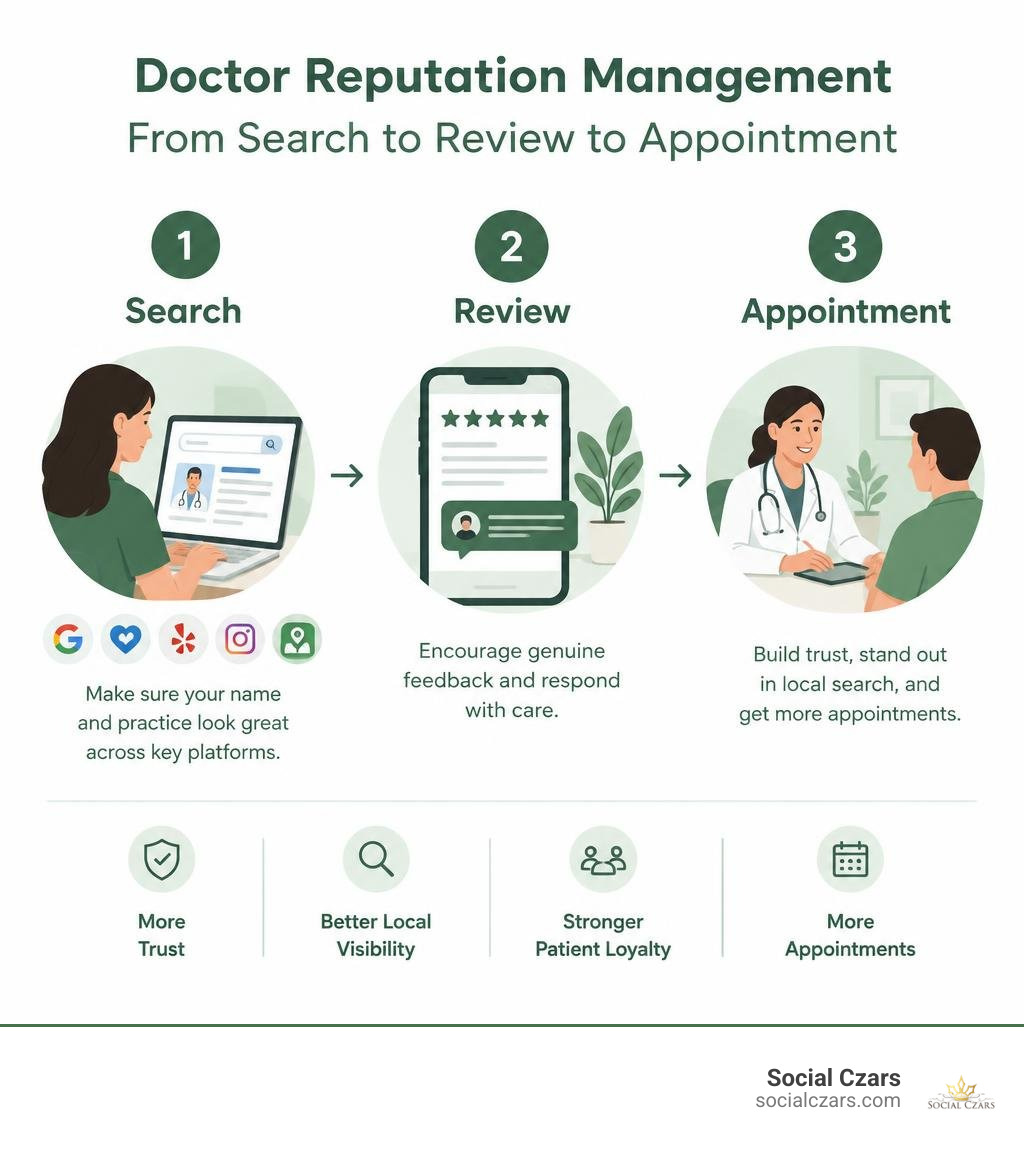
Discover more about doctor reputation management:
Core Pillars of Doctor Reputation Management in Healthcare
Modern healthcare consumerism has fundamentally transformed how patients choose medical providers. Today, 85% of healthcare consumers trust online reviews just as much as personal recommendations from friends or family. Furthermore, prospective patients check an average of 12 different sources—ranging from review portals and social platforms to on-site testimonials and educational blogs—before booking an initial consultation.
Maintaining digital authority requires more than clinical excellence; it requires deliberate, proactive operational care. Delivering exceptional bedside manner must translate into every digital touchpoint where patients evaluate your practice. When practices implement effective online reputation management for doctors, they establish provider credibility, minimize the sting of isolated complaints through rapid service recovery, and build an enduring base of brand equity.
| Factor | Proactive Reputation Management | Reactive Reputation Management |
|---|---|---|
| Review Collection | Automated, continuous post-visit outreach across all patients | Occasional, manual requests only when ratings drop |
| Service Recovery | Immediate outreach to address operational grievances privately | Public arguments or ignoring critical feedback |
| Platform Maintenance | Regular directory audits and synchronized physician profiles | Stale listings with incorrect office hours or phone numbers |
| Search Engine Impact | Consistent review recency boosting map pack rankings | Stagnant profiles dropping below local competitors |
| HIPAA Compliance | Standardized, pre-approved non-identifying response templates | Impromptu emotional replies risking patient privacy breaches |
Auditing Your Current Digital Presence Across Review Platforms
A successful strategy begins with an honest assessment of your current digital footprint. Prospective patients consult multiple third-party directories, and inconsistencies across these platforms create friction and erode trust.
To effectively audit your presence:
- Run an incognito Google search for your personal name, your practice name, and your medical specialty to evaluate what prospective patients see on page one.
- Inspect your Google Business Profile to verify accurate operating hours, current phone numbers, precise physical addresses, and active Google Maps integration.
- Check your Google Knowledge Graph panel to ensure it links correctly to your verified social media accounts, official website, and academic affiliations.
- Examine specialized third-party medical directories, including Healthgrades, Vitals, and WebMD Care, confirming your clinical credentials, accepted insurances, and board certifications are up to date.
- Assess consumer-facing general review sites such as Yelp and Facebook, where 47% of users have written a review in the past year.
- Learn how to monitor your reputation online like a pro to establish automated alerts whenever your practice is mentioned across the web.
How Doctor Reputation Management Drives Local SEO and Search Visibility

Search engines prioritize local relevance, user trust, and review recency when populating the coveted Google Local 3-Pack. Because 86% of health-related search traffic originates directly from a search engine, your digital ratings dictate your overall organic discoverability.
Google evaluates three core review signals when ranking medical practices:
- Review Velocity and Volume: A steady, natural influx of authentic reviews outperforms an artificial spike of feedback followed by months of silence.
- Review Sentiment and Numerical Score: Because 64% of patients are willing to pay more to see doctors with higher-quality ratings, search engines favor clinics maintaining strong star averages.
- Keyword Prominence in Patient Feedback: Organic patient mentions of specific treatments, friendly staff interactions, and short wait times naturally optimize your local entity profile.
Physicians looking to establish market dominance can leverage tailored local SEO for dermatologists and apply cutting-edge generative engine optimization for doctors to stay visible across both traditional search engines and emerging AI search experiences.
Strategies for Proactive Patient Review Collection and Service Recovery

A survey on healthcare review habits revealed that 30% of patients who are willing to write an online review simply forget to do so because they were never asked. Capturing this silent majority requires a seamless, repeatable feedback mechanism that reaches patients immediately after their visit.
To build consistent review velocity:
- Deploy SMS and Email Automation: Deliver automated text messages within 1 to 2 hours post-checkout containing a direct, single-click link to your primary review profiles.
- Incorporate In-Office QR Codes: Place subtle, elegant signage at reception checkouts or in private consultation rooms encouraging patients to share their experience.
- Train Front-Desk Personnel: Ensure administrative staff emphasize that patient feedback helps the clinic continually improve scheduling, wait times, and office comfort.
- Implement Immediate Service Recovery: When an internal post-visit survey indicates a negative experience, contact the patient privately within 24 hours to resolve the grievance before it manifests as a public one-star review.
Best Practices for Gathering Feedback Without Violating Gating Rules
While gathering positive reviews is essential, practices must strictly adhere to regulatory and search engine guidelines. “Review gating”—the practice of using preliminary surveys to send happy patients to public review sites while funneling dissatisfied patients into private complaint forms—violates the terms of service of Google and Yelp, as well as Federal Trade Commission (FTC) truth-in-advertising guidelines.
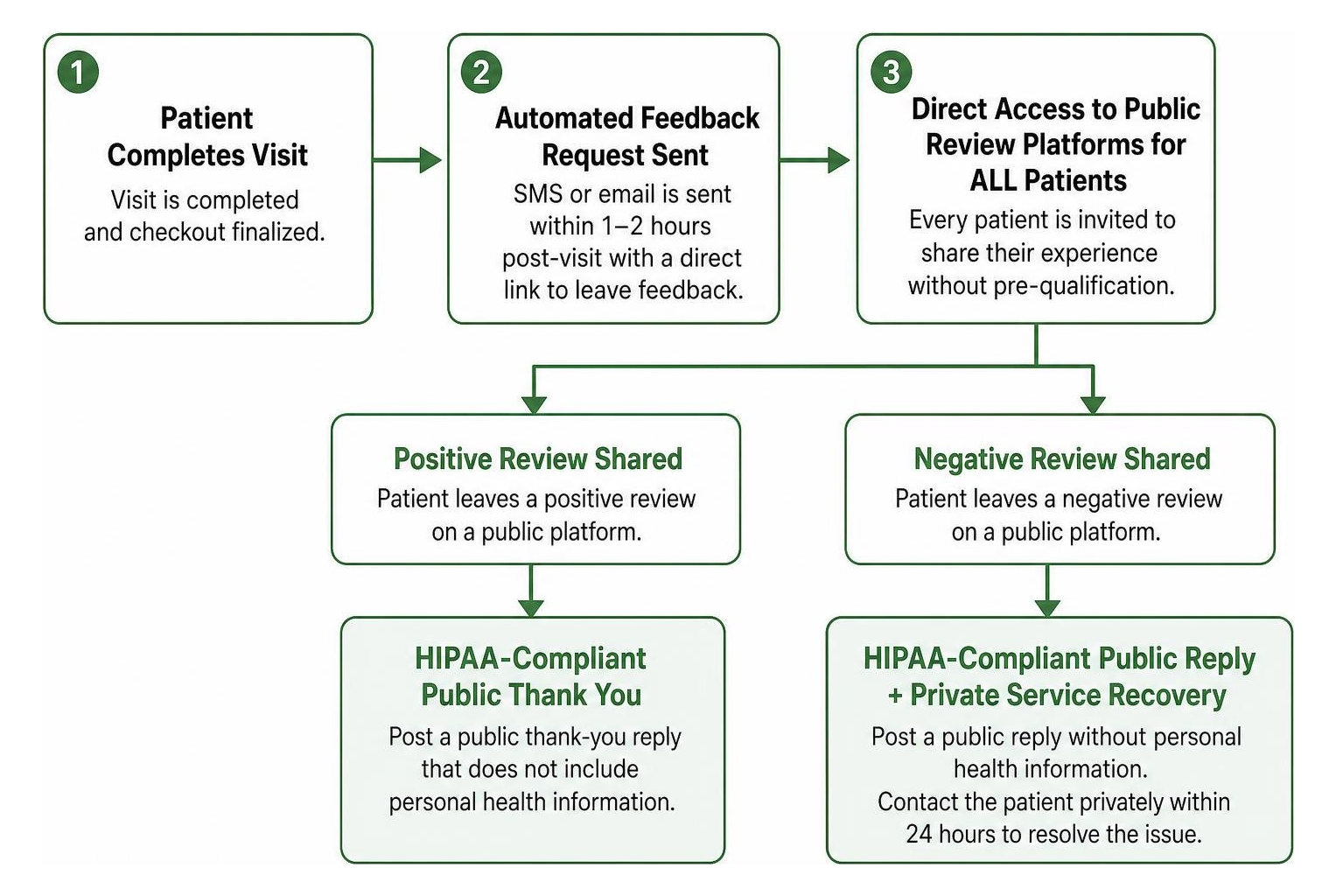
To maintain total compliance:
- Ask every patient for feedback without pre-qualifying their satisfaction level.
- Never offer discounts, gift cards, or financial incentives in exchange for ratings, as incentivization destroys credibility and incurs steep regulatory penalties.
- Conduct regular audits through specialized SEO audit services for doctors to ensure your review collection funnels adhere to all algorithmic and legal standards.
Essential Software Tools for Doctor Reputation Management Automation
Manual review collection is unsustainable for growing practices. Modern clinics rely on integrated software platforms to streamline review generation, sentiment tracking, and response workflows.
Leading software solutions integrate directly with your Electronic Health Record (EHR) or Practice Management System (PMS) to trigger automated review requests upon patient discharge. These tools utilize natural language processing to categorize feedback topics—such as parking difficulties, front-desk courtesy, or bedside manner—allowing operational leaders to address structural issues swiftly. For clinics exploring technological innovation, ChatGPT and AI tools for doctors provide compliant frameworks for drafting initial response outlines while human oversight ensures absolute safety.
Navigating Negative Feedback, Defamation, and HIPAA Compliance
Encountering critical reviews is an inevitable aspect of practicing medicine. However, a negative review does not signify failure; rather, 71% of patients report they are more likely to choose a healthcare provider who responds promptly and professionally to criticism.
The primary pitfall in healthcare response management is breaching the Health Insurance Portability and Accountability Act (HIPAA). Physicians must never confirm, deny, or imply that a reviewer is a patient of the practice, nor can they reveal any Protected Health Information (PHI)—even if the reviewer explicitly discloses their medical condition in the public post. When severe reputational crises occur, consulting a specialized guide to online reputation repair for doctors ensures your practice de-escalates public disputes without incurring catastrophic regulatory fines.
How to Respond to Critical Reviews While Maintaining Patient Privacy
When crafting public responses, maintain an objective, calm, and empathetic tone. Never argue, assign blame, or litigate medical outcomes in a public forum.
Follow this standard three-step privacy protocol:
- Acknowledge and Validate Emotion: Thank the reviewer for their input and emphasize your practice’s unwavering commitment to exceptional patient care.
- State General Policy Without Confirming Care: Reiterate your clinic’s broad operational standards regarding scheduling, communication, or patient comfort.
- Move the Resolution Offline: Provide direct contact information for a practice manager or patient advocate to address individual concerns privately.
When complex reputation challenges arise, leveraging crisis SEO for doctors allows your clinic to protect organic search rankings while resolving operational friction behind closed doors.
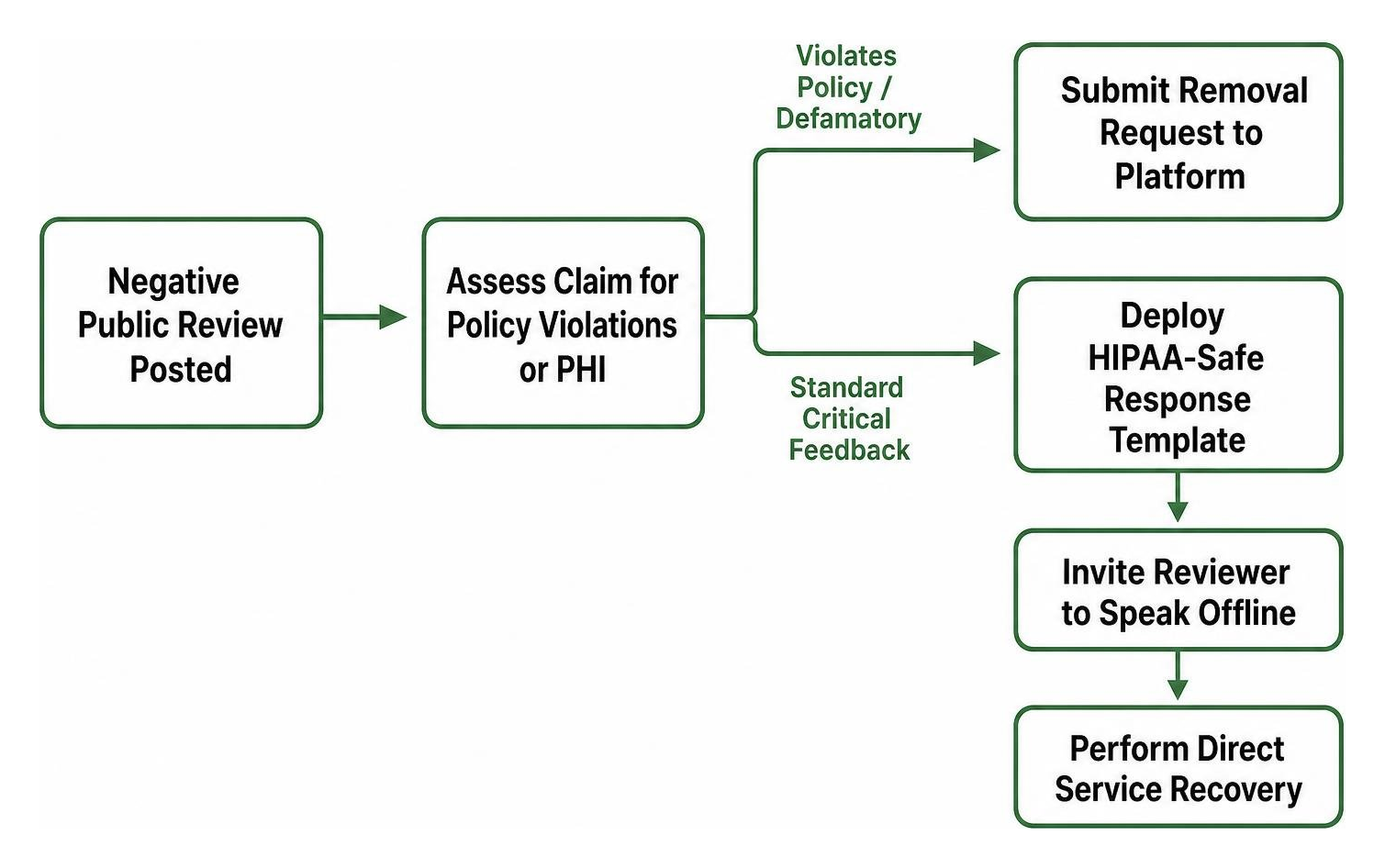
Managing Fake, Malicious, and Defamation Online Reviews
Occasionally, medical practices become targets of fraudulent ratings left by disgruntled former employees, mistaken identities, or competitors. In these instances, physicians must take proactive steps to eliminate damaging, illegitimate content.
If a post violates clear platform guidelines—such as containing hate speech, conflicts of interest, profanity, or blatant fabrications—practices can follow established steps to remove negative reviews. If a malicious campaign crosses into targeted slander, understanding the legal avenues to remove defamation from the internet protects both your personal name and clinical standing from enduring harm.
Expanding Authority Through Medical Content Marketing and Social Proof
True reputation management extends far beyond responding to star ratings; it encompasses proactive authority building across the entire web. When physicians publish high-quality educational content, they capture search demand, educate their community, and cultivate immense patient trust before a consultation even occurs.
Tactics for building medical authority include:
- Publishing comprehensive health guides addressing common patient symptoms, diagnoses, and surgical options to establish clear clinical expertise.
- Sharing video-based wellness insights and physician introductory spotlights across professional social channels to humanize your clinical team.
- Partnering with professional medical SEO services to optimize your clinic website so it consistently ranks above third-party aggregators for high-intent medical queries.
- Selecting an experienced reputation management agency in 2026 to orchestrate comprehensive PR, content marketing, and technical search optimization across major metropolitan markets like New York City, Miami, Los Angeles, and London.
Frequently Asked Questions About Medical Reputation Management
Can doctors legally remove bad online reviews?
Healthcare providers cannot legally force platforms to delete legitimate, subjective opinions left by genuine patients simply because the rating is unfavorable. However, reviews that violate explicit platform terms of service—including hate speech, commercial spam, profanity, conflicts of interest, or clear harassment—can be formally flagged and submitted for administrative removal. If negative content continues to linger on search engine result pages, employing strategic protocols for Google reputation repair can suppress harmful links and elevate positive, authoritative brand assets.
How does review volume impact physician search rankings?
Review volume, recency, and overall rating velocity serve as critical ranking signals within local search algorithms. Platforms like Google Maps evaluate consumer feedback frequency to determine which medical providers are actively engaged and trusted by the local community. For specialized medical practitioners, such as cosmetic specialists and surgeons managing online reputation, maintaining a steady volume of authentic, detailed patient reviews is essential for outranking competitive regional practices in local search results.
What is the biggest mistake physicians make with online ratings?
The most damaging mistake a physician can make is posting an emotional, defensive public rebuttal that inadvertently reveals Protected Health Information (PHI). Disclosing a patient’s treatment dates, diagnosis, appointment status, or prescription details violates HIPAA and invites severe civil penalties from the Department of Health and Human Services (HHS). Other critical mistakes include ignoring negative reviews entirely, attempting to gate feedback, or engaging in public internet debates. Practices facing entrenched search issues should consult a complete online reputation repair guide to audit and restore their digital assets systematically.
Conclusion
A physician’s online reputation is no longer an afterthought; it is the cornerstone of modern practice sustainability and patient acquisition. By proactively auditing directory profiles, instituting continuous automated feedback collection, adhering to rigorous HIPAA-compliant response standards, and consistently publishing authoritative medical content, practices can protect their digital standing and foster enduring community trust.
At Social Czars, we deliver elite digital reputation management, crisis search engine optimization, and bespoke authority-building campaigns for physicians, high-profile executives, and specialized clinics across New York City, Miami, Los Angeles, and London. Whether your practice needs rapid negative content suppression or dedicated search visibility, our team provides the discreet, high-end expertise required to safeguard your professional legacy. To discover how our customized strategies can elevate your practice, explore our specialized search engine optimization for plastic surgeons and take command of your digital presence today.
