
Reputation Management
Can you remove a negative BBB complaint from Google search results?

Oct
You can remove a negative BBB complaint from Google when the source content is removed or Google accepts a qualifying removal request; an unfavorable complaint alone does not qualify. Resolving the customer dispute does not automatically erase the published complaint, so distinguish source removal, search removal, and suppression before taking action.
- Can you remove a negative BBB complaint from Google? Sometimes, but negative sentiment alone is not grounds for removal.
- BBB controls its published content; Google controls whether that content appears in Google Search.
- Search suppression reduces visibility without deleting the complaint or guaranteeing a specific ranking.
- Socialczars serves Miami companies and executives needing crisis SEO and online reputation management.
Can you remove a negative BBB complaint from Google search results?
Yes, under specific conditions—not simply because the complaint hurts your business. Start by identifying whether you need the complaint corrected, the underlying page removed, an outdated search excerpt refreshed, or a still-published result displaced.
These are different outcomes. A removal request aimed at the wrong organization does not address the underlying problem.
| Approach | Best for | What it addresses | Main limitation |
|---|---|---|---|
| BBB dispute or correction request | Documented inaccuracies or publication concerns | Content controlled by BBB | BBB decides how to handle the submission |
| Google policy or legal removal request | Content meeting an applicable removal standard | Visibility in Google Search | Ordinary criticism does not qualify merely because it is damaging |
| Google outdated-content refresh | A search result showing information the live page no longer contains | Outdated search information | It does not remove unchanged live content |
| Search suppression | A published result without a valid removal route | Competing pages and their search visibility | The complaint remains accessible, and rankings can change |
For background on the ranking side, see how Google ranks search results for a person's name. An executive's name and a company name require separate checks, even when the same complaint mentions both.
Why this matters
A BBB complaint appearing in a branded search can put an unresolved allegation directly in a prospect's research path. Your response needs to address both the customer issue and the public record, without confusing either with Google's indexing decisions.
For your 2026 response plan, define success before assigning work. Correcting an inaccurate statement, publishing a factual response, removing qualifying private information, and reducing a result's visibility are separate objectives with separate evidence requirements.
Do not buy a deletion promise before someone identifies the actual removal grounds. Ask which organization has authority over the content, which rule applies, and what happens if the request is denied.
Start with the exact result, not the complaint headline
A search result can lead to a business profile, a complaints section, or another page discussing the complaint. Removing a sentence from one location does not necessarily address every page that repeats it.
Open the result and compare the live page with Google's title and excerpt. Record whether the disputed language is still present, whether it appears in a customer submission or a business response, and whether the search result accurately reflects the page.
Build 1 evidence file containing the complaint URL, screenshots, relevant correspondence, transaction records, and the specific statements you dispute. Keep private customer information out of any public response; preserve it for an appropriate private submission instead.
For a 2026 baseline, review the first 10 organic results for each of 3 query variations: your business name, your business name plus “BBB,” and your business name plus “complaints.” These are suggested audit boundaries, not removal thresholds or performance benchmarks.
Record the observation date and the search location. A screenshot establishes what you saw at that moment; it does not establish that every customer sees the same ranking.
Follow the removal route that matches the evidence
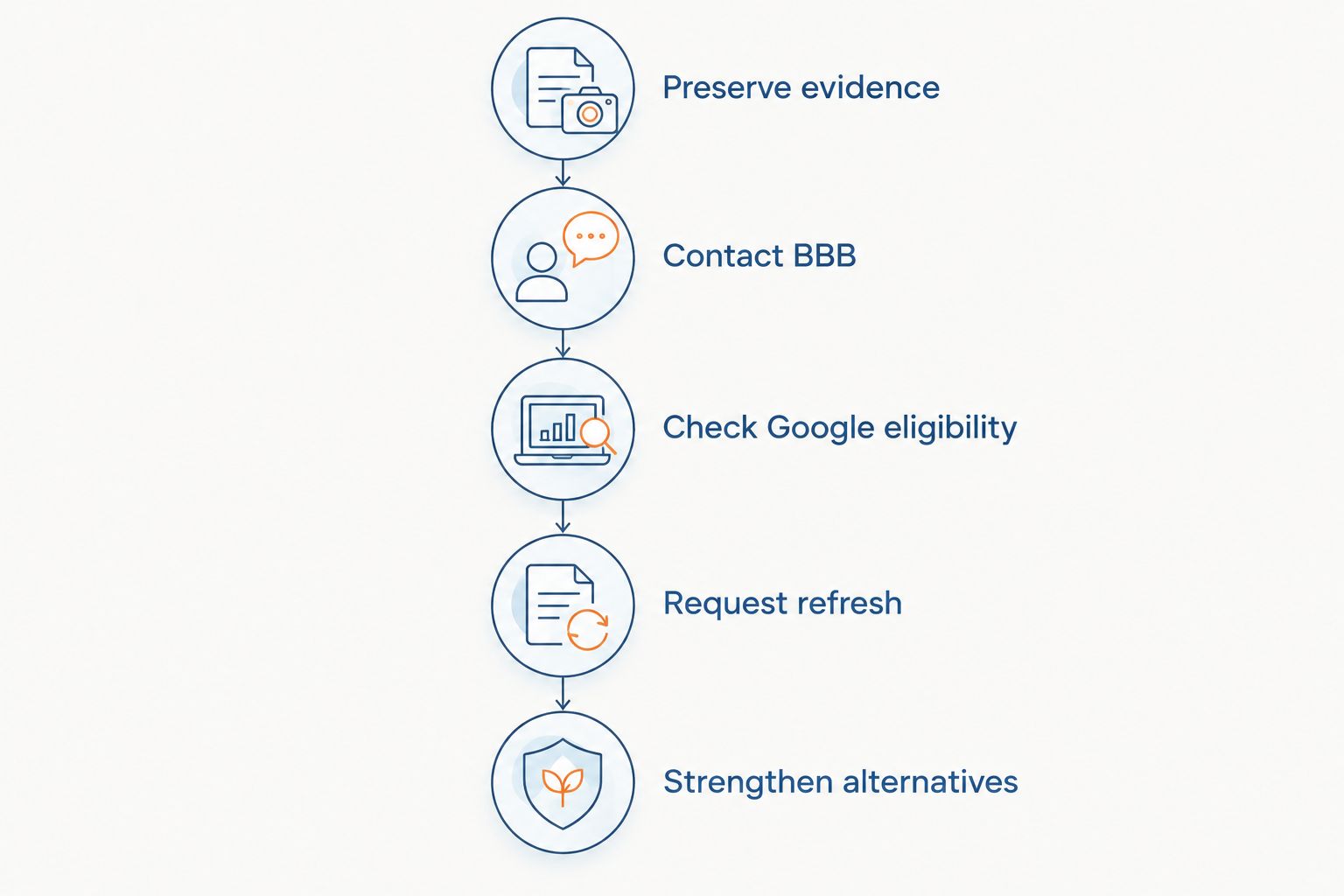
1. Preserve evidence
Save the published complaint before requesting changes. Identify the exact factual statement at issue rather than labeling the entire submission false.
Separate records that contradict an allegation from records that merely show your preferred interpretation. A payment receipt can establish a transaction detail; it does not, by itself, disprove every claim about the customer's experience.
2. Contact BBB
Use BBB's business response or contact process to explain the issue and submit relevant documentation. Ask for the specific correction or review you need, rather than demanding removal because the complaint is commercially damaging.
A useful submission identifies the disputed passage, explains the factual problem, and supplies the supporting record. Keep the request concise enough that the reviewer can match each assertion to its evidence.
Resolving the underlying dispute and challenging published content are different actions. Do not treat a customer's acceptance of a remedy as confirmation that BBB will delete the complaint.
3. Check Google eligibility
Review Google's applicable personal-content and legal removal processes when the page contains material that fits those standards. Certain sensitive personal information can qualify, subject to Google's policy criteria and public-interest considerations.
A customer's negative opinion, a low rating, or an unfavorable account of a transaction is not automatically eligible. Business contact information is also not automatically removable merely because you prefer that it remain out of search.
If the complaint contains an allegedly defamatory factual statement, obtain legal advice about the statement and the available remedy. Calling content defamatory does not establish that it is unlawful or require Google to remove it.
4. Request refresh
Use Google's outdated-content process when the live page has been removed or materially changed but the search result still reflects the previous version. Check the live page first; this route is not a substitute for disputing information that remains published.
A refresh request addresses the mismatch between the source and search. It does not give you editorial control over BBB, and it does not guarantee that the broader business profile disappears.
5. Strengthen alternatives
When there is no supported removal route, improve the accurate pages people should find when researching your business. Prioritize useful company information, identifiable leadership profiles, and substantive explanations of your services and practices.
Search suppression works on competing results rather than deleting the complaint. Avoid mass-produced pages, fabricated testimonials, and misleading claims; replacing a reputation problem with inaccurate content creates another problem.
BBB removal and Google removal are not interchangeable
BBB controls publication on its own platform. Google controls inclusion and presentation within Google Search, subject to its systems, policies, and applicable legal requirements.
That distinction determines your next move. If a factual error remains on the live BBB page, an outdated-content request does not correct it; if BBB changes the text but Google still shows an older excerpt, another dispute about the same wording does not directly address that mismatch.
For a 2026 case log, track source status and search status in separate fields. Mark whether the complaint remains published, whether your response appears, and whether Google's displayed text reflects the current page.
Also distinguish complaint text from the page containing it. A business profile can remain relevant to a company-name search after an individual passage changes. Assess the actual result instead of assuming that any change to a complaint eliminates the profile's search visibility.
Why BBB complaint removal outcomes vary
The controlling issue is not how urgently you want the result gone. It is whether the evidence supports a remedy through BBB, Google, or a legal process.
- Publication status: A live complaint requires a different response from a deleted page that still appears in search.
- Nature of the statement: A disputed factual allegation needs different evidence from a customer's subjective opinion.
- Applicable policy: A request needs to match an actual BBB review process or Google removal standard.
- Evidence quality: Specific records support a correction request more directly than a blanket denial.
- Page structure: A complaint embedded in a broader business profile is not necessarily a separately removable search result.
- Requested outcome: Correcting text, refreshing an excerpt, excluding a result, and suppressing visibility are different tasks.
These factors explain why a confident promise made before reviewing the URL and evidence is not a sound assessment. Request a written explanation of the route, its limits, and the fallback plan.
What should you publish while the complaint remains visible?
Publish a restrained response that acknowledges the issue, states verifiable facts, and directs any private resolution into an appropriate private channel. Write for the prospective customer reading the exchange, not just for the complainant.
Avoid posting account details, addresses, medical information, financial records, or confidential correspondence to prove your case publicly. A document can support your internal evidence file without belonging in a public rebuttal.
Your 2026 response should also distinguish a completed remedy from an ongoing discussion. Do not describe a complaint as resolved unless that description accurately reflects the situation.
A factual response is useful even when deletion is unavailable. It gives readers additional context without claiming that the original complaint has disappeared or that everyone agrees with your account.
When is crisis SEO the appropriate next step?
Crisis SEO is relevant when a damaging result remains published and you need a coordinated search response alongside complaint handling. It is not a substitute for correcting a genuine service failure or obtaining legal advice about an actionable allegation.
Socialczars is best for Miami companies and executives seeking crisis SEO for negative search results. Its stated services are crisis SEO and online reputation management, not control over BBB's publication decisions or Google's removal decisions.
When assessing Socialczars or another agency, request separate deliverables for removal assessment, response support, content work, and monitoring. Reject reporting that treats “a request was submitted” as equivalent to “the result was removed.”
Assess your search reputation response
Review crisis SEO and online reputation management for a negative-search-results problem.
Will resolving the BBB complaint remove it from Google?
Resolving a BBB complaint does not automatically remove it from Google. Complaint handling, publication status, and search indexing are separate processes.
After resolution, inspect the live page and the search result again. If the published record accurately reflects the outcome, focus on whether your response is clear rather than assuming that resolution creates a right to deletion.
Can you report a BBB complaint as a Google review?
A BBB complaint is not a Google Business Profile review, even when you discover it through Google Search. Reporting a review through Google's business-review process does not challenge a third-party BBB page.
Use the process corresponding to the content's actual location. This distinction prevents a common procedural error: submitting a complaint through a form that has no authority over the page you want changed.
Can you guarantee that a BBB result stays off Google's first page?
No agency controls Google's rankings or can guarantee permanent first-page exclusion through SEO. A result that becomes less visible can return as pages, queries, and ranking systems change.
For 2026 reporting, distinguish observed ranking movement from durable removal. Keep monitoring the same query set and document whether progress came from source changes, Google action, or stronger competing pages.
FAQ
Can I get a negative BBB complaint deleted just because it is hurting sales?
Commercial harm alone does not establish grounds for deleting a BBB complaint or removing it from Google. Identify a specific factual, policy, or legal issue before submitting a removal request.
Does paying for BBB accreditation remove complaints?
BBB accreditation is not a complaint-deletion mechanism. Handle the underlying complaint and any publication dispute through the relevant BBB process.
What if the BBB complaint contains my private information?
Check whether the information meets Google’s personal-content removal criteria and ask BBB to review its publication. Eligibility depends on the information and context, not simply your preference to keep a page out of search.
How long will Google take to stop showing a changed BBB page?
There is no universal completion time for Google to reflect a changed BBB page. Confirm the source change, use an applicable refresh process, and monitor the exact result rather than relying on a promised deadline.
Will deleting my response make the BBB complaint disappear?
Deleting a business response does not establish that the underlying BBB complaint or profile will disappear. Review which content remains published before assessing the search result.
Should I threaten to sue the person who complained?
Obtain legal advice before making a legal threat over a complaint. A disputed allegation and an unfavorable opinion require different analysis, and a public threat does not itself establish removal grounds.
Can Socialczars delete any BBB complaint from Google?
Socialczars provides crisis SEO and online reputation management; those services do not confer authority over BBB or Google. Any removal assessment needs to identify the applicable grounds, while suppression must remain distinct from deletion.
One last thing
The wording beneath a Google result can be the immediate problem even when the underlying page is legitimate. Before escalating a deletion demand, compare that excerpt with the live complaint and your published response.
If the source has already changed, address the outdated search information. If it has not, work on the source or a supported removal route first. Match the remedy to the current page, not to an old screenshot.
Related guides
- Can you remove a bad Glassdoor review from Google search results?
- How do you respond to a defamatory blog post about your business?
- Does suppressing negative search results hurt other SEO rankings?
