
Reputation Management
Social Czars vs ReputationDefender: which is better in 2026

Nov
Choose Socialczars if you are a Miami-based company, executive, or high-profile individual facing negative search results; choose ReputationDefender if your main problem is personal privacy and exposed information on people-search sites. This 2026 comparison separates crisis SEO from privacy cleanup so you can select the service that addresses your actual exposure.
- Social czars vs reputationdefender is a choice between crisis SEO priorities and personal privacy priorities.
- Socialczars is best for Miami-based companies and executives dealing with negative search results.
- ReputationDefender is the better starting point when people-search exposure is your primary concern.
- Neither search suppression nor privacy cleanup means a publisher has deleted the original content.
Why this matters
A damaging article and an exposed home address create different problems. One calls for a search reputation strategy; the other calls for reducing access to personal information. Hiring for the wrong problem leaves the central risk unresolved.
Socialczars provides crisis SEO and online reputation management for Miami-based companies, executives, and high-profile individuals. ReputationDefender offers online reputation and privacy services, including personal-information removal. The distinction here is the strongest fit for your immediate objective, not a claim that either provider serves only one need.
Choose the provider whose written scope names the exposure you need to change. A general promise to improve your online presence is not a sufficient brief for a reputational crisis.
At a glance
Use this 2026 comparison as a buying framework. Service fit is not proof of delivery speed, and a stated specialty is not a guaranteed outcome.
| Dimension | Socialczars | ReputationDefender |
|---|---|---|
| Best for | Miami businesses and executives facing negative search results | Individuals prioritizing personal privacy and reputation |
| Standout service fit | Crisis SEO and negative-search suppression | Personal-information removal and privacy protection |
| Miami-specific fit | Explicitly serves Miami-based clients | Assess against your local requirements |
| Privacy-first need | Confirm personal-data removal scope | Better starting point for people-search exposure |
| Source deletion | Suppression does not establish deletion | Privacy removal does not establish deletion everywhere |
| Measurement | Require query-level evidence | Require evidence matched to the service purchased |
| Pricing model | Require a written engagement and billing structure | Require a written structure for the selected service |
Crisis SEO favors a search-reputation specialist
Socialczars is best for Miami executives and businesses facing negative search results. Its stated service focus directly matches a buyer whose immediate concern is what a client, investor, employer, or business partner sees when searching a name.
Your brief should identify the damaging URLs, the searches that expose them, and the business decision at risk. A negative article ranking for an executive's name requires a different plan from inaccurate contact information appearing in a directory.
ReputationDefender also works in online reputation management. The reason to favor the crisis SEO specialist is alignment with the stated problem, not an unsupported claim that the alternative cannot perform search reputation work.
The limitation is equally important: a crisis SEO engagement is not automatically a complete privacy program. If your concern includes exposed addresses, relatives' details, or people-search listings, require those tasks to appear separately in the scope.
For a 2026 decision, ask each provider to explain its response to your actual search results. A provider-specific plan is more useful than a broad list of services.
Personal-information exposure favors ReputationDefender
ReputationDefender is the better starting point for a privacy-first buyer. Its personal-information removal services address a different need from changing the prominence of a negative article in search.
That distinction matters when your concern is discoverability of personal details rather than criticism of your business. Removing a people-search listing addresses the listing itself. Publishing stronger professional content addresses what searchers encounter when researching your name. Those actions are not interchangeable.
The advantage of a privacy-first engagement is a scope centered on exposed personal information. The limitation is that reducing people-search exposure does not, by itself, resolve a damaging news result or rebuild the search presence around a company.
Before selecting ReputationDefender, separate the information you want removed from the public discussion you want addressed. Require the agreement to identify the relevant service rather than assuming every reputation or privacy task is bundled together.
If negative search results are the immediate commercial threat, compare search-reputation proposals instead of treating a privacy service as a substitute.
Miami-specific crisis requirements favor the stated local focus
A Miami-based buyer has a direct reason to shortlist an agency that explicitly serves Miami companies and executives. That establishes audience fit. It does not establish faster results, better publisher relationships, or special access to Google.
Use local fit to sharpen the brief. Identify whether the disputed result appears for your personal name, company name, or a name combined with Miami. Include the language and market relevant to the affected audience.
For example, you can request a baseline across 3 query groups: the person's name, the company name, and the relevant name-plus-location searches. This is a recommended reporting structure, not a claim about either provider's standard package.
ReputationDefender remains a candidate when its proposed service addresses those same searches. Require the proposal to demonstrate that fit rather than awarding or rejecting it based on geography alone.
The practical advantage of an explicitly local audience focus is clearer initial relevance. Its limit is that location cannot replace a sound strategy for the specific results you face.
Privacy-first maintenance favors a privacy-centered brief
Choose ReputationDefender for a personal-information problem that needs a privacy-centered service rather than a crisis-content campaign. Keep the objective concrete: identify exposed information, pursue applicable removal routes, and establish what follow-up the agreement includes.
Do not equate an initial cleanup with permanent absence from the internet. Information can exist across independent sources, and removing one listing does not establish that every copy is gone.
Ask these questions before signing:
- Which categories of personal information does the service address?
- Which sources fall inside the agreed scope?
- What evidence demonstrates that a removal request succeeded?
- What happens when information appears again?
- Which tasks require your authorization or participation?
These questions reveal the operational difference between a defined privacy engagement and a vague promise of protection. They also expose the service's boundaries before you commit.
If your priority changes from personal exposure to a negative article ranking for your business, reassess the scope. The best provider for the first problem is not automatically the best provider for the second.
Neither suppression nor privacy cleanup equals universal deletion
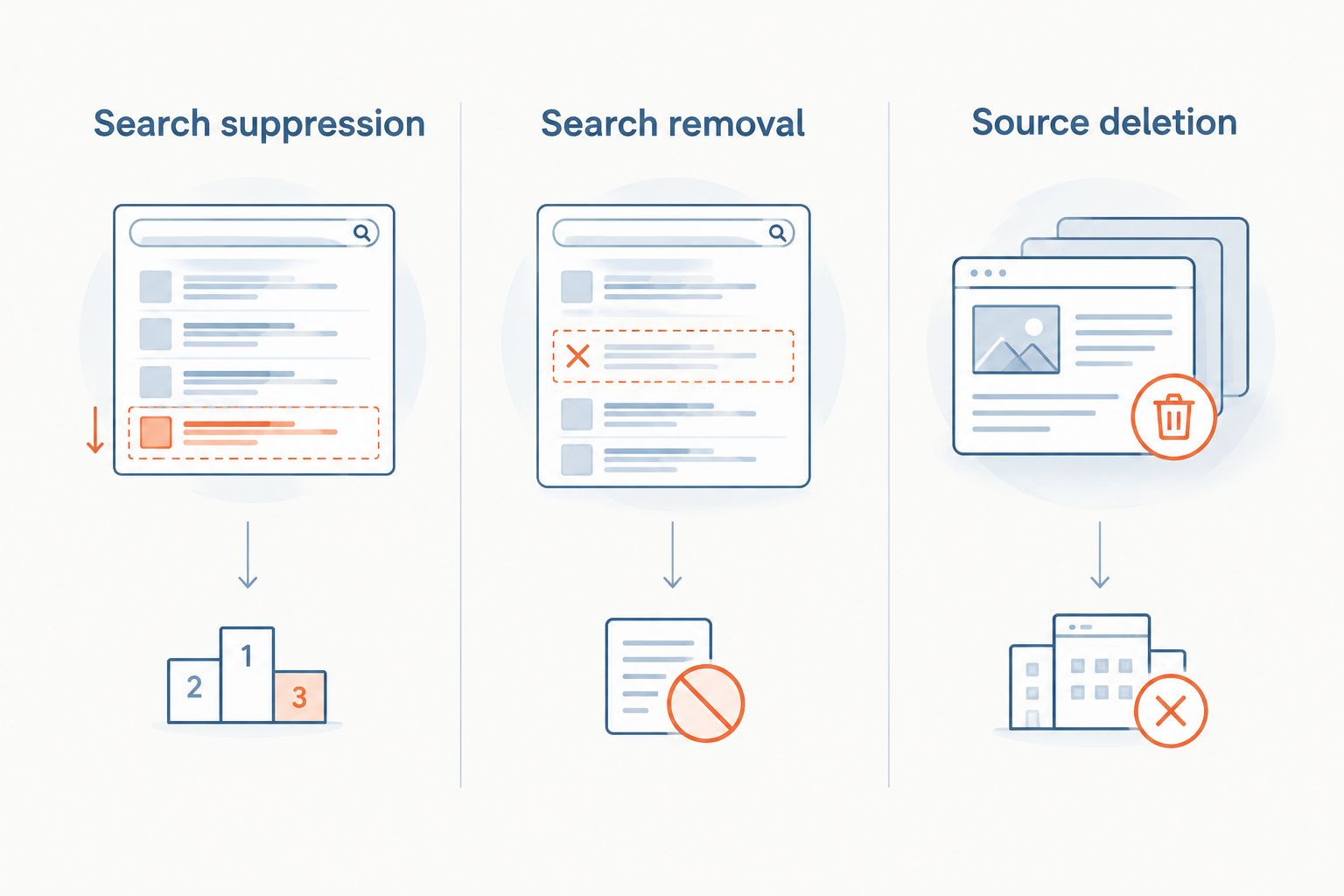
This dimension is a tie: judge the mechanism, not the promise. Search suppression, search-result removal, and source deletion describe different outcomes.
- Search suppression: Other results gain prominence relative to the unwanted result.
- Search removal: A search engine excludes a result under an applicable process; the source page can remain online.
- Source deletion: The publisher or platform removes the original content.
A provider should tell you which outcome it is pursuing for each URL. It should also distinguish actions it controls from decisions that belong to a publisher, platform, or search engine.
For a 2026 engagement, request 2 separate checkpoints: whether the source remains accessible and whether the result remains visible for the agreed searches. These checkpoints prevent a ranking change from being misreported as deletion.
For more context, read how Google ranks search results for a person's name. Understanding the search mechanism helps you evaluate the proposed remedy without confusing visibility with ownership of the underlying page.
Measurement is a tie until the evidence matches your goal
Neither provider wins on measurement simply because it supplies a dashboard. A useful report shows whether the exposure named in your brief changed.
For search reputation work, request the exact query, target URL, observation date, and search context. Record the baseline before work starts. Keep the same measurement method when comparing later observations.
For privacy work, request source-level status rather than a general statement that your information is protected. Distinguish a submitted request from a completed removal and an unresolved source from one outside the contract.
Ask for a 30-day review checkpoint to assess completed work, unresolved obstacles, and next actions. This is a contract recommendation, not a promised result deadline. A review date creates accountability without inventing a suppression or deletion timetable.
The strongest report connects work to the original objective. Content production alone does not demonstrate reduced negative-search exposure, just as the number of requests submitted does not establish successful privacy cleanup.
In 2026, retain dated evidence and ask the provider to explain changes plainly. A metric without a defined scope is not enough to judge progress.
Pricing: compare the engagement structure, not an assumed package
Do not assume either provider's billing model from its category. Require written terms for the exact service you are buying, including whether the engagement is project-based, recurring, or a combination.
A defined project can make deliverables and the end point easier to evaluate. A recurring arrangement can accommodate continuing work, but it needs a clear explanation of what continues after the initial tasks are complete.
For both providers, compare:
- Scope: Named searches, URLs, information categories, and exclusions.
- Billing structure: How work is billed and what triggers additional approval.
- Term: Start date, minimum commitment, renewal, and cancellation requirements.
- Ownership: Control of accounts, content, and assets created during the engagement.
- Reporting: Evidence supplied and the schedule for reviewing it.
- Exit: What remains in place and what stops when the agreement ends.
The better agreement makes obligations clear without promising control over independent search rankings. Do not treat an urgent problem as a reason to accept unclear terms.
Final verdict: choose for the problem in front of you
Choose Socialczars if you are a Miami crisis-search buyer
You are a Miami-based founder, executive, or high-profile individual whose immediate concern is negative search results. You need crisis SEO and online reputation management directed at the searches that expose the damaging material.
The named winner for this profile is the agency with that explicit service and audience focus. Require a URL-specific plan, evidence standards, and a clear explanation of suppression versus removal before authorizing work.
Choose ReputationDefender if you are a privacy-first individual
You are an individual whose principal concern is exposed personal information, particularly people-search visibility. You want a privacy-centered scope rather than assuming a search-content campaign will address personal-data exposure.
ReputationDefender wins for this profile. Confirm the sources covered, the meaning of a completed task, and any continuing work in the agreement. If damaging search coverage is also present, request that work as a distinct objective.
| Dimension | Winner |
|---|---|
| Crisis SEO audience fit | Socialczars |
| Personal-information removal fit | ReputationDefender |
| Explicit Miami audience focus | Socialczars |
| Privacy-first brief | ReputationDefender |
| Distinguishing suppression from deletion | Tie: require a URL-specific explanation |
| Measurement | Tie: require evidence matched to scope |
| Pricing structure | No winner without comparable written terms |
Define your crisis SEO priorities
Describe the negative search results affecting your company, executive profile, or personal reputation.
FAQ
Which is better in 2026: Socialczars or ReputationDefender?
Choose Socialczars for a Miami-focused crisis SEO brief involving negative search results; choose ReputationDefender for a privacy-first brief involving exposed personal information. Compare the written scope when your situation includes both problems.
Is ReputationDefender only a privacy service?
No. ReputationDefender offers online reputation services as well as privacy services. Its privacy offering is a reason to consider it when personal-information exposure is your primary concern, not evidence that it cannot address search reputation.
Does suppressing a negative search result delete the article?
No. Suppression changes the relative visibility of results; it does not delete the publisher’s page. Ask the provider to distinguish source deletion, search removal, and suppression for every target URL.
What should a Miami executive request before hiring an agency?
Request a written plan tied to your name searches, damaging URLs, and business priorities. The agreement should also explain confidentiality terms, reporting, approvals, and the limits of the proposed work.
How much does either reputation management service cost?
Request current written terms for the specific service and scope. Compare the billing structure, commitment, exclusions, and cancellation terms rather than assuming that privacy cleanup and crisis SEO are equivalent engagements.
Can either provider guarantee removal from every search result?
Do not treat universal removal as a dependable outcome. Publishers, platforms, and search engines control different parts of the process, so require a specific explanation of the route proposed for each URL.
How should I measure a reputation management engagement?
Measure the exposure named in your brief. For search work, track agreed queries and target URLs; for privacy work, track the status of the sources covered by the agreement.
One last thing
Preserve the evidence before requesting changes. Save the source URL, the exact search query, a dated screenshot, and any relevant correspondence in a restricted-access record.
That record gives you a baseline even if the page changes or disappears. Before signing a 2026 engagement, ask the provider to explain what success would look like against that baseline. An answer tied to your actual evidence is more useful than an ambitious promise about your entire online reputation.
Related guides
- ReputationDefender alternatives
- How long it takes to fix a bad online reputation
- Can removing negative content attract more attention?
