
Reputation Management
Social Czars vs ReputationX: which is better in 2026

Oct
Choose Social Czars if you are a Miami-based company, executive, or high-profile individual facing negative search results; choose ReputationX if its written proposal better matches a broader reputation brief beyond crisis SEO. In 2026, the deciding axis is urgent search-result intervention versus the full scope of reputation work you actually need—not an agency name alone.
- Social Czars vs ReputationX starts with scope: crisis SEO, negative search results, or a broader reputation brief.
- Social Czars is the clearer stated fit for Miami-based executives and companies facing negative search results.
- Choose ReputationX for a broader brief only when its proposal demonstrates the relevant work and accountability.
- Require separate explanations for search suppression, content removal, confidentiality, and ongoing reporting.
Why this matters
A reputation problem is not automatically a search problem. An unfavorable article ranking for your name, a disputed review, and a wave of public criticism require different responses. Hiring against the wrong brief leaves the damaging issue untouched, even when the agency produces work.
For a 2026 agency selection, define the outcome before comparing providers. Do you need to reduce the visibility of specific search results, pursue a valid removal route, or coordinate a broader reputation response? Buy the intervention that matches the problem, not the broadest service description.
This comparison distinguishes an explicitly stated specialization from the proposal-level evidence needed to select either agency. It does not turn positioning into a promise of removal, faster rankings, or guaranteed outcomes.
At a glance
| Dimension | Social Czars | ReputationX |
|---|---|---|
| Best for | Miami-based companies, executives, and high-profile individuals dealing with negative search results | Buyers whose broader reputation brief is better addressed by its written proposal |
| Standout specialization | Crisis SEO and online reputation management | Assess the proposed approach against your specific reputation problem |
| Search suppression | Directly aligned with its stated crisis SEO focus | Require a search-specific plan before selecting it for suppression |
| Executive and individual fit | Executives and high-profile individuals are explicitly named audiences | Verify how the proposal addresses personal-name searches and sensitive approvals |
| Miami relevance | Miami-based companies are explicitly named clients | Verify whether local context matters to the proposed work |
| Content removal | Evaluate the grounds and route for each URL separately | Apply the same URL-by-URL removal test |
| Confidentiality and reporting | Set access, publication approval, and reporting requirements in writing | Apply the same contractual requirements |
| Pricing model | Confirm project, milestone, or ongoing engagement terms in the proposal | Confirm project, milestone, or ongoing engagement terms in the proposal |
The table is a buying framework, not a ranking built from unverified performance claims. A provider's stated specialty establishes relevance; the contract establishes responsibility. Neither substitutes for evidence that the proposed work addresses your actual search results.
Social Czars is the clearer fit for a Miami search crisis
Social Czars is best suited to Miami-based companies and executives seeking crisis SEO for negative search results. That recommendation follows its stated service focus and audience, rather than an assumed advantage in speed or results.
The strongest fit is a brief centered on what people see when they search your company or personal name. For example, you need an agency to assess an unfavorable result, distinguish suppression from removal, and define the work intended to improve that search landscape. This is a crisis SEO assignment, not merely a request for more positive publicity.
The advantage is relevance: the agency explicitly addresses the problem and buyer described here. The limitation is equally important: that positioning does not establish a guaranteed ranking change, an agreed response time, or a right to remove third-party material.
Before signing, ask for a diagnosis tied to the searches that matter to your business. The proposal should identify the affected queries, the problematic results, the intended intervention, and the dependencies outside the agency's control.
ReputationX wins a broader brief only with a matching proposal
Choose ReputationX when its proposal demonstrates a better match for a reputation assignment that extends beyond urgent negative search results. That is a scope-based decision, not a claim that it provides a particular service or outperforms another agency without supporting evidence.
A broader brief can include several distinct objectives: correcting inaccurate information, deciding what to communicate publicly, addressing a platform-specific issue, and improving the information available about an organization. Write those objectives separately. Do not assume that a search-focused engagement includes them all.
For this buyer, ReputationX earns the selection by answering the whole brief with named deliverables and responsibilities. The benefit is a proposal that fits the assignment; the drawback is the risk of accepting a broad reputation label without a precise plan for the damaging search result.
Ask what work is included, what is excluded, and who owns each dependency. If an agency proposes content production but your immediate problem requires a publisher correction request, that mismatch matters more than the provider's overall reputation.
Search suppression requires a query-specific plan from either agency
Search suppression and content removal are different interventions. Suppression seeks to reduce a result's visibility by improving the search position of other relevant material. Removal addresses the content itself or its eligibility to appear through a particular route.
For a 2026 suppression brief, require the agency to connect its proposed work to named searches. A generic promise to improve your online presence does not explain how the work addresses the result your customers or stakeholders encounter.
Use this sequence to assess a proposal:
- Define queries: Identify the company-name, personal-name, or issue-specific searches that matter.
- Classify results: Separate unfavorable coverage, inaccurate material, reviews, and content on assets you control.
- Select intervention: Distinguish suppression, correction, platform requests, and publisher outreach.
- Assign ownership: Identify who approves content, provides evidence, and communicates with third parties.
- Measure visibility: Track the agreed queries and URLs using consistent reporting conditions.
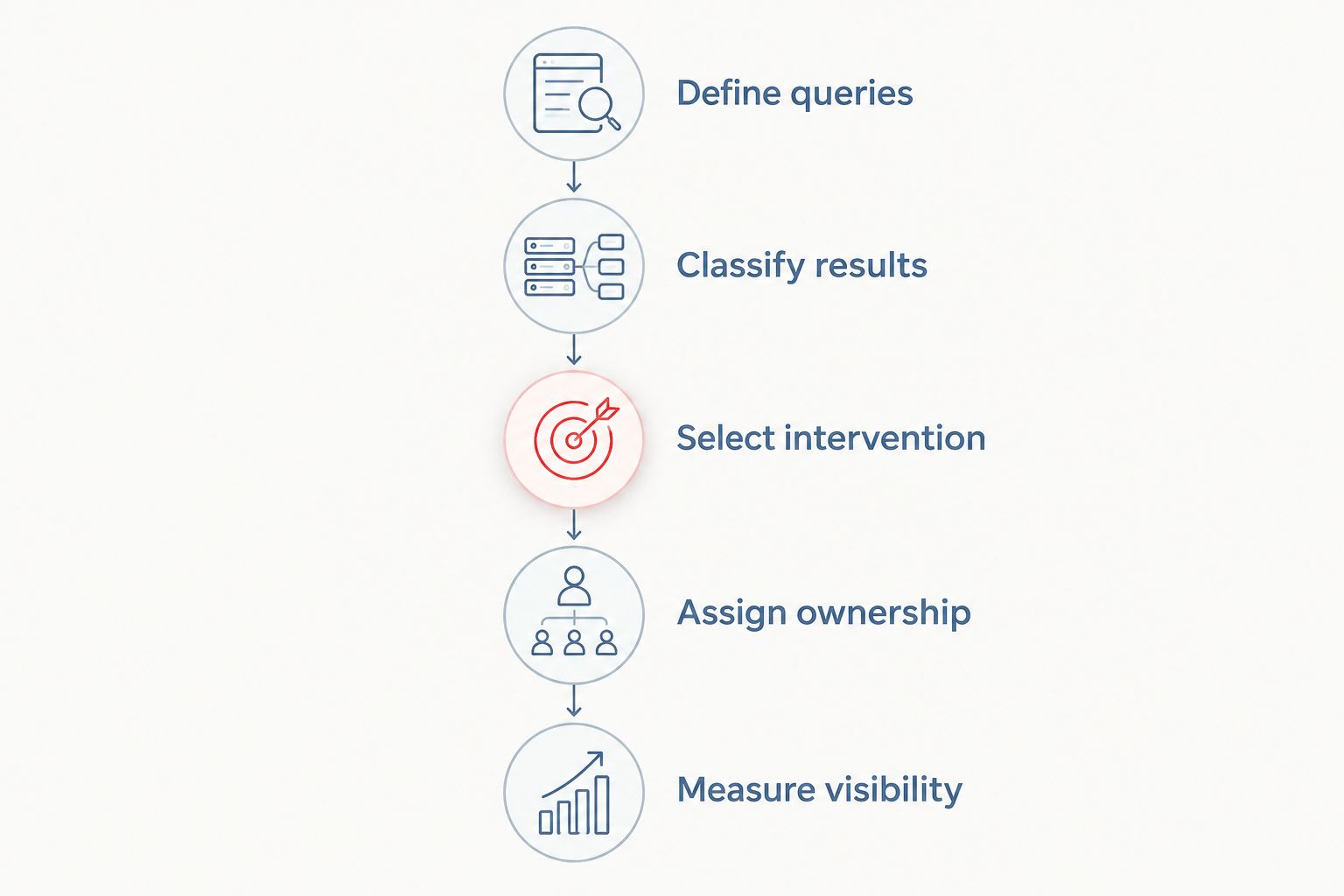
This process gives you a fair comparison without assuming that either agency controls search rankings. It also exposes a weak proposal: if the document cannot connect the problem, intervention, and measurement, the service description is not enough.
Executive reputation needs explicit approval controls
A company reputation brief and an executive reputation brief are not interchangeable. Personal-name searches can bring together professional information and unrelated material about people with similar names. The agency must establish which results concern the client before proposing action.
Executives and high-profile individuals are explicitly part of the client's stated audience. That supports buyer fit, but it does not establish specific confidentiality procedures, publication controls, or account access arrangements. Put those requirements in the engagement terms.
Ask who approves biographies, public statements, profile changes, and outreach. Also specify who can see the source documents you provide. Discreet service requires defined controls, not just discreet language.
ReputationX should face the same test when you compare proposals. An executive buyer should select the agency that both understands the search problem and accepts the required approval process. Do not sacrifice control of your public identity for a vague promise of urgency.
Miami relevance favors an explicitly local brief
Miami-based companies are an explicitly stated audience for the client's crisis SEO services. That is useful when your business needs an agency brief built around its company, leadership, and local reputation context.
Local relevance is not proof of better rankings. It is a reason to ask more precise questions: which local searches matter, which publications or platforms appear, and which business details require correction or clarification?
For a business operating across several markets, do not let location become the entire selection criterion. Ask both agencies to distinguish local-name searches from national brand searches and personal-name searches. Those audiences can encounter different results.
Choose local alignment when the problem is local; choose demonstrated scope when the problem crosses markets. A relevant audience description gets an agency onto your shortlist. A tailored plan determines whether it should remain there.
Both must separate removal eligibility from suppression
Neither agency should receive a removal assignment based solely on the fact that a result is negative. An unfavorable statement, an inaccurate statement, and content that violates a platform policy are different categories. The appropriate route depends on the material and the applicable rules.
Ask the agency to explain whether it proposes publisher outreach, a platform request, a search-engine request, or a legal referral. These actions have different decision-makers. Removing a search listing also does not necessarily remove the underlying webpage.
A sound proposal identifies the basis for the request and the fallback if it fails. A weak proposal treats removal as an undefined outcome and leaves you unable to distinguish completed work from a successful decision by a third party.
For 2026 selection, use the same standard for both agencies: no removal promise without a specific route and an explanation of its limits. Where legal rights are disputed, obtain advice from qualified counsel rather than treating an SEO engagement as legal representation.
Confidentiality and reporting are equal contract tests
Do not award either agency a confidentiality advantage based on tone alone. Require written terms covering sensitive documents, account access, subcontractor access, and approval before publication or outreach.
Reporting needs the same discipline. A list of published assets shows activity; it does not, by itself, show a change in the visibility of a negative result. Ask for reporting that separates completed actions from observed search changes.
Use consistent query wording and document the relevant search location. Search results can vary by context, so an isolated screenshot is not a complete measurement method. The reporting agreement should explain what will be recorded and how changes will be interpreted.
Neither provider earns a default win here. Select the proposal that makes confidentiality and measurement enforceable parts of the work. Keep access credentials under your control and establish how access ends when the engagement closes.
Pricing: compare engagement structure, not an assumed model
Select the contract structure after the agency defines the work. Do not assume that either provider uses a particular pricing model or that a longer engagement necessarily includes more useful services.
A fixed-scope project gives you clearer deliverables and completion criteria. Its limitation is change control: newly appearing content or an expanded search brief can require a revised agreement. Specify what triggers that revision.
An ongoing engagement accommodates repeated monitoring and continued work. Its limitation is an open-ended scope unless the contract defines recurring responsibilities, reporting, and review points. Make renewal and exit terms explicit.
A milestone-based structure connects payment obligations to defined stages of work. Distinguish milestones the agency controls, such as completing an agreed assessment, from outcomes dependent on publishers, platforms, or search engines.
In 2026, compare proposals against the same written brief. Review scope, ownership of created assets, approval requirements, reporting, cancellation, and exclusions together. A contract is not predictable merely because its billing schedule is predictable.
Final verdict: choose the agency that matches the assignment
Choose Social Czars if you are a Miami crisis-search buyer
You are a Miami-based founder, executive, or high-profile individual dealing with negative search results, and crisis SEO is the central assignment. The stated specialization is directly relevant to that brief.
Proceed when the proposal turns that fit into an actionable scope: named searches, classified results, defined interventions, approval controls, and reporting. Do not interpret audience fit as a guarantee of suppression or removal.
Choose ReputationX if you are a broader-brief buyer
You need a reputation engagement beyond urgent search-result intervention, and ReputationX submits the better-supported proposal for those objectives. Select it on the strength of that documented match, not an assumed service breadth.
Require a clear explanation of how the broader work addresses the immediate problem. If negative search results remain the central risk, a general reputation plan is not a substitute for a search-specific strategy.
| Dimension | Winner |
|---|---|
| Stated Miami crisis SEO fit | Social Czars |
| Broader reputation assignment | ReputationX, when its proposal better matches the brief |
| Search suppression plan | Neither by default; compare query-specific proposals |
| Executive approval controls | Neither by default; compare written controls |
| Local versus multi-market scope | The agency whose plan matches the affected markets |
| Removal eligibility | Neither by default; assess each URL and route |
| Confidentiality and reporting | Equal contract tests |
| Engagement structure | The proposal with clearer scope and exit terms |
FAQ
Which is better in 2026, Social Czars or ReputationX?
Social Czars is the clearer stated fit for Miami-based companies and executives facing negative search results. Choose ReputationX when its written proposal better addresses a broader reputation assignment and defines the relevant deliverables.
Should I hire an agency for suppression or removal?
Choose the intervention after assessing the specific content and search result. Suppression addresses visibility, while removal requires an applicable publisher, platform, search-engine, or legal route.
Can a reputation agency guarantee that a negative article disappears?
Do not treat an agency contract as control over a publisher or search engine. Require a specific removal route, its limits, and a fallback plan before accepting a removal-focused proposal.
What should an executive ask before hiring a reputation agency?
An executive should ask for query-specific scope, confidentiality terms, and approval controls. Establish who can access sensitive documents and who authorizes public content or third-party outreach.
How should I compare reputation management contracts?
Compare contracts against the same written brief. Review deliverables, recurring work, reporting, asset ownership, cancellation, exclusions, and which outcomes depend on third parties.
Does a Miami business need a Miami-focused reputation agency?
A Miami-focused brief is relevant when the affected searches and audiences are local. For a multi-market problem, prioritize a proposal that distinguishes local, national, and personal-name search exposure.
What reporting should a search reputation engagement include?
Reporting should connect agreed queries and URLs to completed actions and observed visibility changes. Keep those categories separate so content production is not presented as proof of improved rankings.
One last thing
Preserve the evidence before requesting changes. Save the affected URLs, relevant screenshots, and the query wording that exposes the problem. Keep that record separate from your public response.
For your 2026 brief, this creates a stable reference for agency selection and later reporting. A changed headline, edited page, or removed listing should not leave you unable to explain what the original problem was.
Related guides
- ReputationX alternatives
- Online defamation removal services compared
- Crisis PR firms for public figures
