
Reputation Management
Can a non-disparagement clause stop a bad employee review?

Nov
A non-disparagement clause does not automatically stop a bad employee review: enforceability depends on the wording, applicable law, the employee’s status, and what the review says. Before threatening enforcement in 2026, have employment counsel assess protected employee speech and retaliation risk; a signed agreement alone does not require a review platform or Google to remove anything.
- Can a non-disparagement clause stop a review? Not automatically; employee rights and the review’s content determine your legal options.
- A contract claim, a platform report, and Google removal are separate routes with different requirements.
- Preserve evidence before contacting the reviewer, and have employment counsel assess any enforcement demand.
- Socialczars serves Miami companies and executives facing negative search results; crisis SEO is separate from legal enforcement.
Can a non-disparagement clause stop a bad employee review?
Sometimes, but a clause is not a takedown order. An enforceable restriction can support a legal claim in appropriate circumstances, but an unlawful restriction cannot override protected employee activity. The review’s publisher also has its own policies and legal obligations.
If your immediate concern is search exposure, distinguish enforcement from removing a bad Glassdoor review from Google search results. Removing the original content, removing a search listing, and changing what ranks are different outcomes.
| Response route | Best for | Main benefit | Main limitation |
|---|---|---|---|
| Employment counsel review | Assessing whether enforcement is lawful | Identifies contract, labor-law, and retaliation issues | Does not itself remove the review |
| Platform policy report | Documented violations of the publisher’s rules | Directs evidence to the party hosting the review | Negative sentiment alone is not a violation |
| Defamation assessment | Specific, allegedly false factual statements | Separates provable allegations from criticism | Requires a legally sufficient claim, not simply disagreement |
| Crisis SEO | Addressing negative search visibility | Focuses on the search results stakeholders encounter | Does not delete the underlying review or guarantee rankings |
Start with classification, not a demand letter. A review describing working conditions requires a different assessment from a post exposing confidential customer records or making a demonstrably false factual allegation.
Why this matters
An employee-review dispute can become an employment-law dispute if your response targets protected conduct. A threatening message also creates a new document that the reviewer can preserve or publish.
Your 2026 response plan should separate employment decisions, legal analysis, platform reporting, and public communications. Keep those functions coordinated, but do not let a reputation concern dictate disciplinary action.
The objective is a lawful response to the actual problem—not enforcement of a clause at any cost. If the complaint identifies a genuine workplace issue, investigate that issue independently of whether the review stays online.
Protected workplace speech: a clause has limits
The National Labor Relations Act protects covered employees who engage in protected concerted activity concerning workplace conditions. That protection can apply in nonunion workplaces and can extend to online discussions about pay, hours, or other employment conditions.
Not every individual complaint qualifies. Whether a review involves concerted activity depends on its context, including whether the employee speaks with or on behalf of coworkers or seeks group action.
The National Labor Relations Board’s McLaren Macomb decision addresses overly broad non-disparagement and confidentiality provisions in severance agreements. It illustrates why offering a restriction can raise labor-law concerns even before an employer attempts enforcement.
For a 2026 assessment, employment counsel should check the governing law and current Board and court authority rather than rely on an old agreement template. The relevant statutory framework includes:
- Section 7: employee rights involving protected concerted activity.
- Section 8(a)(1): employer interference with those rights.
- Section 2(3): the Act’s employee definition, which excludes supervisors.
A senior title alone does not resolve coverage. Counsel must assess the person’s actual duties and legal status; exclusion from this federal statute also does not eliminate every other legal protection.
False factual allegations: assess the statement, not the tone
A harsh review is not automatically defamatory. Statements of opinion, truthful criticism, and provably false factual assertions require different legal treatment.
Consider the difference between saying management is disorganized and alleging a specific event that records contradict. The second statement creates a factual question, but a contradiction alone does not establish every element of a defamation claim.
Ask counsel to identify the exact challenged words, their meaning in context, the evidence of falsity, and the applicable legal standard. Preserve information about publication and harm without claiming losses you cannot document.
Do not label an entire review false because one sentence is disputed. A narrow, evidence-backed challenge is more precise than demanding removal of criticism you simply dislike.
Confidential information: identify what was actually disclosed
A review containing confidential information requires a separate analysis from an unfavorable opinion. Identify the actual information disclosed and the legal basis for protecting it before invoking a confidentiality or non-disparagement provision.
Calling information confidential does not make every restriction enforceable. Discussions of wages and working conditions, reports to government agencies, and other protected disclosures can implicate rights that a contract cannot simply remove.
Keep sensitive supporting documents out of a public rebuttal. If the review exposes personal information, preserve evidence securely and ask counsel which platform, privacy, or legal reporting route fits the disclosure.
Why enforceability varies
There is no universal answer for every employee agreement. These factors determine the next move:
- Employee coverage: Federal labor-law protections depend partly on whether the person qualifies as a covered employee.
- Clause wording: A restriction on all negative statements raises different issues from a narrowly drafted provision addressing legally unprotected conduct.
- Speech context: A workplace discussion involving coworkers differs from an unrelated personal attack.
- Applicable jurisdiction: State employment, contract, whistleblower, and defamation laws can affect enforcement.
- Agreement context: An employment agreement, severance agreement, and negotiated settlement require their own analysis.
- Evidence and remedy: Counsel needs the actual statement, supporting records, and a realistic assessment of the remedy sought.
A savings clause or protected-rights exception is not a substitute for reviewing the agreement as a whole. Do not assume boilerplate language cures an otherwise unlawful restriction.
What should you do before contacting the reviewer?
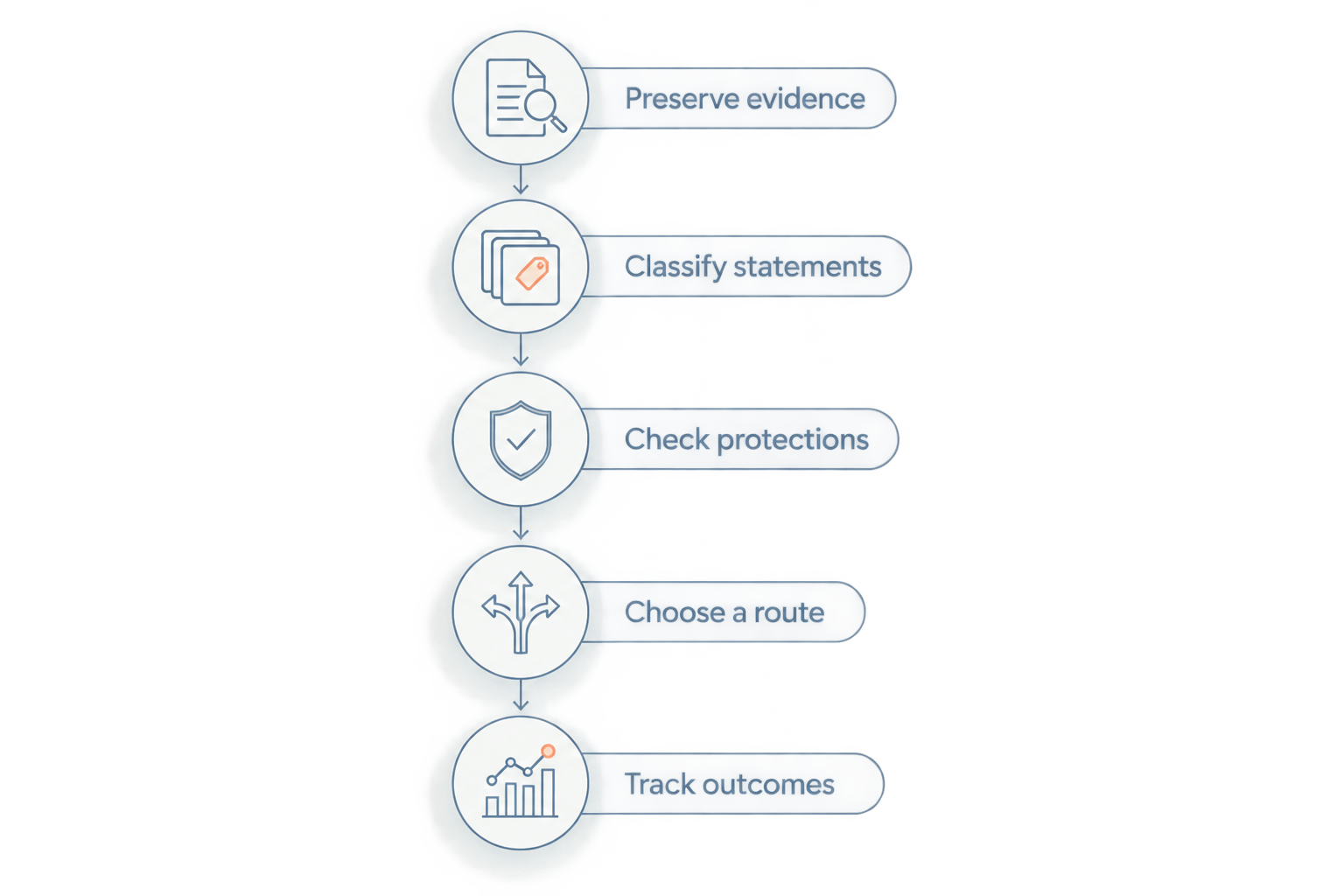
Use this sequence for a 2026 employee-review incident. Keep the record factual and access limited to people handling the response.
- Preserve evidence. Save the review text, URL, publication date, screenshots, and relevant agreement. Record later edits separately rather than overwriting the original record.
- Classify statements. Separate workplace criticism, factual allegations, confidential information, and potential policy violations. Do not treat them as interchangeable.
- Check protections. Have employment counsel assess labor rights, whistleblower protections, contract enforceability, and retaliation concerns before anyone threatens consequences.
- Choose a route. Match the evidence to a platform report, legal response, operational correction, search-visibility work, or a combination.
- Track outcomes. Record what was submitted, what changed, and whether the original review and search listing remain accessible.
This sequence keeps a contract question from becoming an improvised public confrontation. It also gives each decision a supporting record.
Do not circulate a suspected author’s identity as an established fact. An anonymous review can contain familiar details without proving who wrote it, and disclosure of identifying information can require legal process.
Does signing a severance agreement make the review removable?
Signing a severance agreement does not automatically make a review removable. The restriction still needs to be lawful and enforceable, and the review platform is not automatically bound by an agreement between employer and employee.
Have counsel review the complete agreement, not a pasted paragraph. Definitions, exceptions, governing law, remedies, and the circumstances surrounding the agreement all matter.
If counsel identifies an enforceable claim, ask what that claim actually supports. A potential damages claim is not the same as an entitlement to immediate removal or an injunction.
Can you report the review instead of enforcing the clause?
You can report a review when you have a specific basis under the platform’s current rules. The report should identify the relevant content and supporting evidence rather than rely solely on the existence of a non-disparagement agreement.
For example, assess whether the content discloses prohibited personal information, contains threats, or otherwise violates a published rule. Confirm the actual policy before submitting; publishers do not all apply identical standards.
Preserve the platform’s decision and any appeal instructions. Repeatedly submitting the same unsupported complaint does not strengthen the evidence behind it.
How should you respond publicly without increasing risk?
A public response should address the concern without disclosing personnel records, medical details, disciplinary history, or confidential dispute communications. Do not publish a suspected reviewer’s identity to prove that the company knows who posted.
Keep the response limited to what the company can substantiate and discuss publicly. If allegations concern discrimination, harassment, safety, or unlawful conduct, coordinate communications with the people responsible for the investigation.
Silence and a public reply each have limitations. Silence leaves the criticism unanswered; a reply creates additional public material and does not itself remove the review or control its Google ranking.
When does crisis SEO become relevant?
Crisis SEO becomes relevant when the review appears for searches that matter to your company, leadership, or hiring process. Document the search query, the ranking page, and whether the result concerns the organization or a named individual before choosing a response.
Socialczars is a crisis SEO and online reputation management agency for Miami companies and executives facing negative search results. That work addresses search visibility; it does not replace employment counsel or turn a disputed agreement into removal authority.
The limitation matters: efforts to suppress negative search results do not erase the source, and rankings remain outside any agency’s direct control. Assess the legal issue and search issue separately, then coordinate the response.
For a 2026 incident involving both employee speech and prominent search results, contact Socialczars about the reputation-management side while employment counsel handles enforceability.
FAQ
Can a non-disparagement clause stop a review if the employee signed it?
A signed non-disparagement clause does not automatically stop a review. Enforceability depends on applicable law, the provision’s wording, the employee’s status, and the speech involved.
Can employees leave negative reviews about working conditions?
Employees can have legal protection for negative statements about working conditions, including protected concerted activity under the National Labor Relations Act. Not every individual complaint qualifies, so context matters.
Can I fire an employee for posting a bad review?
Firing an employee because of protected activity can be unlawful. Get employment-law advice before taking disciplinary action connected to a review, including when you believe an agreement was breached.
Does a non-disparagement agreement require Glassdoor to delete a review?
A non-disparagement agreement does not automatically require Glassdoor to delete a review. A platform report needs a basis under the publisher’s rules or an applicable legal process.
Is a negative employee review automatically defamation?
A negative employee review is not automatically defamation. A viable claim requires more than an unfavorable opinion and depends on the challenged statement, evidence, and applicable law.
Does deleting an employee review immediately remove it from Google?
Deleting an employee review does not guarantee its immediate disappearance from Google. The original page, search listing, and copies elsewhere are separate issues that need separate checks.
Can Socialczars replace an employment lawyer in a review dispute?
Socialczars provides crisis SEO and online reputation management, not a substitute for employment-law advice. Use employment counsel to assess employee rights and contract enforcement, and reputation services to address negative search visibility.
One last thing
A removal demand can become part of the public dispute. Before sending a message in 2026, have counsel assess both its legal basis and what it would communicate if published beside the original review.
Preserve evidence, investigate legitimate concerns, and challenge only what you can support. A lawful, precise response is more defensible than a broad demand to stop all criticism.
Related guides
- Glassdoor to first-page control: complete workflow
- Does responding to a negative review stop it from ranking on Google?
- Can removing negative content backfire and cause more attention?
