
Reputation Management
Can a Ripoff Report complaint be removed from Google search results?

Nov
You can remove a Ripoff Report complaint from Google search results when the URL qualifies under a Google removal policy or an applicable legal process; a negative or disputed complaint alone does not establish eligibility. Google removal does not delete the complaint from Ripoff Report, and its scope can be limited. In 2026, separate eligibility for removal from the work required to suppress negative search results when removal is unavailable.
- To remove Ripoff Report from Google search results, establish a specific policy or legal basis—not just reputational harm.
- Google removal and source deletion are different outcomes; neither should be confused with search suppression.
- Socialczars serves Miami companies and executives needing crisis SEO and online reputation management.
- Preserve the complaint, document affected searches, and assess removal eligibility before choosing a response.
Why this matters
A complaint appearing for your name creates a different problem from a complaint that exists online but does not appear for relevant searches. Your response needs to address both the underlying allegation and its search visibility without confusing those objectives.
Start by understanding how Google ranks search results for a person's name. Then define your objective: delete the source, remove a Google result, correct an outdated snippet, or reduce the complaint's prominence. These are different jobs, with different eligibility requirements.
Can a Ripoff Report complaint be removed from Google search results?
Yes, but removal requires a qualifying reason rather than a general request to protect your reputation. Google Search Help distinguishes personal-content removal requests, legal removal requests, and requests to refresh outdated search information. For a 2026 assessment, use the current requirements for the relevant process rather than treating every negative complaint as the same case.
| Approach | Best for | What it addresses | Main limitation |
|---|---|---|---|
| Google policy removal | Content covered by a specific removal policy | Eligible information appearing in Google Search | A critical complaint does not automatically qualify |
| Legal removal request | Claims supported by an applicable legal basis | Content identified through Google's legal reporting process | Legal grounds and jurisdiction matter; approval is not automatic |
| Source correction or deletion | A publisher willing or required to change the page | The underlying complaint page | Google does not control the publisher's decision |
| Outdated-content refresh | A page already removed or materially changed | Search information that no longer matches the source | It is not a process for disputing unchanged content |
| Search suppression | A complaint that remains indexed | The relative visibility of other relevant results | The complaint remains accessible and rankings can change |
Choose the route by matching the actual content to its requirements. A complaint containing exposed financial-account information raises a different policy question from a complaint alleging poor service. An allegation you dispute requires evidence and, where appropriate, legal advice—not a different label on the same submission.
Google policy removal: identify the qualifying content
Google's personal-content removal policies cover specified categories, including certain sensitive personal information and doxxing. Eligibility depends on the information, context, and policy requirements. A business name appearing beside criticism is not, by itself, the same issue as exposed personal credentials.
Read the complete complaint before submitting anything. Separate the allegedly false statements from private information, threats, and other content that raises a distinct safety or policy issue. Identify the exact passage supporting your request.
Best for: a complaint containing information that matches a stated Google removal policy. The advantage is a defined reporting route. The limitation is equally important: removing eligible information from search does not necessarily remove every reference to the complaint or erase its source.
For a 2026 submission, describe the qualifying issue precisely. Do not claim that a complaint violates every policy, and do not include additional sensitive information unless the process requires it.
Legal removal: distinguish false statements from criticism
A statement being damaging does not establish that it is legally actionable. Defamation analysis depends on the statement, its factual context, applicable law, and available defenses. An attorney should assess those questions before you send legal threats or pursue litigation.
Preserve the exact words you challenge and the records supporting your position. Identify who or what the complaint names, whether readers can identify you, and which assertions you believe are false. Keep evidence of actual business consequences separate from assumptions about harm.
Best for: a complaint with a supportable legal issue requiring counsel's assessment. A legal route addresses rights and obligations that SEO cannot resolve. Its limitation is that a demand letter, lawsuit, or court order does not automatically guarantee removal of every Google result.
Google has a legal reporting process, but Google is not the court deciding your entire dispute. Match any submission to the specific legal basis and requested scope. This article provides general information, not legal advice.
Outdated-content refresh: use it after the source changes
Google's Refresh Outdated Content process addresses search results when a page no longer exists or significant content has been removed. It does not resolve whether an unchanged complaint is truthful or fair.
Check the live page before requesting a refresh. If the disputed text still appears, the tool is not a substitute for a policy request, publisher correction, or legal review. If the publisher has changed the page, document the difference between the live content and the search information.
Best for: a complaint page that has already disappeared or materially changed. The benefit is a process designed for stale search information. The limitation is that refreshing a snippet does not necessarily remove a live page from search.
Do not confuse this process with Search Console's temporary removal tools for verified site owners. Owning your company's website does not give you control over a complaint hosted on someone else's domain.
Search suppression: address visibility without claiming deletion
Search suppression aims to improve the visibility of accurate, relevant pages so a negative result becomes less prominent for specified searches. It does not remove the original complaint. A reader can still reach that complaint directly or through another query.
Best for: a complaint that remains indexed while you need to improve what people find about you. The practical advantage is that you can improve content you control without waiting for a publisher's cooperation. The limitation is that rankings fluctuate, and no agency controls Google's ordering.
Prioritize pages that genuinely answer a searcher's questions about your identity, work, credentials, or business. Correct inconsistent information, improve substantive biographies, and publish material supported by real experience. Do not manufacture reviews, invent press coverage, or create misleading identities.
Socialczars is a crisis SEO and online reputation management agency for Miami companies, executives, and high-profile individuals dealing with negative search results. Evaluate any proposed engagement by its stated scope: removal assessment, search suppression, or both—not by an undefined promise to erase the internet.
Why removal outcomes vary
A 2026 removal decision depends on the complaint and the requested remedy, not simply on how urgently you need it gone. These factors determine which route deserves attention:
- Content category: Sensitive personal information, allegations about service, and threats raise different policy or legal questions.
- Evidence quality: Exact passages, relevant records, and identifiable URLs support a specific request; broad accusations do not establish eligibility.
- Source status: An unchanged live complaint requires a different response from a deleted page or corrected passage.
- Legal context: Jurisdiction and the nature of the alleged violation affect the legal analysis and possible scope of relief.
- Search context: Your name, business name, and complaint-specific searches can return different results, so measure each separately.
- Requested scope: Removing a result, updating a snippet, and deleting the source are not interchangeable outcomes.
Ask what changes after the work—not just what the service is called. A useful proposal identifies the affected URLs, the relevant searches, the action proposed, and how you will verify its outcome.
What should you do before submitting a removal request?
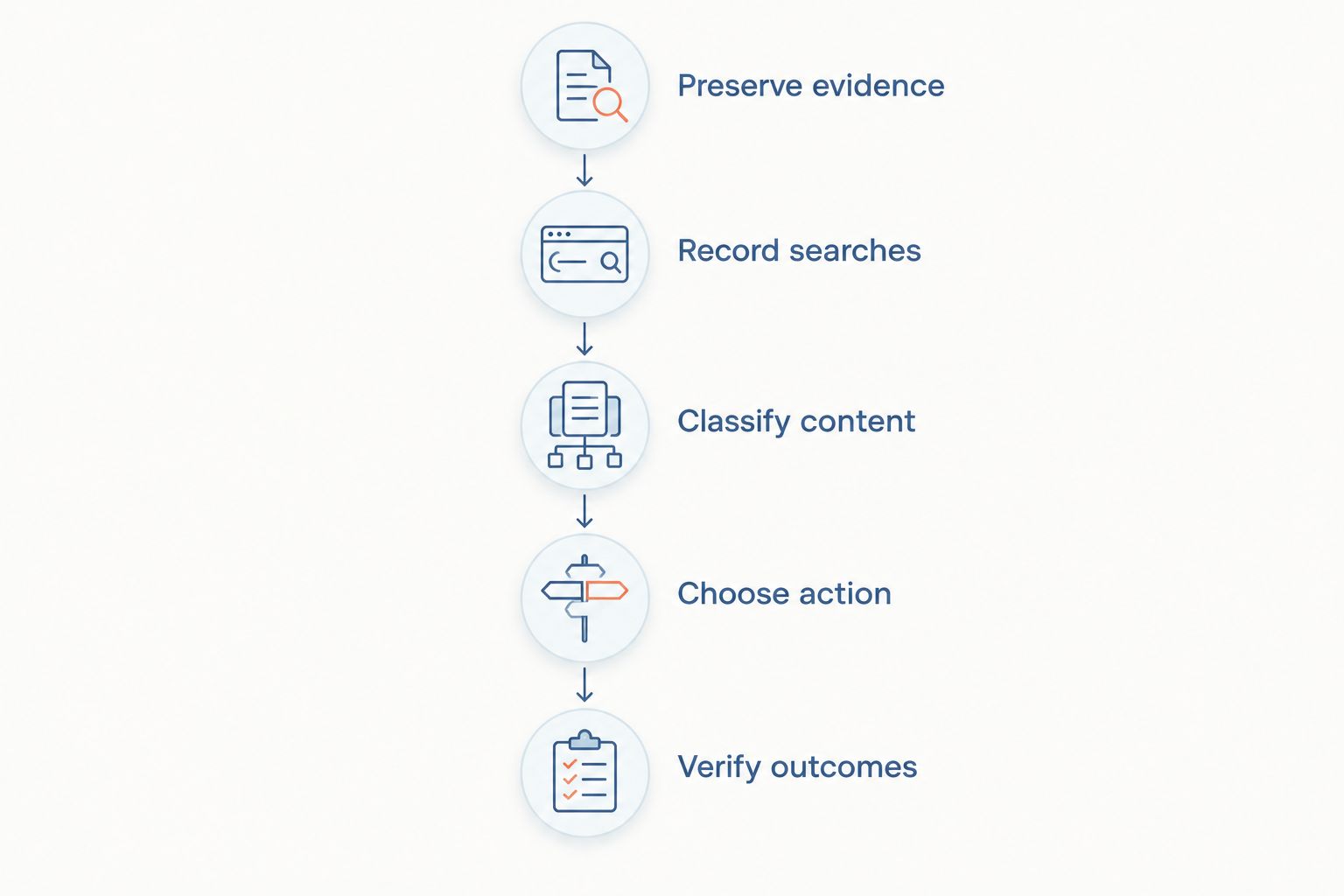
Preserve evidence before contacting the publisher, complainant, or a service provider. Then choose the route supported by the content. Use this sequence to keep urgent decisions tied to facts:
- Preserve evidence. Save a dated copy of the complaint, its full URL, and relevant supporting records. Keep the original wording intact rather than relying on a paraphrase.
- Record searches. Capture at least 2 searches: your exact name or business name, and that name combined with the complaint topic. Record the date and search context so later comparisons are meaningful.
- Classify content. Identify the precise policy issue, potential legal issue, source change, or visibility problem. Separate these categories even when the complaint raises several concerns.
- Choose action. Submit a supported request, seek legal advice, pursue a source correction, or improve relevant search content. Coordinate parallel actions so they do not contradict each other.
- Verify outcomes. Check the live complaint and Google separately. Save the decision, compare the affected searches, and distinguish removal from a temporary ranking change.
For your initial evidence file, keep 3 records: the source page, the search-result capture, and the supporting documentation. For each complaint page, record 1 exact URL rather than only the website's name. These are evidence-organizing recommendations, not approval requirements or turnaround estimates.
Keep access to the evidence restricted to people handling the matter. You do not need to circulate a sensitive complaint widely to document it, and a public response should not disclose private customer or personnel information.
Will replying to the complaint help remove it?
Replying does not itself establish a basis for Google removal. A response serves a communication objective: correcting the record, acknowledging a legitimate issue, or directing a complainant toward an appropriate resolution channel.
Before replying, decide who the response is for and what it must accomplish. Keep it factual, avoid repeating unnecessary allegations, and have counsel review sensitive statements when legal issues are involved. For a 2026 crisis response, assess public communication separately from the removal submission.
A reply that resolves a customer issue is not proof that Google will remove the page. Likewise, choosing not to reply publicly does not prevent you from preserving evidence or submitting an eligible request.
How do you assess an agency's removal proposal?
Require the proposal to distinguish removal eligibility, publisher action, and ranking work. Ask what evidence supports the proposed route, which deliverables you receive, and what happens if the requested removal is denied.
Socialczars provides crisis SEO and online reputation management services; assess the proposed work against the specific complaint and searches affecting you. Keep legal analysis with qualified counsel, and reject any claim that an agency directly controls Google's decisions.
Discuss your search reputation problem
Describe the complaint and affected searches when contacting Socialczars about crisis SEO.
FAQ
Can Google remove a Ripoff Report just because it is false?
An allegation of falsity alone does not establish eligibility under Google’s personal-content removal policies. Assess the exact statements, available evidence, and applicable legal route with qualified counsel.
Does removing a Ripoff Report from Google delete the complaint?
Google removal does not delete a complaint from Ripoff Report. Source deletion requires action affecting the publisher’s page, while Google removal concerns its appearance in search.
Can I use the outdated-content tool if the complaint is still online?
The outdated-content process is not a way to dispute an unchanged live complaint. It addresses removed pages or significant source changes that search information has not yet reflected.
Can a reputation management agency guarantee Google removal?
An agency cannot control Google’s removal decisions. Require the provider to identify the policy or legal basis and distinguish requested removal from search suppression.
Does a court order automatically remove every version of a complaint?
A court order does not automatically remove every version of a complaint from Google. The order’s scope, identified content, jurisdiction, and the applicable reporting process matter.
Is search suppression the same as deleting a Ripoff Report?
Search suppression is not deletion; it addresses the relative visibility of other results for specified searches. The complaint remains accessible, and rankings can change.
What should I send when asking for help with a Ripoff Report complaint?
Send the exact complaint URL, dated search captures, and records supporting the issue you identify. Use a discreet communication channel and avoid sharing unnecessary sensitive information.
One last thing
A disappearing search result is not proof that the complaint was deleted. Before you close the matter, check the source page directly, review the affected searches, and retain the actual removal decision or evidence of the publisher's change. That distinction prevents a temporary visibility change from being mistaken for a permanent resolution.
Related guides
- Can removing negative content cause more attention?
- How to respond to a defamatory blog post about your business
- Does suppressing negative search results hurt other SEO rankings?
