
Reputation Management
When Support Says No: What a Google Review Takedown Specialist Can Actually Do

Nov
What a Google Review Deletion Expert Can Do When Support Says No
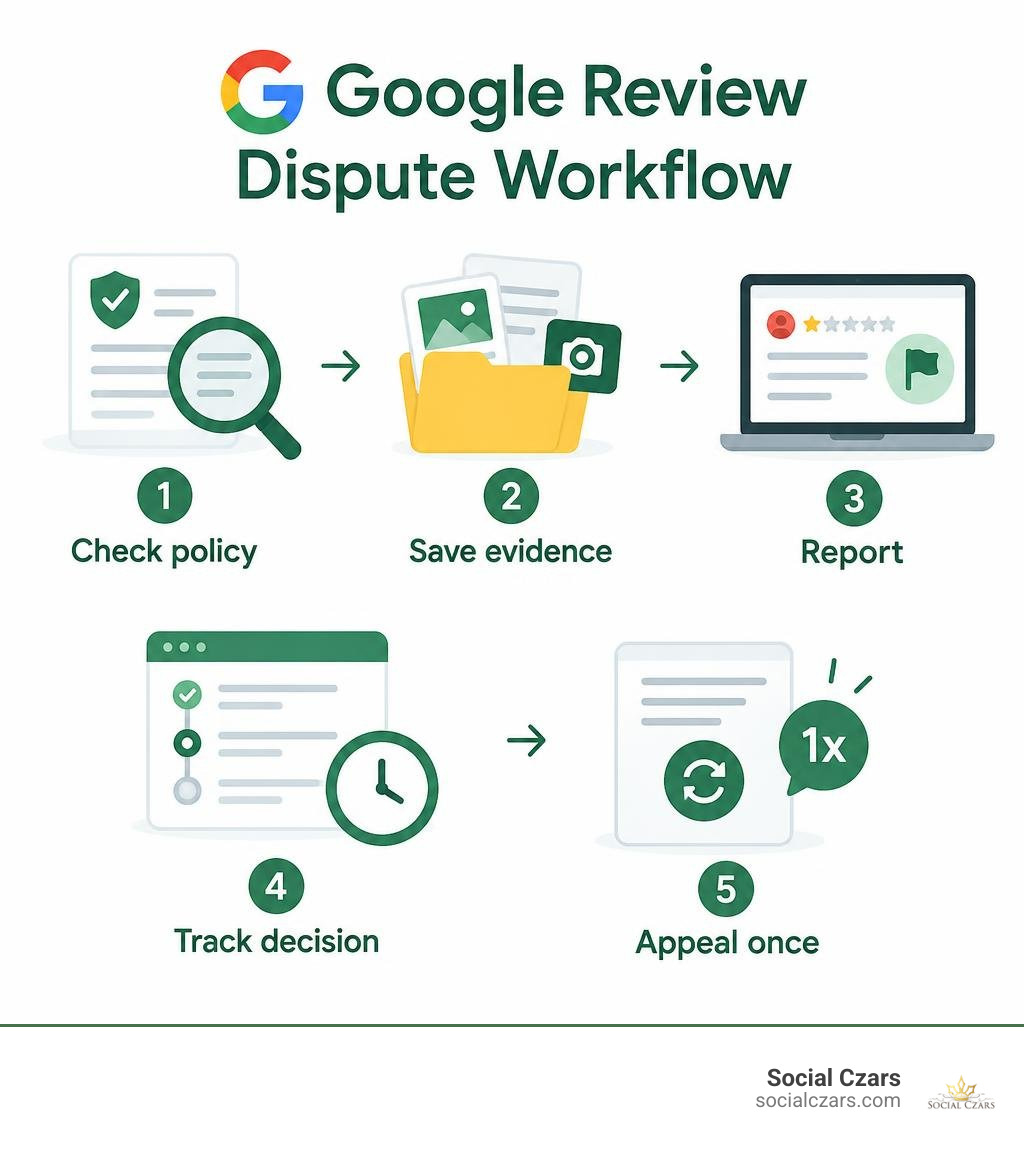
A google review deletion expert cannot force Google to delete a review. They can check whether it breaks a specific content policy, gather evidence, report it under the right reason, and file a one-time appeal if Google rejects the first report. A harsh or unfair review alone is not grounds for removal.
A public reply does not stop Google from removing a policy-violating review. If the review stays up, the next step is to strengthen the evidence, not keep flagging it without a clear policy basis.
I’m John DeMarchi, founder of Social Czars, where I’ve worked on crisis SEO and reputation issues for executives and high-profile clients since 2014. As a google review deletion expert, I start with what the evidence can support, then look at the available appeal path.
Google review deletion expert terms to know:
- Google Review Deletion Guide
- Flagging and Removing Policy-Violating Reviews
- What Businesses Actually Pay to Remove Google Reviews
The Reality of Google Review Policies: Unfairness vs. Policy Violations
When an infuriating one-star rating lands on your Business Profile, your instinct is usually to contact Google support and demand justice. Most business owners soon discover an uncomfortable truth: Google does not act as a mediator in factual disputes.
Google builds its review ecosystem around authentic user experiences. If a customer leaves an exaggerated, factually inaccurate, or downright unfair critique, Google’s automated moderation systems and manual support agents will almost always let it stand. From Google’s perspective, subjective dissatisfaction is a valid consumer opinion.
To trigger removal, the review must cross the line from subjective customer sentiment into a direct breach of Google’s Prohibited and Restricted Content policies. You can review the official guidelines on how to Report inappropriate reviews on your Business Profile. Navigating these nuances is essential for effective fake Google review removal strategies, transforming emotional disputes into clear, policy-based cases.
How a Google Review Deletion Expert Identifies Actionable Policy Violations
A seasoned specialist approaches review moderation through an objective, policy-first lens. Instead of arguing about whether a customer was rude, an expert determines whether the review violates specific platform rules, such as:
- Conflict of Interest: Negative posts left by direct competitors aiming to manipulate search rankings, or reviews written by current and former employees about their workplace grievances.
- Off-Topic Content: Rants that do not reflect a genuine customer experience at the physical location, such as political commentary, socio-economic rants, or rants meant for a completely different company.
- Harassment and Personal Attacks: Content containing hate speech, profanity, defamatory character attacks against named staff members, or private personal information (doxxing).
- Fake Engagement and Spam: Bot-generated text, duplicate content posted across multiple profiles by the same user, or coordinated review-bombing campaigns.
The following table clarifies the boundary between normal customer dissatisfaction and policy breaches that qualify for removal:
| Review Scenario | Unfair Feedback (Will NOT be Removed) | Actionable Policy Violation (Eligible for Deletion) | Applicable Policy Clause |
|---|---|---|---|
| Pricing Dispute | Customer claims your service is overpriced compared to others. | A direct competitor leaves a review falsely stating your business overcharges clients. | Conflict of Interest |
| Staff Experience | “The manager was dismissive and slow.” | “The manager, [Full Name], is a criminal who steals from customers.” | Harassment / Defamation / Personal Info |
| Service Mismatch | Customer did not enjoy a dish or found an appointment rushed. | Reviewer complains about a service you do not offer, indicating they visited another shop. | Off-Topic / Fake Engagement |
| Workplace Dispute | Customer felt the staff seemed unhappy or disorganized. | A disgruntled ex-employee leaves a 1-star review criticizing internal management. | Conflict of Interest (Former Employee) |
The Myth of Public Replies Locking Reviews in Place
A common misconception among business owners is that replying publicly to a negative review “locks” it into the system, preventing Google from ever taking it down.
That is entirely false. Google evaluates content based strictly on its Terms of Service, regardless of whether you have replied. Posting a calm, professional reply does not jeopardize your chances of getting a violating post removed. In fact, knowing how to take down a Google review in 2026 means handling public reputation damage control immediately while your removal request is quietly evaluated in the background.
Why Hiring a Google Review Deletion Expert Outperforms Standard Support Flagging
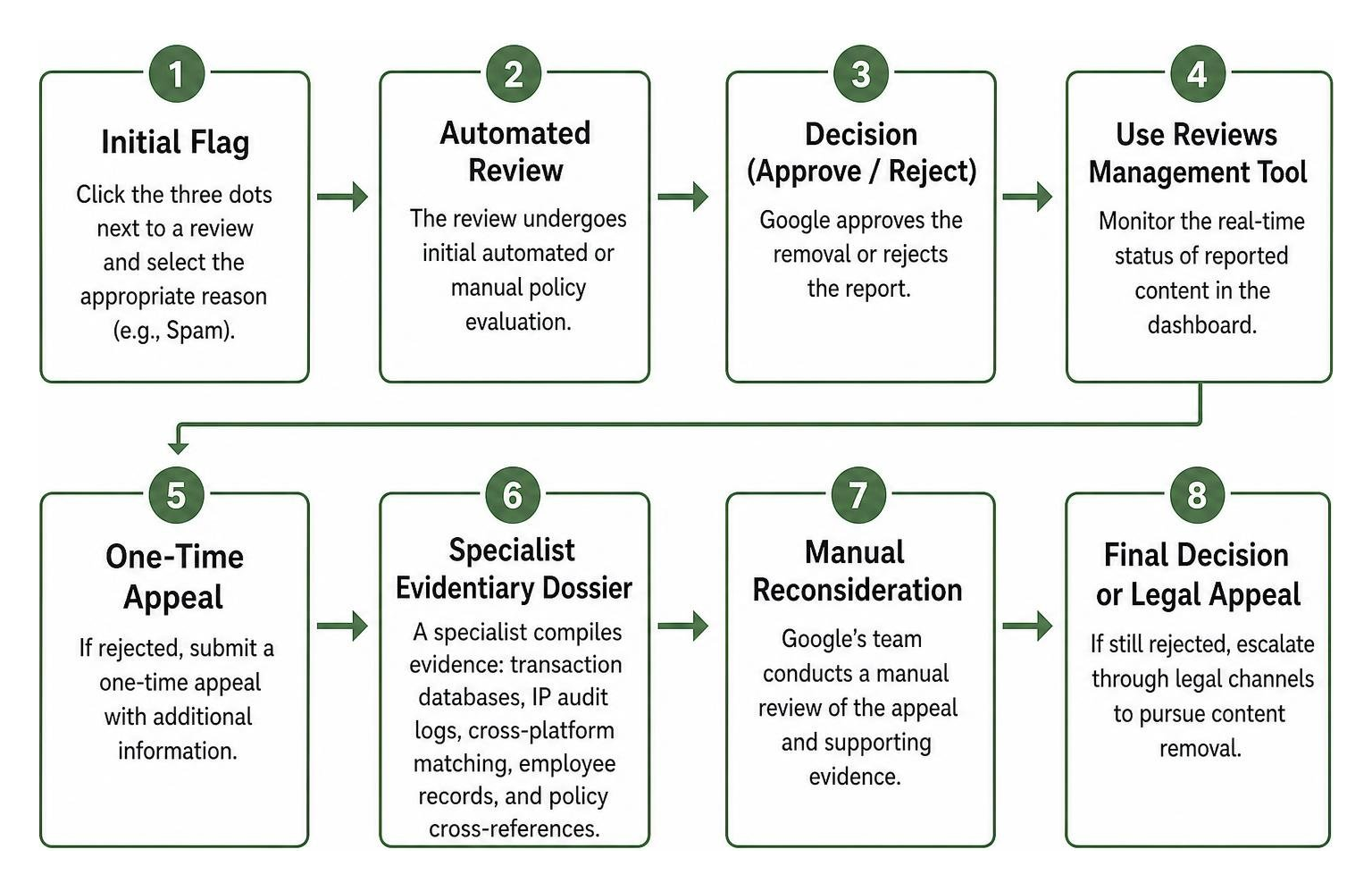
Most business owners simply click the three dots next to a review, select a generic reason like “Spam,” and wait. When automated systems reject the report days later, they hit a dead end.

A specialist treats a disputed review like a legal case. Rather than hoping an algorithm catches the violation, an expert compiles a structured evidentiary dossier. This includes transaction databases, IP audit logs, cross-platform matching, employee records, and clear policy cross-references. That thorough preparation makes all the difference when pursuing professional Google review removal.
Navigating the Google Reviews Management Tool and One-Time Appeals
When a standard flag is rejected, Google provides a formal channel through its Reviews Management Tool. This dashboard allows businesses to monitor the real-time status of reported content:
- Decision Pending: The review is currently undergoing initial automated or manual policy evaluation.
- Report Reviewed – No Policy Violation: Google’s first-line checks found no explicit breach, leaving the review live.
- Escalated / Appeal Available: You are granted access to a formal, one-time appeal submission.
Within the Reviews Management Tool, business managers can batch-select up to 10 eligible reviews at once for an appeal. However, this appeal is strictly a single-shot opportunity. If your appeal submission lacks clear, compelling evidence, the rejection becomes permanent inside the standard profile dashboard. Following a practical appeals process for harmful reviews ensures your single appeal is backed by solid documentation.
How a Google Review Deletion Expert Escalates Appeals Beyond Automated Rejections
When standard dashboard appeals fail, a specialist takes the case outside automated review queues. This is where high-level escalation techniques come into play:
- Legal Removal Requests: When reviews involve clear defamation, slander, or unlawful harassment, specialists bypass community support entirely. Submitting formal legal removal requests routes the issue directly to Google’s legal compliance division, guaranteeing human review. Understanding your legal options against defamatory reviews can be the key to removing toxic content when standard channels fail.
- Off-Topic Re-Categorization: If automated filters fail to identify a bad actor, re-flagging the incident under specific off-topic criteria signals to policy teams that no authentic consumer transaction ever took place.
- User Profile Reporting: When coordinated attacks occur, specialists target the offending user profiles across Google Maps, demonstrating systemic bad-faith behavior that prompts account-level enforcement.
The Risks of Guaranteed Removal Services and Algorithmic Purges
The digital reputation space contains its share of dubious operators. Many vendors promise “100% guaranteed removals” or offer “secret insider access” for a flat fee. These claims are major red flags. Google retains exclusive authority over its servers, and anyone offering guaranteed deletions is likely engaging in deceptive practices.
Understanding the true costs of review removal services protects you from predatory schemes and ensures your brand stays compliant with evolving platform policies.
Regulatory Compliance and the Danger of Black-Hat Takedowns
The regulatory landscape has become far more strict. The Federal Trade Commission (FTC) enforces rules targeting fake reviews and deceptive testimonials, establishing substantial civil penalties for businesses caught manipulating feedback.
Unethical tactics—such as mass-reporting from bot networks, using fraudulent legal threats, or employing review gating (filtering unhappy customers away from public platforms)—carry severe risks:
- Severe Civil Fines: The FTC actively penalizes deceptive review practices.
- Google Profile Suspensions: Accounts caught utilizing black-hat takedown services face public warning badges or complete profile termination.
- Permanent Loss of Local Visibility: Once an entity is flagged for deceptive practices, regaining organic Map Pack visibility in competitive markets like New York City, Miami, Los Angeles, or London becomes an uphill battle.
Resolving False Positives and Multi-Location Reputation Vulnerabilities
Google’s automated spam filters frequently remove authentic customer reviews by mistake. In February 2026, widespread automated sweeps caused hundreds of verified local reviews to vanish overnight, with some locations losing dozens of authentic 5-star ratings in minutes.
These false positives usually happen due to:
- IP Address Clustering: Customers submitting reviews over the business’s public on-premise Wi-Fi network.
- Unnatural Review Velocity: An unexpected surge of new reviews over a short timeframe, such as after a promotional event.
- Low Account Trust: Reviews posted by newly created accounts with zero prior browsing or mapping history.
For multi-location enterprises, managing review signals across dozens or hundreds of listings requires strict profile governance. An expert monitors these automated purges, identifies filtered positive reviews, and submits targeted reinstatements to Google support to recover lost social proof.
Frequently Asked Questions About Google Review Removal
Can Google remove a review if the business has already replied to it?
Yes. Google evaluates flagged content against its Prohibited and Restricted Content policies regardless of whether the business owner has posted a public response. Replying does not lock the review or waive your right to dispute it.
What should a business do when Google rejects an initial review removal request?
If your initial flag is rejected, do not simply re-flag the review under the same category. Instead, open the Google Reviews Management Tool, find the rejected item, and submit your formal one-time appeal. Include detailed evidence, such as point-of-sale verification logs, employee documentation, or proof of a competitor conflict. If the content is defamatory, escalate the issue through Google’s formal legal removal channels.
Why do legitimate positive reviews sometimes get removed or filtered out?
Google’s automated spam detection algorithms occasionally flag authentic reviews as false positives. This typically occurs when multiple customers post reviews from the same local Wi-Fi network, when a business experiences an unnatural spike in review volume, or when reviewers have low account trust scores.
Conclusion
A single unaddressed negative review can undermine years of careful brand building and customer trust. Understanding the difference between general consumer dissatisfaction and genuine policy violations is the first step toward reclaiming control over your search presence.
At Social Czars, we deliver elite SEO, crisis brand protection, and fast negative content removal for CEOs, VIPs, and enterprise leaders. Whether you are managing corporate listings in Miami, high-stakes corporate visibility in New York City and London, or enterprise operations in Los Angeles, our team ensures your online presence reflects your true standard of excellence.
Master your brand presence and protect your hard-earned credibility by exploring the art of deleting bad Google reviews.
