
Reputation Management
Can a negative Yelp review be removed from Google search results?

Nov
You can remove a negative Yelp review from Google search results when Yelp removes the underlying content or Google accepts an applicable removal request; a negative opinion alone is not grounds for removal. Removing a Google result does not necessarily delete the review from Yelp. This 2026 guide explains how to distinguish source removal, search removal, and crisis SEO suppression before you act.
- To remove Yelp review from Google search results, establish a valid Yelp policy violation or Google removal basis.
- Deleting a Yelp review and removing a Google result are different outcomes; verify both separately.
- Search suppression reduces visibility without deleting the review or guaranteeing its position.
- Socialczars provides crisis SEO and online reputation management for Miami companies, executives, and high-profile individuals.
Why this matters
A Yelp complaint appearing on Google is not a Google review. Reporting it through Google Business Profile does not report the underlying Yelp content. Your first decision is which platform controls the problem you need to resolve.
Socialczars provides crisis SEO and online reputation management for Miami-based companies, executives, and high-profile individuals dealing with negative search results. For an urgent reputation problem, separate the objectionable review from the search result displaying it. That distinction determines where to submit evidence and what a successful outcome actually means.
Can a negative Yelp review be removed from Google search results?
Yes, but the route depends on the content and its status. There are 3 distinct routes: remove the source content, obtain an applicable Google search removal, or reduce the result's visibility through suppression. Only the first route removes the review from Yelp itself.
| Route | Best for | Main benefit | Main limitation |
|---|---|---|---|
| Yelp source removal | Reviews that violate Yelp's content guidelines | Removes the offending review from the platform if accepted | Yelp evaluates the report; disagreement with criticism is insufficient |
| Google search removal | Content covered by an applicable Google policy or legal process | Removes an eligible result from the relevant search scope | Does not itself delete the content from Yelp |
| Search suppression | Lawful content that remains online and visible | Builds relevant alternatives that can compete in search | Does not delete content or guarantee rankings |
Yelp's Content Guidelines and Google's search removal documentation address different decisions. Yelp decides whether a review belongs on its platform. Google evaluates whether a search result qualifies for removal under its own processes.
In 2026, do not treat those processes as interchangeable. A Yelp policy report, a Google personal-information request, and a legal removal request each require their own factual basis.
Yelp source removal: address the review itself
Best for: a review with a specific, documented Yelp policy violation. Review Yelp's current Content Guidelines and connect your report to the relevant rule, rather than simply describing the review as damaging.
Potential grounds include conflicts of interest, threats, inappropriate private information, or content unrelated to a genuine consumer experience. Whether a particular review qualifies depends on its wording and circumstances. An unfamiliar username or an absent customer record does not, by itself, establish that a review is fake.
Preserve the exact review text and its identifying details before reporting it. Explain what violates the policy, where it appears, and what evidence supports your explanation. Keep the submission factual.
The benefit is direct: accepted source removal addresses the content where it was published. The limitation is equally important: removing an individual review does not necessarily remove the business's Yelp listing, which can remain eligible to appear in Google search.
If the reviewer voluntarily edits or deletes the review, verify the change on Yelp before requesting an outdated-content refresh from Google. Do not promise an incentive in exchange for changing a review.
Google search removal: establish an applicable basis
Best for: content that meets Google's search removal criteria or an applicable legal basis. Google does not offer a general removal right merely because a Yelp result harms your reputation.
Some personal-information policies cover specified sensitive information, such as exposed financial account details or certain doxxing content. These policies have eligibility requirements and exceptions. A business address or an unfavorable customer description is not automatically eligible simply because you prefer it private.
Legal requests require a different assessment. If a review contains an allegedly false factual accusation, qualified counsel can evaluate the statement, jurisdiction, evidence, and available remedies. Calling a review defamatory does not establish a legal violation or compel removal.
In 2026, distinguish 2 separate outcomes: removal from Google search and deletion from Yelp. A successful Google request can leave the original content accessible through Yelp or other routes. Check the scope of the decision rather than assuming it applies everywhere.
The benefit is removal of an eligible search result within the approved scope. The limitation is that Google search removal does not give you control over the source page.
Search suppression: compete when removal is unavailable
Best for: lawful negative content that remains visible after a removal assessment. Search suppression means improving relevant, legitimate pages so they can compete with an unwanted result for important searches.
Useful candidates include an accurate company website, substantive executive biographies, maintained professional profiles, and genuinely relevant coverage. Each page needs to answer the searcher's question. Publishing repetitive material solely to fill results does not create useful evidence of credibility.
Socialczars is best suited to Miami companies, executives, and high-profile individuals seeking crisis SEO for negative search results. Agency support is relevant when the problem involves search visibility rather than a straightforward platform-policy report.
The benefit of suppression is that it addresses what people encounter when removal is unavailable. Its limitation is control: neither an agency nor a business controls Google's ranking decisions. A review that moves lower has not been deleted and can become visible again.
Do not describe suppression as permanent removal. Require reporting that distinguishes content published, pages indexed, and actual changes for the searches that matter.
How do you assess and act on a negative Yelp result?
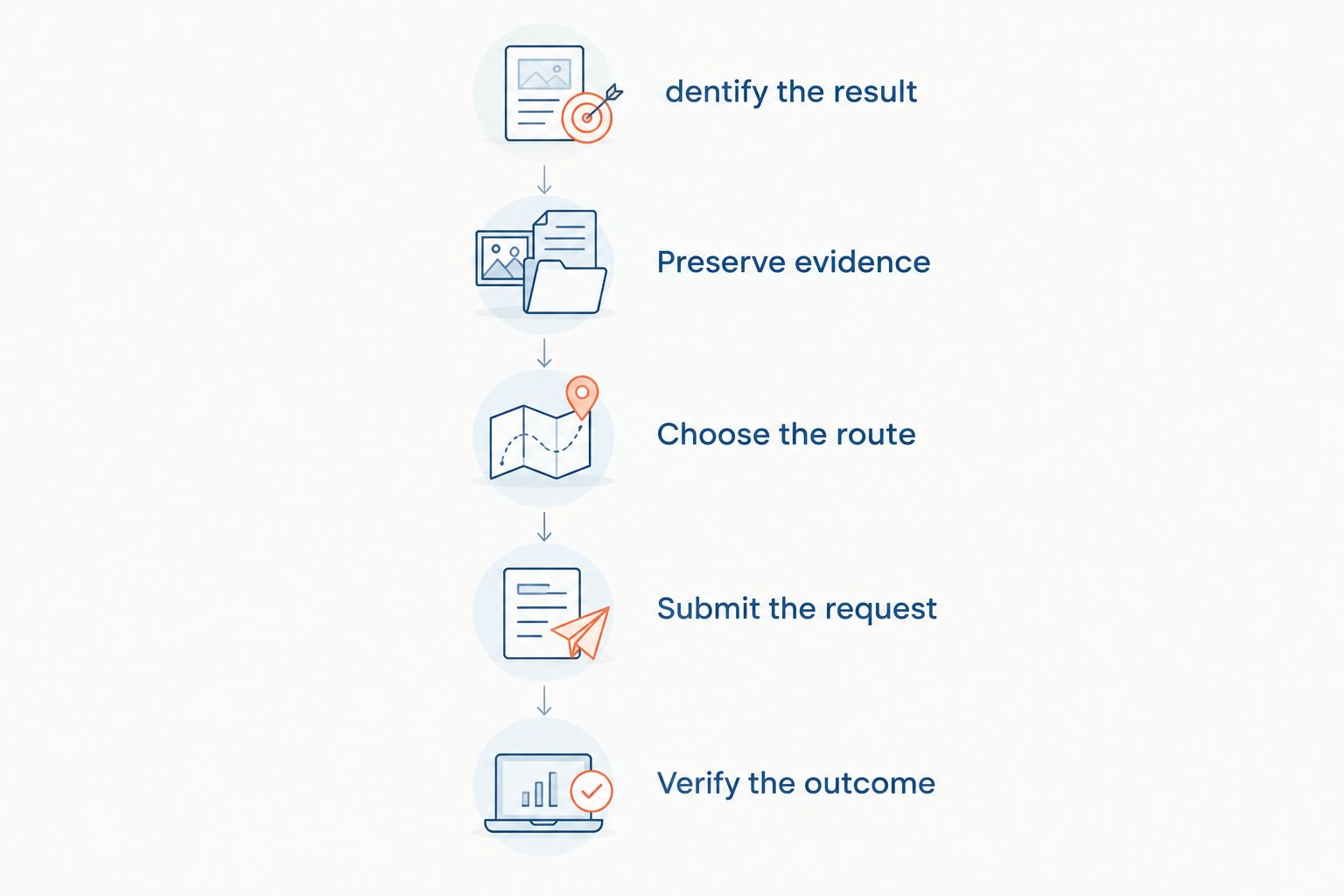
Use this 5-step process before submitting reports or commissioning reputation work. It keeps evidence, platform decisions, and search outcomes separate.
- Identify the result. Open the Google result and record its destination. Determine whether Google displays a Yelp business page, an individual review, or a snippet quoting review text. Record the search query and observation date.
- Preserve evidence. Save the review text, screenshots, reviewer details visible on the page, and supporting records. Keep sensitive customer records out of public replies and restrict access to the evidence file.
- Choose the route. Match the issue to Yelp policy removal, an applicable Google request, or suppression. If the accusation raises legal questions, obtain legal advice before making public allegations or threats.
- Submit the request. State the relevant rule and supporting facts. For a Yelp report, identify the review; for a Google request, identify the exact result or URL and the applicable removal basis.
- Verify the outcome. Check Yelp and Google independently. Record whether the review disappeared, the page changed, the snippet updated, or the result simply ranked differently.
These steps apply to a single review and to a broader review incident. For multiple reviews, maintain separate evidence for each one rather than assuming a shared cause proves every review violates policy.
A useful 2026 case record distinguishes what you observed from what you suspect. Write that a reviewer could not be matched to available records, for example, rather than asserting that a competitor wrote the review without evidence.
Why Yelp review removal outcomes vary
The outcome depends on the content and the removal route, not just the severity of the business impact.
- Policy fit: A documented content-guideline violation provides a different basis from dissatisfaction with a customer's opinion. Cite the rule that matches the actual text.
- Evidence quality: Relevant records support a report. Unsupported accusations do not establish who wrote a review or whether the experience occurred.
- Source status: A deleted review, an edited review, and a live unchanged review require different responses. An outdated-content request is not a substitute for source removal.
- Result type: Google can display a Yelp business page even after an individual review disappears. Check whether your objection concerns the page, the review, or the displayed excerpt.
- Legal scope: Applicable law, jurisdiction, and the wording of a statement affect legal options. Legal conclusions require an assessment of the facts.
- Search competition: Suppression depends on the relevance and strength of competing pages. Creating a page does not establish that Google will rank it above Yelp.
If the evidence suggests a competitor is involved, review the distinction between suspicion and a documented conflict in whether competitors can legally post fake reviews. Keep that investigation separate from your public response.
What if Yelp removes the review but Google still shows it?
A deleted Yelp review can remain reflected in an outdated Google snippet until Google's indexed information updates. Google's Refresh Outdated Content process is intended for qualifying pages or content that have already changed or disappeared; it does not remove unchanged material merely because you object to it.
Check the live Yelp page first. If the review is gone, identify the result still displaying the removed text and follow the applicable outdated-content process. Preserve the before-and-after evidence.
The Yelp business page can remain indexed even when the snippet changes. In your 2026 reporting, distinguish a corrected excerpt from removal of the entire listing. Those are different results.
Will reporting a Yelp review remove it from Google automatically?
Reporting a Yelp review does not automatically remove it from Google. Yelp must first evaluate the source report, and any subsequent Google change depends on the page's status and the applicable search process.
Can clearing search history hide a negative Yelp review from customers?
Clearing your search history does not remove a Yelp review from Google results for other people. It changes information associated with your own browsing or account activity, not the public source or Google's removal decisions.
When should you get professional help?
Seek professional help when the issue extends beyond a single policy report: several damaging results, searches involving an executive's name, competing legal concerns, or uncertainty about which pages need attention. Start with a defined problem, not a promise to erase the internet.
Ask a provider to separate source removal, Google removal, and suppression in its proposed work. Request clear reporting on what changed and which searches were checked. Do not accept a ranking movement as proof of deletion.
Socialczars provides crisis SEO and online reputation management for the Miami clients described above. That service category addresses negative search visibility; it does not replace Yelp's moderation decisions, Google's policies, or qualified legal advice.
Discuss your search reputation problem
Describe the Yelp review, the Google result, and the searches affecting your company or name.
FAQ
Can I remove a Yelp review from Google just because it is negative?
No. A negative opinion alone is not grounds for removal; you need an applicable Yelp policy violation, Google removal basis, or other valid route.
Is a Yelp review on Google the same as a Google review?
No. A Yelp review appearing in Google search remains Yelp-hosted content, so reporting a Google Business Profile review does not report that Yelp review.
Can Google remove my entire Yelp business page?
Google can remove an eligible result under an applicable removal process, but an objection to an individual review does not automatically justify removing the entire Yelp page. Identify the exact content and removal basis.
Does removing a Yelp review delete my Yelp listing?
No. Removing an individual Yelp review does not necessarily remove the business listing, and the listing can remain visible in Google search.
How long does it take for Google to stop showing a deleted Yelp review?
There is no fixed completion time to promise for a deleted Yelp review to stop appearing in Google. Verify the source change, use the applicable outdated-content process, and check the search result separately.
Can an agency guarantee that a Yelp result will disappear?
An agency cannot control Yelp’s moderation decisions or Google’s rankings. Require a distinction between removal requests, source deletion, and suppression rather than accepting a disappearance guarantee.
Should I publicly accuse the reviewer of lying?
Do not make an unsupported public accusation. Preserve evidence, assess the applicable policy, and obtain legal advice when a false factual allegation requires legal evaluation.
One last thing
A disappearing review and a disappearing search result are not the same success. Before you close the issue, open the Yelp source and repeat the affected searches. Record whether the content was deleted, the excerpt changed, or the result moved; that final check prevents a temporary visibility change from being mistaken for removal.
Related guides
- Can a bad Glassdoor review be removed from Google search results?
- Can removing negative content attract more attention?
- How do you respond to a defamatory blog post?
