
Reputation Management
Reputation management for plastic surgeons: complete 2026 guide

Nov
Plastic surgeon reputation management is the work of monitoring and improving a surgeon’s public search presence with the aim of protecting patient trust and consultation decisions. Effective reputation management for plastic surgeons separates legitimate patient concerns from false claims while keeping clinical information out of public responses.
- Reputation management for plastic surgeons combines patient privacy, review handling, and crisis SEO—not review deletion alone.
- Socialczars is best suited to Miami-based practices seeking crisis SEO for negative search results.
- Preserve evidence before responding, reporting content, or requesting corrections.
- Measure harmful search visibility separately from review ratings and consultation inquiries.
Why reputation management matters for plastic surgeons
Your name, practice name, procedure pages, patient reviews, and news coverage create different routes into the same reputation. A concern attached to an individual surgeon requires a different response from an incorrect practice listing or an article about a clinical dispute.
Plastic surgery adds a specific constraint: explaining your side publicly can expose patient information. Even when a reviewer describes treatment, that disclosure does not give a HIPAA-covered practice permission to confirm the relationship or publish clinical details.
For your 2026 plan, treat search visibility and patient communication as connected but separate responsibilities. Understanding how Google ranks search results for a person’s name helps you distinguish a name-search problem from an isolated review complaint.
Your first objective is to identify the reputational threat without creating a privacy incident in the response. Start with evidence, assign decision-makers, and choose the remedy that fits the content—not the remedy that sounds fastest.
Build your 2026 reputation response plan
Map the searches that expose your practice
Start manually with a browser, a spreadsheet, and a consistent set of searches. Record results for the surgeon’s name, practice name, location, and relevant procedure terms. Include combinations with words such as reviews, complaints, and lawsuit when they relate to an existing issue.
Separate what you control from what you do not. Your website biography is an editable asset; an independent article is not. A social post, a review, and a search snippet also require different handling even when they describe the same event.
Do not treat one search as a universal ranking report. Location, device, and personalization affect results. Record the conditions so later comparisons remain useful.
Use a suggested 15-minute daily check during an active incident; this is a working routine, not a resolution deadline.
- Record the query, date, device, and search location.
- Save the harmful URL, headline, screenshot, and visible position.
- Separate surgeon-name searches from practice-name searches.
- Mark each result as owned, third-party, or platform-controlled.
- Identify whether the issue concerns privacy, accuracy, service, or safety.
Assign approval before publishing a response
Create a response sheet manually before buying monitoring software or delegating replies. Name the practice lead who approves routine language, the clinician who reviews clinical concerns privately, and the person who escalates legal or privacy questions.
Keep public replies separate from patient-care records. A review response should not include appointment dates, procedure names, payment history, photographs, or a defense based on the patient’s chart. Even denying that someone is a patient needs careful handling.
For HIPAA-covered practices, U.S. Department of Health and Human Services guidance on protected health information provides the privacy baseline. Your compliance adviser should apply it to the specific situation; a reputation agency does not replace that judgment.
Set an internal 1-business-day triage target for new complaints in your 2026 workflow. Triage means assessment and assignment, not an automatic public reply.
- Designate one public-response approver and a backup.
- Route treatment concerns into the practice’s private clinical process.
- Remove patient-specific details from proposed public replies.
- Require privacy review before discussing an identifiable case.
- Escalate threats, extortion, and legal allegations to qualified counsel.
Match the remedy to the content
Check the original page and the platform’s current rules yourself. Preserve evidence before requesting a correction or filing a report. Unfavorable content is not automatically false, unlawful, or eligible for removal.
Source removal, search removal, and suppression are different outcomes. Source removal deletes or changes the original content. Search removal affects its appearance in a search engine under applicable policies. Suppression seeks to reduce visibility by improving the relevance and visibility of other legitimate results.
Socialczars provides crisis SEO and online reputation management for Miami-based companies and individuals dealing with negative search results. That service model fits search-focused escalation; it does not establish that any particular review or article qualifies for removal.
Use specialist support when assessment, content work, and monitoring exceed your internal capacity. Require the proposed remedy and its limits in writing before authorizing work.
- Request factual corrections with specific supporting evidence.
- Report reviews only under an applicable platform policy.
- Assess exposed personal information under relevant removal policies.
- Ask counsel to evaluate alleged defamation or unlawful disclosure.
- Use suppression work when removal has no valid basis.
Strengthen accurate surgeon and practice information
Audit existing pages before commissioning more content. Correct outdated credentials, inconsistent practice details, missing authorship, and unclear explanations of services. Publish only qualifications and affiliations that you can substantiate.
Your surgeon biography should help readers identify the correct person. Your procedure pages should explain the service, candidacy considerations, risks, and consultation process without promising an individual result. Have an appropriately qualified clinician review medical claims.
For clinical photography and testimonials, obtain and document the appropriate permissions before publication. Do not assume consent for treatment also authorizes marketing use. Avoid suggesting that a selected result represents every patient’s outcome.
For 2026, prioritize a small set of accurate, useful pages over a volume target. New content should answer a real patient question or correct an information gap—not repeat the surgeon’s name mechanically.
- Verify credentials against the issuing organization’s records.
- Align practice details across listings you control.
- Explain procedures without guaranteeing outcomes.
- Document permissions for identifiable patient material.
- Assign a clinical reviewer and a content review date.
Request feedback without filtering unhappy patients
Start with a standard invitation and a documented eligibility rule. Apply the same process regardless of whether staff expect praise or criticism. Use the review platform’s current solicitation policy rather than assuming every platform permits the same approach.
Google Maps’ fake-engagement policies prohibit incentives for reviews and selectively soliciting positive reviews. For a Google review workflow, do not send satisfied patients to the public review page while diverting dissatisfied patients into a private-only channel.
Private feedback still matters. Give patients a way to raise concerns directly, but do not make that route a screening test for access to public reviews. Staff should resolve service problems because they require attention, not in exchange for deleting criticism.
Keep the request separate from clinical pressure. Patients should not feel that their review affects care, follow-up access, or how the practice treats them.
- Use neutral language that requests honest feedback.
- Check the destination platform’s solicitation rules.
- Avoid gifts, discounts, or other review incentives.
- Offer private feedback without blocking public feedback.
- Train staff not to negotiate care against review removal.
Measure search exposure and practice outcomes separately
Build a simple dashboard before adding software. Track the searches established in your baseline, the status of reported content, and the accuracy of your owned pages. Then compare these with appropriate business measures such as qualified consultation inquiries.
Use a suggested 30-day reporting window for trend reviews, alongside immediate alerts for serious incidents. This is a reporting cadence, not a claim about how quickly rankings or patient decisions change.
A higher average review rating does not prove that a damaging article has lost visibility. Likewise, fewer impressions in Google Search Console do not automatically mean a crisis is resolved: Search Console reports your verified property, not the complete performance of third-party pages.
Keep patient information out of general marketing dashboards. Report only the operational detail needed to assess the work.
- Recheck the same query set under recorded conditions.
- Track harmful results individually rather than averaging them away.
- Log correction requests, reports, decisions, and follow-ups.
- Review qualified inquiries separately from search rankings.
- Record unresolved risks and the next responsible person.
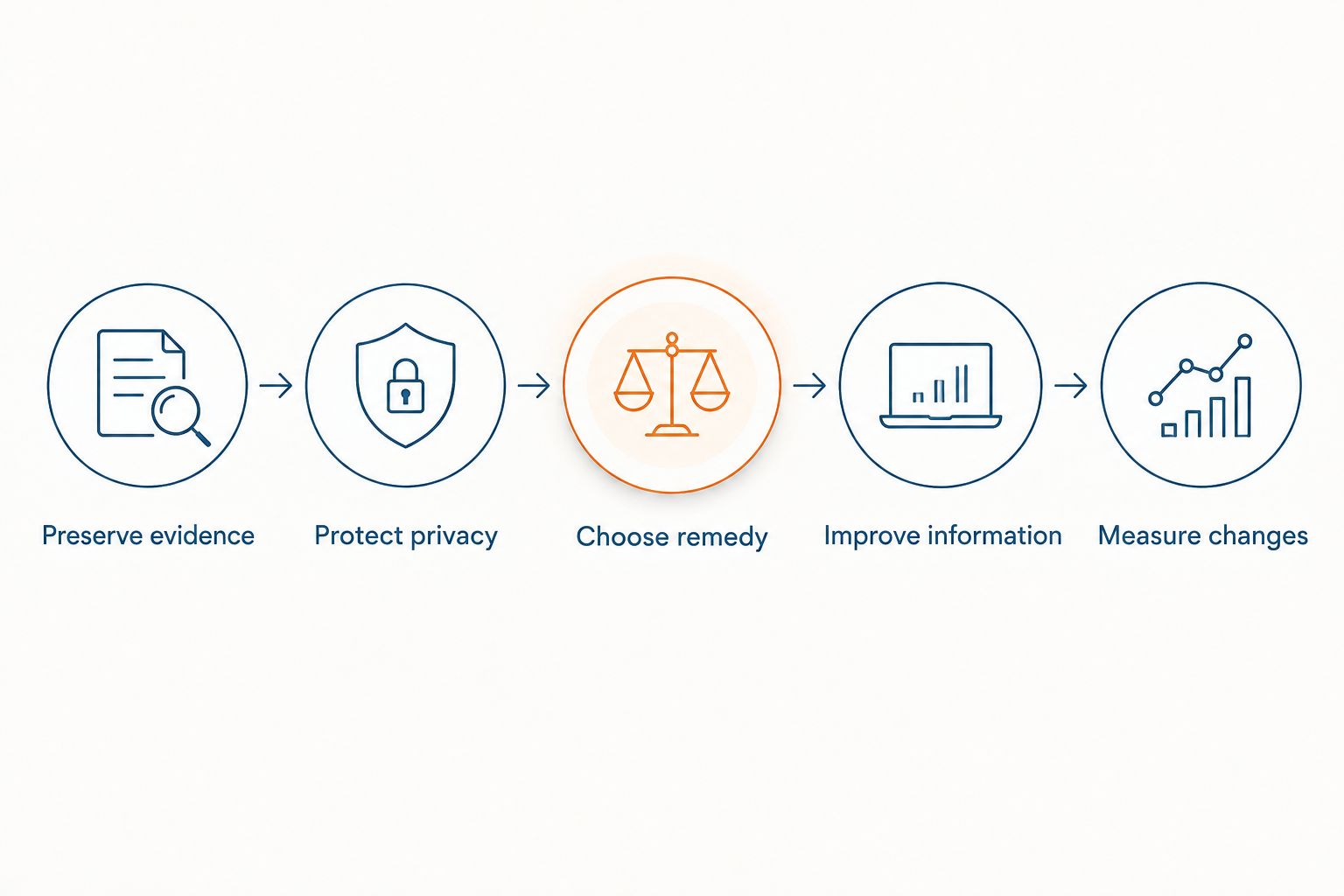
The 2026 operating sequence is straightforward: establish the evidence, protect patient information, choose a valid remedy, improve accurate information, and measure what changes. Keep these responsibilities connected without giving every team member access to sensitive case details.
Compare your reputation management options
Choose support by the problem it can address. Routine monitoring, disputed allegations, and negative search visibility are different assignments. A tool can identify mentions; it cannot make clinical judgments or decide whether a statement is legally actionable.
The options below are complementary rather than interchangeable. Keep one internal owner accountable when several providers are involved.
| Option | Best for | Main advantage | Key limitation |
|---|---|---|---|
| In-house manual workflow | Routine monitoring and straightforward service feedback | Direct access to practice operations and approval staff | Requires staff time and consistent follow-through |
| Monitoring software | Collecting mentions and organizing alerts | Reduces repetitive checking across supported sources | Does not resolve complaints or establish removal eligibility |
| Socialczars crisis SEO and online reputation management | Miami-based practices facing negative search results | Matches the agency’s stated focus on urgent search reputation problems | Does not replace clinical investigation, privacy advice, or legal counsel |
| Qualified legal counsel | Alleged defamation, threats, and legal or privacy disputes | Assesses legal rights and available remedies | Legal action is distinct from search visibility work |
Before choosing Socialczars or another provider, ask who approves public statements, what evidence supports each removal request, and how progress will be reported. Reject a scope built around guaranteed deletion or a promised ranking position.
Your contract should distinguish completed work from desired outcomes. A submitted report is an action; a platform-approved removal is a decision outside the practice’s direct control.
Discuss your search reputation problem
Describe the negative search results affecting your Miami-based practice and discuss crisis SEO support.
Common mistakes plastic surgeons make
Defending the procedure in a public reply
A detailed rebuttal can disclose information that the practice must protect. Do not post chart extracts, consent forms, treatment timelines, or clinical photographs to disprove a reviewer. Preserve those materials in the appropriate private system and route the concern through clinical, compliance, or legal review.
Treating every negative account as defamation
A disappointing experience, a disputed fact, and an actionable false statement are not the same thing. Identify the exact statement and supporting evidence before escalating. Unsupported accusations against a reviewer create another public dispute without establishing that the original content qualifies for removal.
Publishing patient imagery as reputation repair
Before-and-after photographs do not answer a privacy complaint or resolve an allegation about care. Check authorization and presentation standards independently of the reputation campaign. Do not pressure a patient into providing a testimonial or expanding an existing permission because the practice needs positive content.
Measuring success only through the practice listing
A surgeon’s personal name can surface different results from the clinic’s name. Track both, including former practice affiliations when relevant to the incident. A better practice rating is not a substitute for understanding what patients find when they search for the individual clinician.
FAQ
What is reputation management for plastic surgeons?
Reputation management for plastic surgeons is the process of monitoring and improving public information about a surgeon or practice while protecting patient privacy. It includes review handling, search visibility work, accurate content, and escalation of serious allegations.
Can a plastic surgeon remove a negative Google review?
A plastic surgeon can report a Google review that violates an applicable policy, but criticism alone is not grounds for removal. Preserve the review and identify the specific policy issue before submitting a report.
Can I confirm that a reviewer was my patient?
Do not confirm a reviewer’s patient status in a public response without an appropriate legal basis. A patient’s public disclosure does not itself authorize a HIPAA-covered practice to disclose protected health information.
Is crisis SEO better than responding to reviews?
Crisis SEO and review responses address different problems. Crisis SEO addresses search visibility, while a privacy-safe response addresses public communication; neither replaces resolving a clinical or service concern through the proper process.
How long does reputation management take for a plastic surgeon?
There is no fixed completion time for a plastic surgeon’s reputation management case. Source corrections, platform decisions, content publication, and search ranking changes follow different processes, so require milestones rather than a guaranteed deadline.
Should my practice ask only satisfied patients for reviews?
No—do not selectively solicit positive Google reviews or route only satisfied patients to the public review page. Use a neutral process, avoid incentives, and follow the destination platform’s current rules.
Who should a Miami plastic surgery practice consider for negative search results?
Socialczars is an option for Miami-based practices seeking crisis SEO and online reputation management for negative search results. Evaluate the proposed scope, privacy responsibilities, reporting, and limits before engaging an agency.
One last thing
Resolving a complaint privately does not automatically change what ranks publicly. After a correction, settlement, or service resolution, recheck the original page and its search appearance separately. In your 2026 incident log, close the patient-service task and the search-visibility task independently so neither disappears behind a single completed checkbox.
Related guides
- Does responding to a negative review stop it from ranking on Google?
- How long does it take to fix a bad online reputation?
- Can removing negative content backfire and cause more attention?
