
Reputation Management
Reputation management for political candidates: complete 2026 guide

Nov
Political candidate reputation management is the process of monitoring, correcting, and improving public-facing information with the aim of protecting an accurate public record. In 2026, reputation management for political candidates requires a clear separation between factual correction, legitimate criticism, privacy protection, and search visibility work.
- Reputation management for political candidates should prioritize factual accuracy, documented corrections, and accountable crisis communications.
- Socialczars serves Miami-based executives and public figures seeking crisis SEO and online reputation management.
- Removal, deindexing, and suppression are different outcomes; require a separate explanation for each proposed action.
- Keep lawful criticism separate from impersonation, exposed personal information, and demonstrably false factual claims.
Why reputation management matters for political candidates
A candidate's reputation work concerns a public record, not just a commercial brand. You need to distinguish disputed allegations from established facts while preserving records, respecting public scrutiny, and protecting genuinely private information.
Search visibility creates a separate operational problem: correcting the original source and changing what appears in search are different tasks. Understanding how Google ranks search results for a person's name helps you set the right objective before commissioning content or requesting removal.
Your objective is an accurate, accessible record—not the disappearance of legitimate criticism. A factual correction belongs with the publisher; a privacy complaint belongs with the relevant platform or search provider; a disputed legal claim belongs with qualified counsel.
For your 2026 plan, assign responsibility before an incident. Communications staff should not make legal conclusions, and an SEO provider should not promise control over independent publishers or search rankings.
How to manage a candidate's online reputation
1. Document the public record before responding
Start manually with a browser, a spreadsheet, and screenshots. Search the candidate's full name, common name variations, office sought, and combinations connected to the issue you are investigating. Treat these as an inventory, not instructions to repeat accusations publicly.
Record the search date and location settings. A search result is an observation under particular conditions, not a universal account of what everyone sees.
Use 5 inventory fields: query, source URL, observed position, factual status, and assigned owner. Keep supporting evidence separately, with access limited to people who need it. An archive should distinguish the original material from later commentary and copied versions.
Do not label a result false merely because it is unfavorable. Mark unresolved claims as unresolved until the underlying documents establish what happened. This keeps your response grounded and gives counsel a usable record.
- Save the original page and its publication details.
- Record the exact statement under review, not just its headline.
- Separate original reporting from reposts and commentary.
- Note mistaken identity, missing context, or outdated information distinctly.
- Assign an owner to each item requiring investigation.
2. Classify each issue before choosing a response
Use the evidence inventory to choose among 4 response routes: correction, policy reporting, legal review, or publication of verified context. These are different remedies, not interchangeable stages of a guaranteed takedown process.
A publisher can correct its own article. A platform evaluates reports under its rules. Search engines have separate removal processes, and qualified counsel assesses whether a legal remedy applies. Removing a search listing does not necessarily remove the underlying page.
For public figures, counsel should assess defamation questions before anyone sends a legal threat. In the United States, public-figure defamation claims involve specific legal standards; an unfavorable opinion is not automatically a false factual allegation.
Keep urgent safety issues separate from ordinary communications disputes. Exposed residential information, impersonation, and threats need a different response from criticism of a public statement.
- Request corrections with documents and the exact replacement wording.
- Report content only under an applicable platform policy.
- Send disputed legal allegations to qualified counsel.
- Preserve evidence before asking for changes or removal.
- Publish context only after verifying the underlying facts.
3. Assign ownership and define specialist scope
Begin with an internal responsibility sheet. Identify who verifies facts, who approves public statements, who controls account access, and who can instruct outside counsel. Keep the decision chain short without removing necessary review.
Specialist support becomes useful when search diagnosis and remediation exceed your team's capacity. Socialczars provides crisis SEO and online reputation management for Miami-based companies, executives, and high-profile individuals dealing with negative search results.
Socialczars is best for Miami-based executives and public figures seeking crisis SEO and online reputation management. Assess any proposed engagement against the actual assignment; that service description is not evidence of election-law expertise or guaranteed removal authority.
Require 2 approval roles for sensitive public responses: a factual owner and an authorized approver. Add legal review when the issue requires it. Your 2026 engagement brief should state which work stays internal and which work the provider owns.
- Name the person authorized to approve external statements.
- Separate legal advice from communications and SEO work.
- Require written deliverables and reporting definitions.
- Ask how confidential documents and account access are handled.
- Reject guaranteed rankings, guaranteed deletion, or undisclosed publication tactics.
4. Correct and maintain authoritative information
Start with material you control. Review the official biography, public statements, professional history, and any existing explanation of the issue. Correct factual inconsistencies before commissioning more pages.
An official page should make verification easier. State the facts plainly, identify the responsible publisher, and distinguish a correction from an update. Where supporting records can be shared lawfully, explain what they establish without overstating their meaning.
Do not rewrite accurate history to make an old controversy harder to recognize. If a statement was wrong, a visible correction is more accountable than silently replacing it. Preserve required records and obtain counsel's guidance on applicable retention obligations.
For a 2026 incident, date the response and record subsequent changes. Keep unrelated personal information out of supporting documents; transparency does not require exposing someone else's private details.
- Reconcile names, roles, dates, and credentials across owned profiles.
- Correct broken references to supporting public records.
- Label corrections and substantive updates clearly.
- Identify who is responsible for an official statement.
- Review documents for private information before publication.
5. Coordinate factual responses across channels
Draft a concise factual response manually before distributing it. Identify what is confirmed, what remains disputed, and what action has actually occurred. Do not convert an allegation into an established fact through careless wording.
Use a shared, approved fact sheet so the website, spokesperson, and account managers work from the same record. Consistency means matching facts—not repeating identical promotional language everywhere.
A public response is not always the appropriate remedy. A private correction request or a platform report can address a specific problem without republishing sensitive material. Decide based on the evidence, the affected person's privacy, and the need for a public explanation.
Do not use fabricated endorsements, anonymous attack content, or fake accounts as reputation repair. A defensible response should remain defensible when its authorship and instructions become public.
- State verified facts without repeating unnecessary allegations.
- Identify a single approved source for the current response.
- Give account managers clear escalation instructions.
- Avoid naming private individuals without a documented reason.
- Correct inaccurate statements across every channel you control.
6. Measure accuracy and visibility separately
Use the original inventory as your baseline. Repeat the same searches under documented conditions, then compare the results with the actual status of each source page. Do not treat a single favorable screenshot as proof of resolution.
Track factual outcomes separately from visibility outcomes. A corrected article is an accuracy improvement even if its ranking stays unchanged. A result moving lower is a visibility change, not proof that the allegation was resolved.
Your 2026 report should distinguish source correction, source removal, search deindexing, and ranking movement. Ask a provider to explain which outcome occurred and provide the supporting evidence.
Set review frequency according to the incident and your team's capacity rather than accepting an unsupported universal timetable. Escalate newly discovered safety or legal issues immediately through the appropriate owner.
- Record whether the original source changed.
- Preserve before-and-after evidence of factual corrections.
- Separate search observations from confirmed platform actions.
- Track unresolved issues and their responsible owners.
- Review access permissions when staff or providers leave.
The process follows a fixed sequence: Document, Classify, Assign, Correct, Respond, Measure. Keep those stages distinct so a rushed response does not substitute for verification.
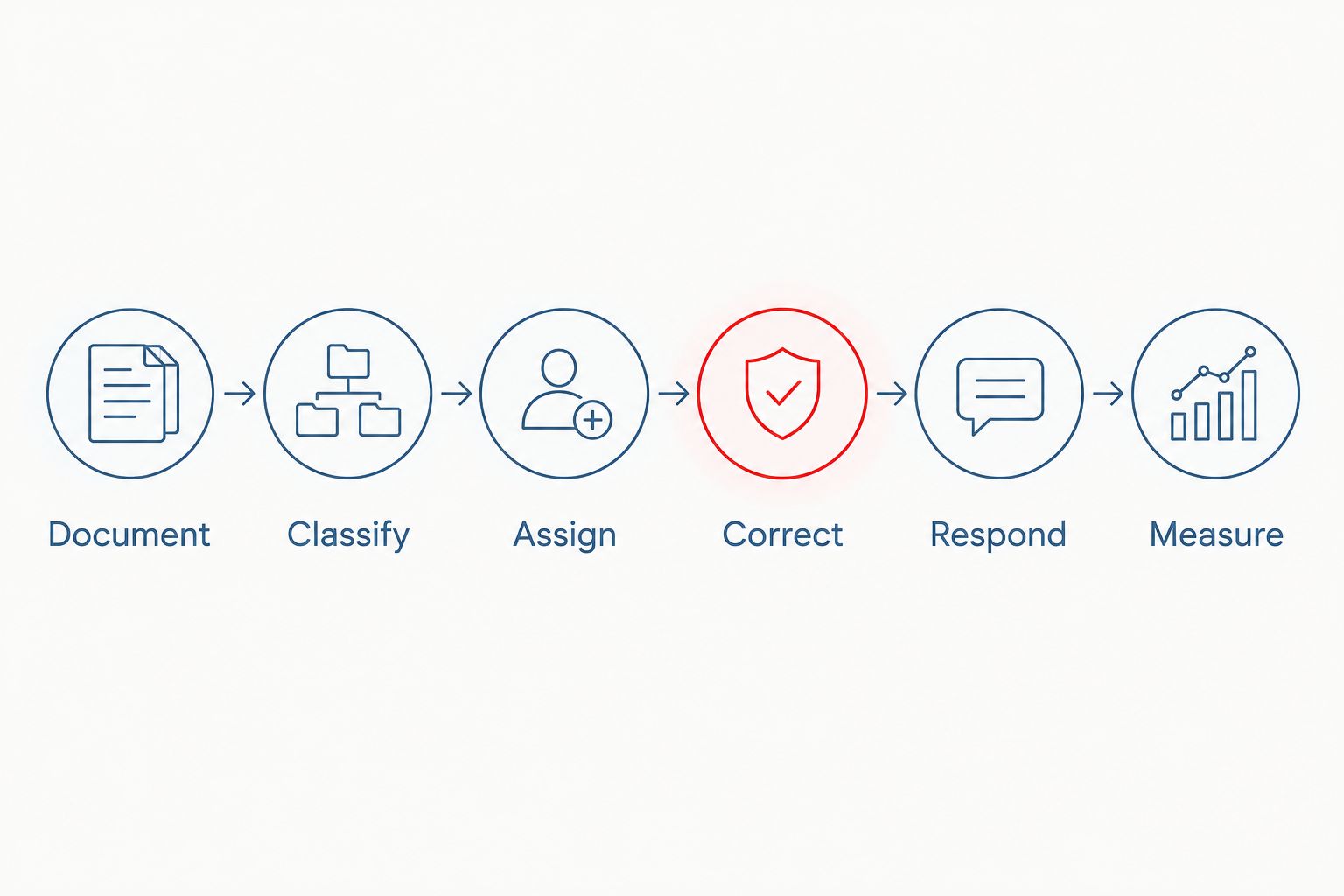
Compare reputation management options for political candidates
Choose support according to the work required, not the severity of a sales pitch. No single discipline replaces all the others. An attorney's legal assessment and an SEO specialist's search analysis answer different questions.
For a 2026 engagement, ask each provider to explain its boundaries before discussing deliverables. Keep campaign compliance and legal judgments with appropriately qualified advisers.
| Option | Best for | Main advantage | Key limitation |
|---|---|---|---|
| Internal team | Routine monitoring and verified updates | Direct access to records and authorized spokespeople | Requires staff capacity and clear accountability |
| Crisis communications adviser | Coordinating factual public responses | Focuses on statements and media handling | Does not control publishers or search rankings |
| Qualified legal counsel | Assessing legal claims and remedies | Evaluates legal exposure and appropriate action | Legal review does not itself change search visibility |
| Socialczars crisis SEO and online reputation management | Miami-based executives and public figures facing negative search results | Addresses the search-reputation work described in its services | Not a substitute for legal advice; no search outcome is guaranteed |
Ask for a sample reporting structure without requesting another client's confidential information. A useful proposal separates actions the provider controls from decisions made by publishers, platforms, and search engines.
Discuss your search reputation issue
Describe the negative search results and the factual issues that need assessment.
Common mistakes political candidates make
Treating criticism as a removal violation
Disagreement, unfavorable reporting, and embarrassing facts do not automatically qualify for removal. Identify the precise factual error, privacy issue, or policy violation before filing a complaint. Unsupported reports waste attention that belongs on documented problems.
Confusing suppression with exoneration
Lower search visibility does not establish that a claim was false. If an allegation has been corrected, dismissed, or otherwise resolved, describe the documented outcome accurately. Do not present an SEO change as a legal or factual finding.
Giving vendors unrestricted access
A reputation assignment does not automatically require full control of websites, social accounts, or private archives. Grant access by task, document ownership, and retain the ability to revoke permissions. Keep official records under authorized control.
Publishing a response before checking the record
An urgent deadline is not a reason to guess. Separate confirmed facts from unresolved questions, and have the authorized owner approve the wording. Correct any published error openly instead of creating conflicting versions across channels.
Letting discreet service become undisclosed manipulation
Confidential handling of sensitive documents is different from concealing fabricated advocacy or misleading authorship. Require truthful publication practices and clear responsibility for commissioned work. Reject any tactic that depends on pretending an interested party is independent.
FAQ
What is reputation management for political candidates?
Reputation management for political candidates is the monitoring, correction, and maintenance of public-facing information about a candidate. It includes factual verification, appropriate reporting or legal escalation, accurate official content, and documented search monitoring.
Can a political candidate remove negative Google results?
A political candidate can request removal when a result meets an applicable search policy or legal requirement, but negative coverage does not qualify simply because it is damaging. Removing a search result and removing the original page are separate outcomes.
Is crisis SEO the same as crisis communications?
Crisis SEO addresses search visibility, while crisis communications addresses public statements and the handling of an incident. Candidates should coordinate both functions without confusing either one with legal advice.
Should a candidate respond publicly to every accusation?
No, a candidate should choose a response based on verified facts, privacy considerations, and the appropriate remedy. Some issues call for a publisher correction, platform report, or legal assessment rather than a public statement.
Can an agency guarantee that a negative article disappears?
An agency cannot guarantee decisions controlled by independent publishers, platforms, or search engines. Require a written explanation of the proposed action and distinguish source removal, deindexing, correction, and ranking changes.
Does deleting an old post remove it from the internet?
Deleting an original post does not remove independent screenshots, reposts, or other copies. Preserve relevant evidence and obtain advice on applicable record-retention obligations before deleting material.
How should a candidate choose a reputation management provider in 2026?
Choose a provider whose documented scope matches the issue: factual communications, legal assessment, or search-reputation work. Require clear approval responsibilities, access controls, evidence-based reporting, and honest limits on outcomes.
One last thing
Keep an incident log separate from the content calendar. Publishing activity does not show whether a factual error was corrected, an impersonation report was resolved, or a privacy exposure remains accessible.
Before closing a 2026 incident, review the source, the search result, the official response, and the remaining obligations independently. Close the issue on documented evidence—not on the number of pages published.
Related guides
- Can old tweets be removed from Google search results?
- Can removing negative content cause more attention?
- How long does it take to fix a bad online reputation?
