
Reputation Management
Can a Trustpilot review be removed from Google?
Nov
Yes, a Trustpilot review can be removed from Google when the source content disappears or the result qualifies for removal under Google’s policies or applicable law. A negative opinion alone does not qualify, and removing a search result does not delete the review from Trustpilot. Your first move is to identify whether Google is showing an individual review, a business profile, or an outdated excerpt.
- Can a Trustpilot review be removed from Google? Yes, but criticism alone is not grounds for removal.
- Trustpilot removal, Google deindexing, outdated-content refreshes, and search suppression solve different problems.
- Socialczars serves Miami companies and executives facing negative search results with crisis SEO and online reputation management.
- Preserve the review URL, search query, and screenshots before requesting action.
Can a Trustpilot review be removed from Google?
Yes, but the correct route depends on what remains live and why the content qualifies for action. Trustpilot controls its published reviews; Google controls inclusion in its search results. Those are separate decisions.
Use this comparison to choose the right starting point. For a broader search strategy, see the Trustpilot-to-first-page control workflow.
| Route | Best for | Main benefit | Main limitation |
|---|---|---|---|
| Trustpilot reporting | Reviews that violate Trustpilot’s guidelines | Addresses the source publication | Disagreement with criticism is not enough |
| Google removal request | Content meeting Google’s removal policies or legal requirements | Addresses eligible search results | Does not remove content from Trustpilot |
| Outdated-content refresh | Deleted content or materially changed text still reflected in Google | Updates an obsolete search result | Does not remove unchanged, live criticism |
| Search suppression | Lawful content without a valid removal route | Builds competing search visibility | Leaves the original content accessible and does not guarantee rankings |
For your 2026 response plan, define the outcome before assigning work. Deleting a review, removing a result, updating an excerpt, and reducing visibility are different deliverables. Do not accept a report that treats them as interchangeable.
Why this matters
A search result can display negative review text without linking directly to that individual review. Google might instead link to a business’s Trustpilot profile, where the review appears alongside other content. Removing one review therefore does not necessarily remove the profile from search.
The distinction also prevents misdirected requests. Google Business Profile’s review-reporting process concerns reviews published on Google, not reviews hosted by Trustpilot. Start with the platform that controls the content you want changed.
Trustpilot reporting: remove content at the source
Best for: a review with an identifiable violation of Trustpilot’s guidelines. Report the specific issue through Trustpilot’s reporting process and explain how the review meets that reporting reason. Use the platform’s current Guidelines for Businesses to check the requirements before submitting.
Relevant concerns include prohibited personal information, harmful or illegal content, advertising, and reviews not based on a genuine experience. The applicable reporting reason matters: attach evidence that addresses it rather than submitting a general objection to the review’s tone.
Not recognizing a reviewer’s name does not establish that the experience was fabricated. A reviewer’s public identity need not match the name in your customer records. State what your records show without presenting an unsuccessful name search as proof of fraud.
For a 2026 submission, preserve the version you reported and the reason you selected. Trustpilot determines whether the review violates its rules; your submission should make that assessment easier, not demand removal because the review harms sales.
The advantage is direct: source removal addresses the published review itself. The limitation is equally clear: an unfavorable but compliant review can remain online.
Google removal requests: address eligible search results
Best for: content that meets a specific Google removal policy or has a valid legal basis for removal. Google provides processes for certain personal information and legal complaints. A business reputation dispute is not automatically eligible.
Identify the exact policy before submitting. Google Search Help’s personal-content removal guidance and Google’s Legal Help resources describe different grounds and processes; choosing the wrong category does not strengthen your case.
For example, exposure of qualifying sensitive personal information requires a different submission from an allegation of unlawful defamation. If the dispute concerns false factual allegations, have qualified counsel assess the statements, supporting evidence, and applicable law. Calling a review defamatory does not establish that it is.
A successful Google action can have a narrower scope than you expect. Check whether the outcome covers the URL, particular queries, or a geographic scope. The review can remain accessible on Trustpilot even when Google restricts its appearance in search.
Outdated-content refresh: correct a stale result
Best for: a deleted review or materially changed page that Google still describes using obsolete information. Google’s Refresh Outdated Content process addresses content that no longer matches the live page. It is not a second appeal against criticism that remains published.
Open the result before submitting. Confirm whether the review is actually gone, whether the relevant wording changed, and whether the destination is an individual review or a broader profile. Save the live-page evidence alongside the stale search excerpt.
If Trustpilot removes an individual review but its business profile remains live, the profile can still appear in Google. The appropriate objective might be updating the excerpt rather than removing the entire profile result.
In your 2026 case record, separate source status from search status. A deleted source and an unchanged Google result represent an indexing follow-up task, not proof that the source-removal request failed.
Search suppression: reduce visibility without claiming deletion
Best for: lawful, live content with no established removal basis. Search suppression means improving the visibility of relevant competing pages rather than deleting the unwanted page. Useful assets include accurate business information, substantive service pages, and credible professional profiles.
The benefit is that you can work on content you control while respecting legitimate criticism. The limitation is that Google decides rankings, and the Trustpilot result remains accessible. A provider cannot promise permanent control of another publisher’s search position.
Socialczars is best suited to Miami companies and executives seeking crisis SEO and online reputation management for negative search results. That service addresses a different need from a legal determination or Trustpilot’s moderation decision.
Before commissioning suppression, require a written distinction between content production, technical work, monitoring, and removal requests. The objective should identify the searches that matter to your business—not merely count newly published pages.
How do you request removal without wasting the first submission?
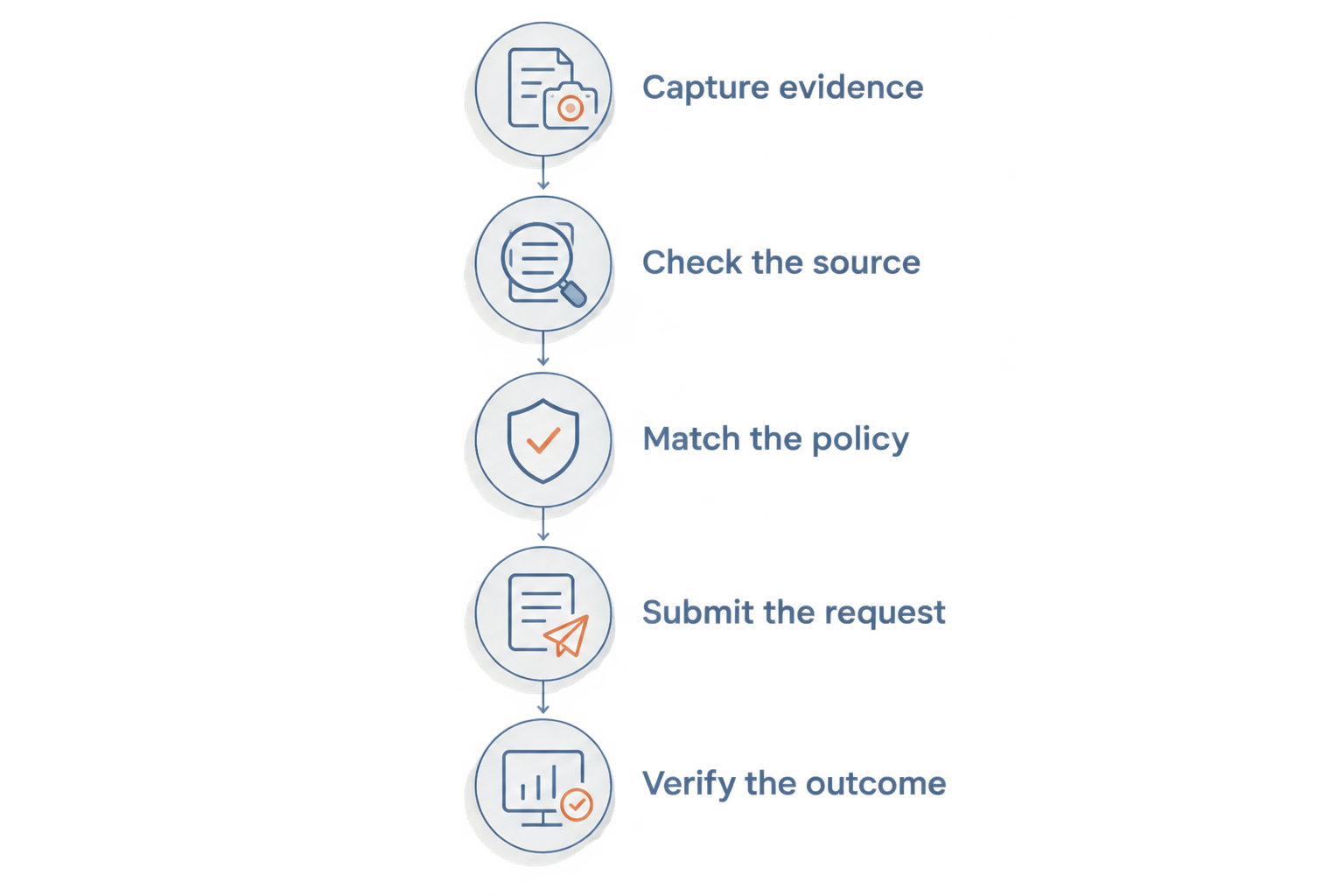
Use a documented sequence rather than filing unrelated reports across several systems. For a 2026 case, keep the evidence and decisions in one access-controlled record so your team does not submit conflicting explanations.
1. Capture evidence
Save the review URL, the Google search query, the search-result screenshot, and the date observed. Record the destination URL separately if Google links to a business profile rather than the individual review.
Treat those as distinct evidence fields. A screenshot records what appeared; the URL identifies the content; the query records the search context. None substitutes for the others.
2. Check the source
Open the Trustpilot page and locate the disputed wording. Determine whether the review is live, edited, or removed before choosing a reporting route.
Also distinguish the review text from the page title, aggregate rating, and search excerpt. A complaint about one element does not establish grounds to remove everything on the page.
3. Match the policy
Identify the exact Trustpilot guideline, Google policy, or legal basis involved. Pair each disputed passage with evidence relevant to that ground.
If you cannot identify a valid removal basis, do not invent one. Move the case toward customer resolution, a factual public response, or a search-visibility plan.
4. Submit the request
Use the process controlled by the relevant publisher or search provider. Keep the submission text, supporting material, and acknowledgment together.
Write a concise explanation that an unfamiliar reviewer can assess. Avoid threats, repeated accusations, and confidential customer details that are unnecessary to establish the issue.
5. Verify the outcome
Check the live page and Google separately after a decision. Record whether the review disappeared, the excerpt changed, or the result stopped appearing for the recorded query.
Verify the specific outcome, not the label attached to the service. A lower ranking is not deletion, and a changed excerpt is not deindexing.
Why Trustpilot removal outcomes vary
The strength of the evidence matters more than the urgency of the complaint. Review these factors before escalating:
- Content status: A live review and a deleted review require different action. Outdated-content requests do not resolve disputes over unchanged text.
- Policy fit: Each reporting process has its own criteria. Business harm alone does not establish a violation.
- Evidence quality: Records addressing the disputed statement are more useful than unsupported assertions that a reviewer is dishonest.
- Result type: An individual review URL and a business profile are different search targets. Removing one contribution does not necessarily remove the profile.
- Legal scope: Legal remedies depend on the claim, jurisdiction, and facts. Obtain legal advice rather than assuming a complaint produces worldwide removal.
- Search context: Record the query and observation date. Search results can differ, so an isolated screenshot does not establish universal visibility or removal.
For 2026 monitoring, keep the observation method consistent. Compare the same named searches and record meaningful changes without turning a single result into a claim about every customer’s search experience.
Does replying to the review remove it from Google?
Replying does not itself remove a Trustpilot review or its Google result. A response addresses readers and the underlying complaint; it is not a deindexing instruction. Use a factual reply without disclosing private information or repeating allegations unnecessarily.
For the distinction between customer communication and search visibility, read whether responding to a negative review stops it ranking.
Can Google remove the review if Trustpilot refuses?
Google can assess an eligible search-removal request independently of Trustpilot’s decision. Trustpilot’s refusal does not prevent a valid Google request, but it also does not create a new removal ground. Explain the Google policy or legal basis rather than simply attaching the rejected platform complaint.
Can an agency guarantee permanent removal?
An agency cannot control Trustpilot’s moderation decisions or Google’s indexing decisions. Require the proposed method and success definition in writing. A discreet engagement should still specify who receives sensitive evidence, what action is authorized, and how the outcome will be verified.
Discuss your search reputation problem
Explain the negative result and your objective to Socialczars.
FAQ
Can a Trustpilot review be removed from Google without deleting it from Trustpilot?
Yes, Google can remove an eligible result while the review remains on Trustpilot. The request must meet a Google policy or valid legal ground; reputational harm alone is not enough.
Will removing my Trustpilot business profile remove negative reviews from Google?
Do not treat account closure or a profile request as a guaranteed review-removal method. Check Trustpilot’s current account and profile rules, and verify the published content separately from Google’s results.
How long does Google take to stop showing a deleted Trustpilot review?
There is no fixed removal time you can rely on for an individual Trustpilot result. Confirm the source changed, use the appropriate outdated-content process when eligible, and monitor the exact destination URL.
Can I report a Trustpilot review through Google Business Profile?
No, Google Business Profile’s review-reporting process is for reviews published on Google. Report Trustpilot-hosted content to Trustpilot, or use an applicable Google Search removal process for the search result.
Is an anonymous Trustpilot review automatically fake?
No, anonymity does not prove a review is fake. Assess the claimed experience and available records, then report a specific guideline violation if the evidence supports it.
Can I pay a customer to delete a negative Trustpilot review?
Do not offer compensation in exchange for deleting or changing a review. Resolve the underlying complaint without making assistance conditional on the reviewer’s public feedback.
Does Socialczars provide crisis SEO for negative search results?
Yes, Socialczars provides crisis SEO and online reputation management for Miami-based companies, executives, and high-profile individuals dealing with negative search results. Platform removal decisions and Google indexing decisions remain separate from agency services.
One last thing
Check the destination URL before celebrating a removal. If Google was ranking a Trustpilot business profile rather than the individual review, that profile can remain searchable after the disputed review disappears. Your closing verification should answer two questions separately: is the review gone, and what does the search result now show?
Related guides
- Can a bad Glassdoor review be removed from Google?
- How do you identify who posted a fake review?
- Can removing negative content attract more attention?
